
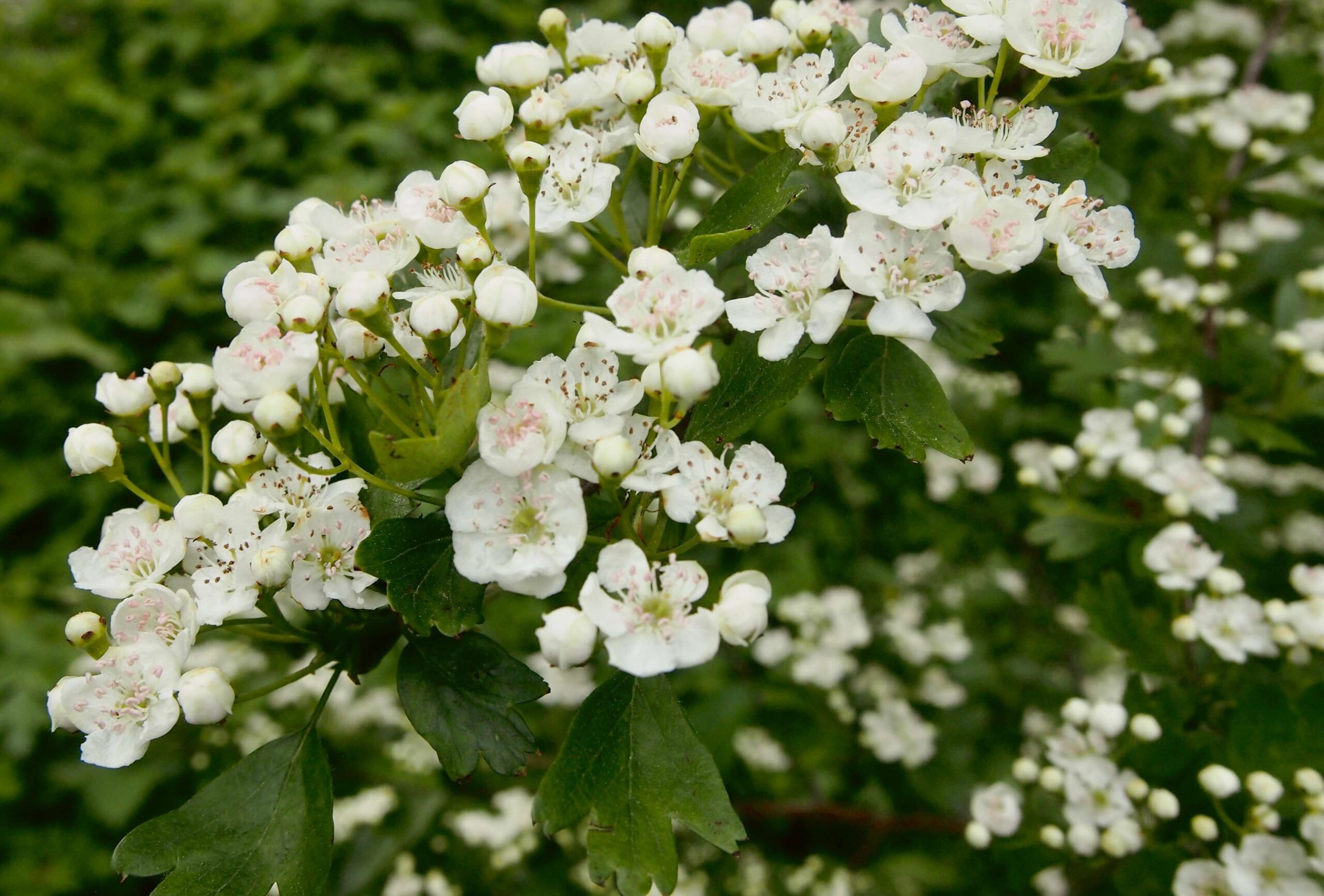
Astroherbal Dispatch: Full Moon in Scorpio/Beltane (Hawthorn)
Astroherbal dispatch for Scorpio Full Moon and Beltane.
Content warning : this month’s dispatch contains discussions of death, sex and eroticism.
Read series intro here.
by Hat Fidkin
24th April 2026
A note before we begin
Welcome one and all to this month’s Astroherbal Dispatch. I hope that everyone is hanging in there whilst we continue to move through the intensity and uncertainty that the interplay of Neptune-Saturn-Mars in Aries is stirring up. It goes without saying this is an explosive and destabilising season in more ways than one.
Astrology has a lot to offer, and can be supportive, in making sense of world events. A shadow side of this is that it can sometimes feed into fear-mongering, which can feel terrifying and panic inducing for some (including myself).
I want this space to be one that cultivates hopeful curiosity in relation to planetary transits and the changing seasons, amidst the slew of End Times astro-content available on the internet. I’m here to acknowledge, but not be swallowed by, The Chaos.
That being said, you’re more than welcome to reach out via my website if you want my take on the astrology of the moment and how this might impact you as an individual, as well as for my recommendation for astrologers who specifically practice ‘mundane astrology’ (aka ‘geopolitical astrology’), as this is not a specialism of mine.
I am here with you in solidarity, and hope this space can be one of gentle learning and plant kinship whilst you navigate this Earthly realm in strange times.
Mayday Magick
The Moon is Full at 11 degrees of Scorpio on the 1st of May, 2026 at 17.22. In these lands, the cross-quarter point between Spring Equinox and Summer Solstice is celebrated through the Celtic festival of Lá Bealltainn (Scotland) /Bealtaine (Ireland)/ Calan Mai (Wales) / Laa Boaldyn (Isle of Man)/ Beltane (England).
Beltane is likely to be a survival of ancient celebrations around the time the first herds were turned out to their wild pastures after the winter. All ritual observances were intended to increase fertility of land, livestock and people.1 Beltane has since become an occasion for people to celebrate the coming of the summer months with lively merrymaking: lots of dancing, singing, bonfires, eating, drinking, and general revelry.
There’s two ways of marking Beltane. The first way is Solar-focused and astrologically precise; the second is Lunar-led, determined by the power of the Moon in its fullness.
Going by the Sun, Beltane is the point at which the Sun is at exactly 15 degrees of Taurus, the halfway point between the Spring Equinox/Ostara (Sun at 0 degrees in Aries) and Summer Solstice/Litha (Sun at 0 degrees in Cancer). If you prefer this logical and exact approach, that would mean that this year (2026), you’d be celebrating Beltane on the 6th May.
Led by the Moon, you’re celebrating the rising of the first Full Moon after the May blossoms, which is almost always a Full Moon in Scorpio, but whose date changes slightly each year.
A third option is simply celebrating every year on the first of May, regardless of what’s going on in the sky. Although this connects Beltane with the fixed Gregorian calendar rather than a fluid seasonal one, this alignment with the energies of modern secular observations of Mayday as International Workers Day is another nice alternative (in the ‘UK’ the closest Monday to 1st May is always a bank holiday, recalling time off for traditional celebrations).
Any and all of these options are totally valid! Celebrating in small ways through the first week of May could be an option if you’re not sure which one to pick, or it’s hard to find the time for a full-blown party!
The Full Moon happens to fall on the 1st this year. In any case, I prefer the Lunar approach, as it recognises the plants and the natural world around us as changeable, living timekeepers. I also feel that the Full Moon in Scorpio is the most rich and magickal root expression of Beltane’s energies.
As mentioned above, Beltane falls when the Sun is in Taurus. Taurus is a fixed earth sign,2 who watches over the second house,3 and is ruled by Venus. It’s the steadfast growth of both ancient trees and tiny saplings, after an explosive awakening in Aries at the beginning of springtime. It’s the slow sinking into longer days, the smell of blossom in the air. It’s taking pleasure in simple routines, and indulging in the feeling of inhabiting a body warmed by the Sun.
The opposite sign to Taurus is Scorpio (Full Moons always fall in the opposite sign to that of the Sun in any month). Scorpio is a fixed water sign of the 8th house,4 and is traditionally ruled by Mars. Its modern ruler is Pluto (more on this below). It is a sign with an unfounded bad reputation, but forget pop astrology’s accusations of manipulation and deception. Scorpio is a newborn’s defiant first scream, and the last breath’s surrender. It’s burning intensity and passion, the touch of the healer’s hand, a step into the cold night, unafraid, wanting answers.
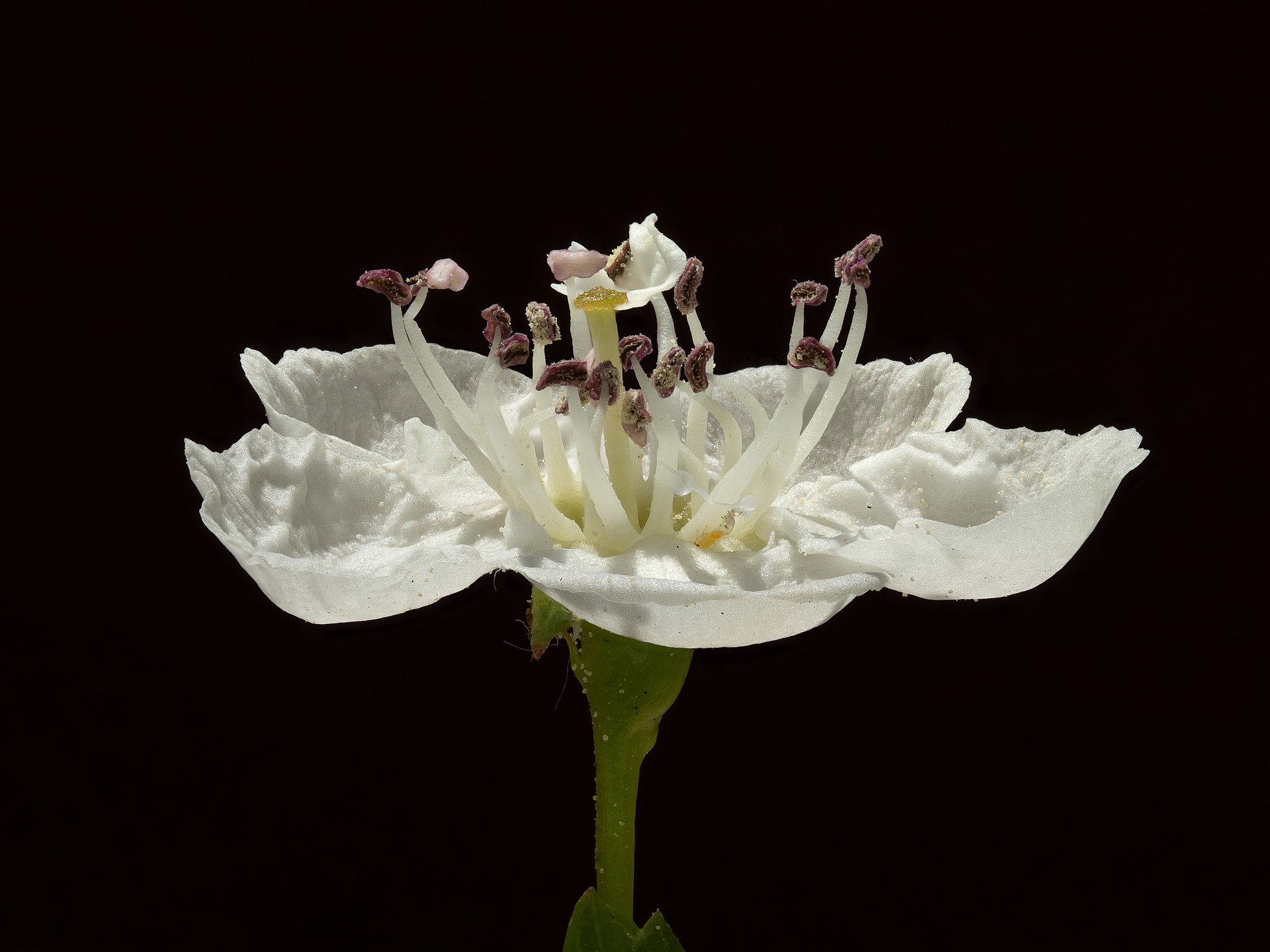
I consider myself somewhat of a traditional astrologer (see my website for a bit more on this if you like) meaning the seven inner planets (Mercury – Saturn) are given most importance when determining rulerships. However, along with Mars, I’d like to invite Pluto – Scorpio’s modern ruler and the higher octave of Mars5 – to the Beltane party, as its energies are particularly relevant to my musings here, especially as the plant for the Full Moon in Scorpio is guardian of the underworld, the May Tree of magick and mystery; Hawthorn, Crataegus monogyna.
n.b. I’ll be using the names ‘Hawthorn’, ‘Whitethorn’ and ‘Fairy tree’/‘May tree’ interchangeably to refer to the plant throughout. These, along with many others, are used throughout these lands and change depending on locality.
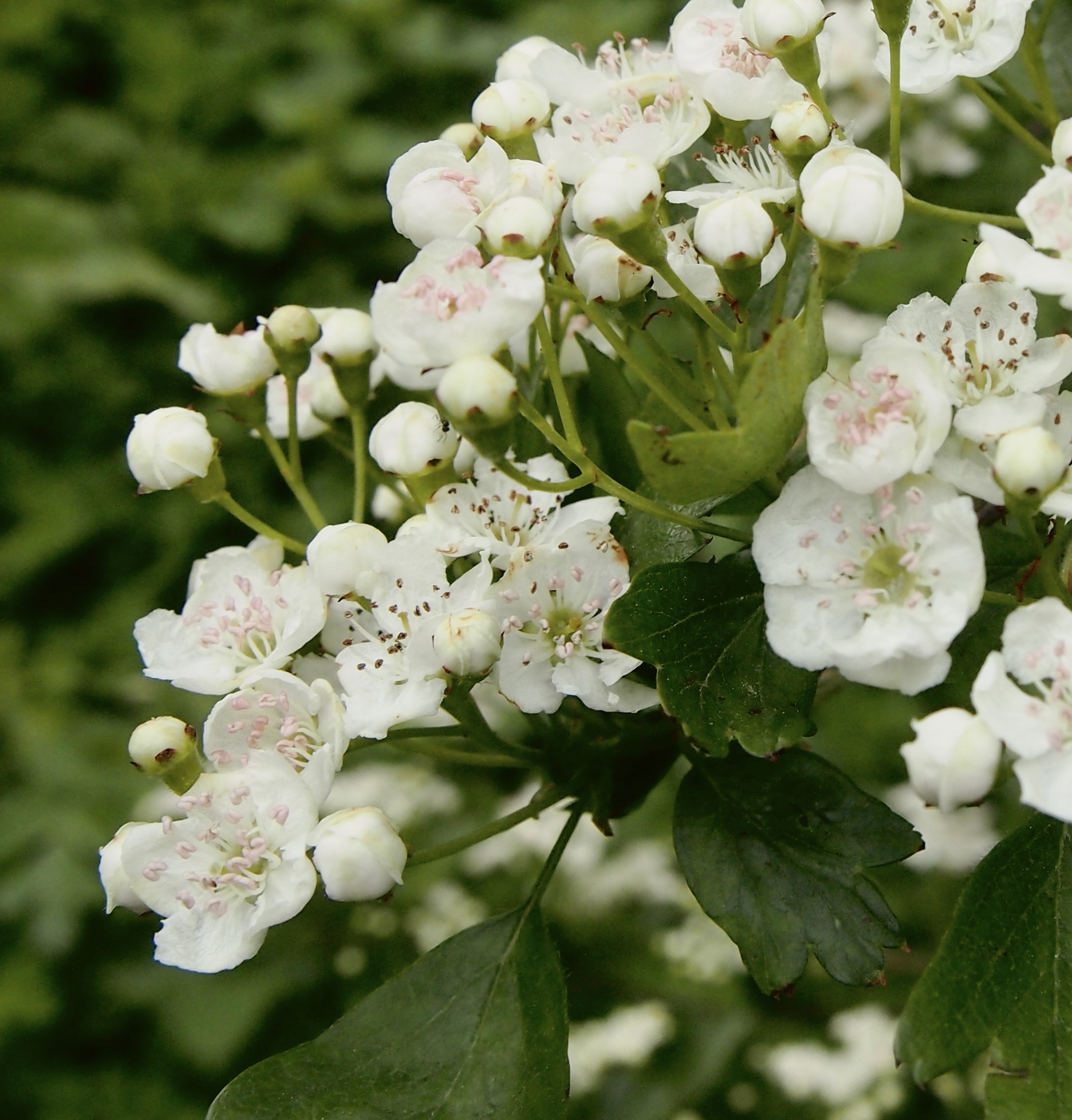
Hawthorn, Crataegus monogyna.
Energetics of the Fairy Tree
As a heavily Scorpionic creature, I am intimately familiar with the energies of the 8th house; the whispering veil, a certain draw to the darkness, an unexplainable familiarity with the cyclical nature of things. I want to share with you folktales, both anecdotal and ancient, of Beltane and Hawthorn, through the lens of Scorpio. Beltane is a time of merriment, fertility and a romantic heralding of summertime, but it’s also a festival steeped in the darker, shadow-realm faerie trickery of debauchery and death.
Traditionally, Hawthorn is co-ruled by Mars and the Sun. Whilst I somewhat agree with its placement in the solar dominion (Hawthorn is perhaps most well-known in contemporary usage as a cardio tonic, and the heart is ruled by the Sun), I find the qualities described by its Martian and Plutonian placements far more accurate to the spirit and soul of the plant, so I will be focusing on those here.
Scorpio is a fixed water sign, ruled by Mars. Mars is always hot, and water is always wet, making Scorpio energy express itself in the body, well, hotly and wetly. The energy of water signs moves downwards, and a Moon in Scorpio pulls energy towards the reproductive organs – one of the parts of the body ruled by Scorpio in what medical astrology designates as ‘body zone 8’ (see image below), along with the colon, rectum, sweat glands, excretory system and, perhaps somewhat confusingly, the nose (but stay with me – we’ll get to that later).
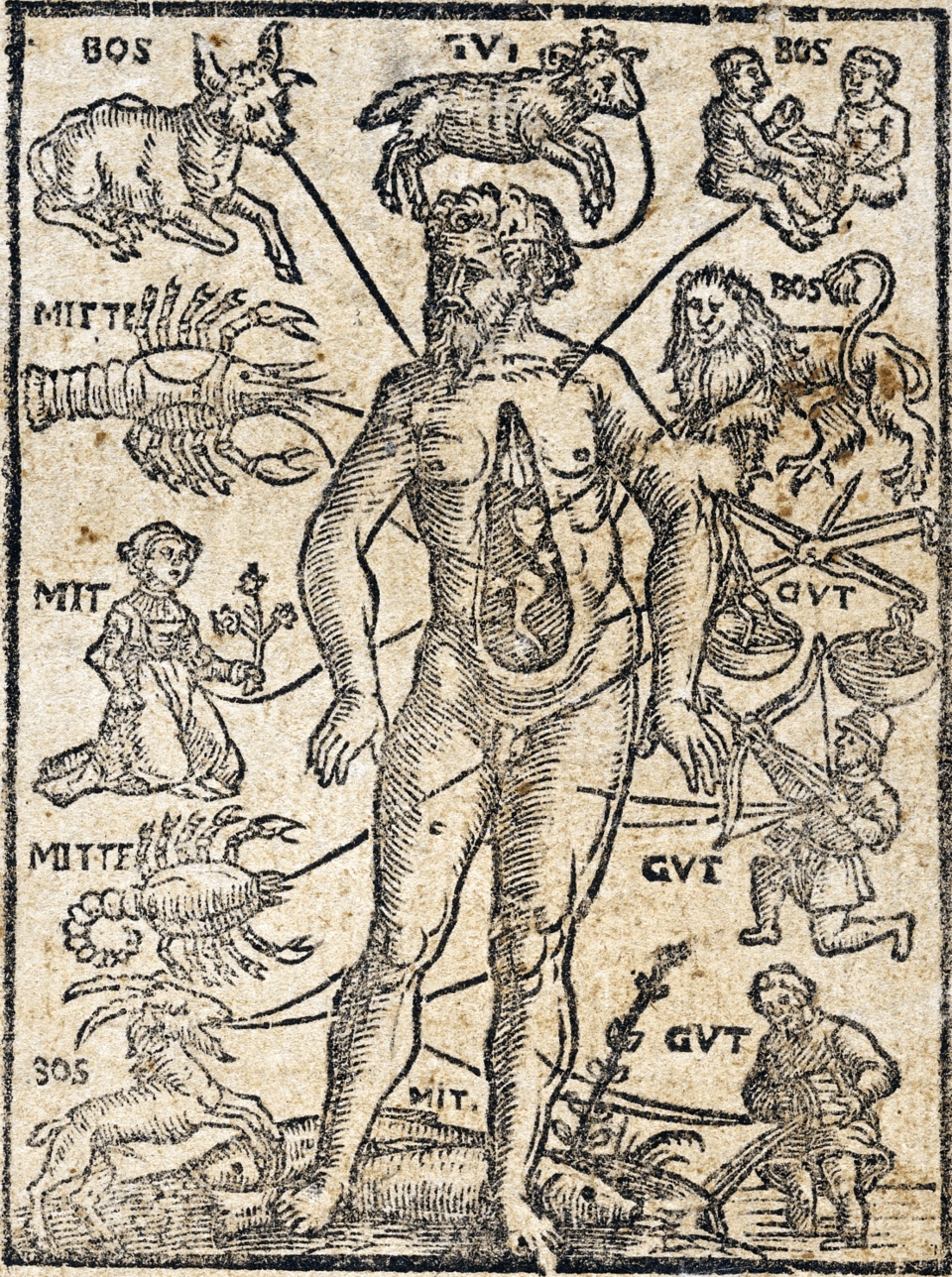
A 1580 woodcut illustration of ‘Homo Signorum’ (the ‘zodiacal man’), showing the signs mapped onto the body from head (Aries) to feet (Pisces)
This downward rush of energy may account for its long association with folks feeling freaky and rushing to frolic around the time of Beltane. You might be familiar with the tales of people running off to the woods to have sex on Beltane eve in years gone by, before the sanitisation of the festival by Christianity in Britain and Ireland. Civil authorities even tried banning some parties for fear of their wild debauchery.6 Now, in England at least, the festival is more generally associated with skipping gaily around the Maypole than with copulating in the forest.
A typical signature of a Martian plant is one with thorns, of which the Whitethorn has plenty. C17th astrologer-herbalist Nicholas Culpeper said of the plant: “And thus you see the thorn gives a medicine for his own pricking, and so doth almost everything else.”7 This is because infusions of Hawthorn leaves – being gently astringent – can help to extract (perhaps their own) splinters and thorns.8 As a cardiovascular tonic, Hawthorn also tones the musculature (Mars) of the heart (Sun). Flowers and berries are also useful in a decoction for sore throats, especially “wet, goopy, inflamed ones” of a Scorpionic nature.9
Mars also rules the arteries and red blood cells. Hawthorn pectin can lower cholesterol and reduce fat absorption, as well as having anti-oxidant properties.10 In Traditional Chinese Medicine, Hawthorn/山楂, shān zhā is used as a digestive aid and revered for preventing stagnation in the body, which is interestingly a malady often suffered by those with a lot of Taurus or Scorpio in their birth charts. Coastal Salish Tribes of the Pacific Northwest also use Hawthorn – čibadac in Lushotseed – as a heart medicine for balancing blood pressure, and as a food source.11
Fire and Folk Practice
The etymology of Beltane likely connects back to the root bil tene, meaning a “bright/goodly fire”, i.e. two fires.12 Cattle, and even children, were driven between these two fires, to bless and protect them from death and disease before being driven out into the pasture to spend the summer grazing (the cattle, not the children).
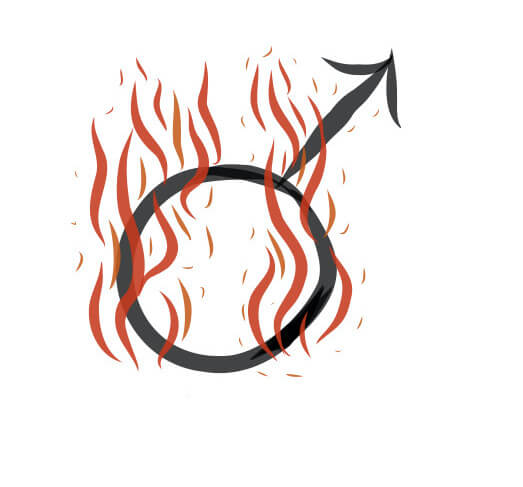
Another interesting etymology put forward suggests that “Belltainn contains the genitive form of beltu – ‘dying’ – which would make the word cognate with Giltine, a Lithuanian goddess of death.”3 Giltine is sister of Laima, goddess of life’s new beginnings; in these two sisters the Taurus/Scorpio axis is reflected. This connection is a loose one, but nonetheless, an exciting possible thread in the tapestry of Beltane’s fearsome associations with death.14
In Alba/Scotland, Beltane cakes, or bonnach Bealltainn figured variously throughout the festival in, but were mainly used as offerings to the spirits of the land to placate them, ensuring the survival of livestock for the coming year. One ritual demanded that participants stand and face the Beltane fires whilst reciting to the elemental beings:
This I give to thee, preserve thou my horses; this to thee, preserve thou my sheep;
They would then address the predators of the land, saying:
This I give to thee, O fox ! spare thou my lambs : this to thee, O hooded crow ! this to thee, O eagle.15
With each address, a piece of bonnach Bealltainn would be thrown into the fires.
Another use of the Beltane cakes is in a game where they are divided into portions, and one of them is blackened by charcoal. People would draw lots and whoever got the blackened bit was deemed ‘the Beltane carline’ or ‘Cailelach beal-teine’ meaning ‘hag’ or ‘old woman’, who’d then be chased by the other merrymakers, ending the spectacle by being symbolically “thrown into the fire”.16 Sometimes, even the miming of drawing and quartering them was involved. It has been proposed that this originated from real human sacrifices by ancient Celts, and the ‘chosen one’ was usually a woman.17
Perhaps these sacrifices may also constitute a dark origin of the tradition of the crowning of the ‘May Queen’. In England it was sometimes said that the girl chosen as May Queen would not live another full year, deepening the ‘cursed’ mythology of she chosen. The original May Queen of Welsh folklore in the Mabinogion, Blodeuwedd, meaning ‘flower-face’, was turned into an owl – a guardian animal of Scorpio – after betraying her husband Llew.18
Slow Sinking Downwards
In Traditional Medical Astrology, the outer planets (Uranus, Neptune, Pluto) aren’t involved much for two reasons: one, because they literally hadn’t been discovered during the art’s heyday – practitioners and scholars today are still figuring out their relation to our physical bodies (Pluto was only discovered in 1930!) – and two, because the energies of the planets beyond Saturn’s icy boundaries are considered so abstract and literally ‘far away’ from Earth, that they exist in realms far beyond conception; that is, not in the physical body, the mind or even the spirit, but somewhere else entirely.
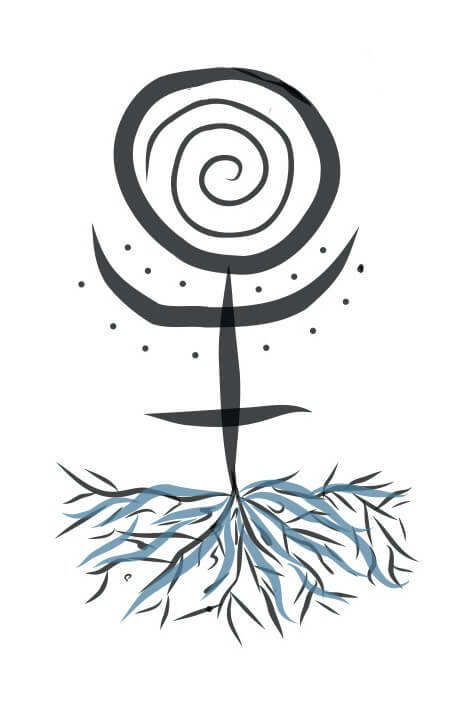
Pluto – the dark planet of death and rebirth, raw universal power, and deep time – finds its terrestrial reflection in Hawthorn, a plant ally that marks the place where the nether-realm meets the human. It warns us: ‘here, there is magick to be found, but take caution; everything is not what it seems’. In the underworld, there is no such thing as linear time. In an intimate meeting with the Hawthorn, you might, for just a moment, begin to feel the glimmers of a way of being, that surely is all but incomprehensible.
With the Whitethorn abloom in hedges across the land, the ancestors of these soils wove many a Mayday folktale. They whispered under the Full Moon’s light, warning of creatures from the other realm crossing over and leaving a trail of destruction and sorrow in their wake. Beltane, like Samhain, is a time where the veil thins and the dead can speak through the landscape.
In Cymru/Wales, this festival is Calan Mai, or Clamme, one of the ysbryd nosau – ‘spirit nights’ of the year.19 In Alba/Scotland, it was said that ‘witches would stay up all night on Bealltainn eve and would travel around in the form of hares to take the toradh (produce – specifically the toradh of dairy cattle) from their neighbours.’20 If you did decide to stay up late and brave a possible encounter with a witch or spirit, you might end up being taken by them; in Eire/Ireland, ‘whoever is foolhardy enough to join a fairy dance on Beltane Eve will not be set free till Beltane next year.’21
Though Mayday mischief aside, messing with the tree of the fairies at any time of the year is ill-advised. ‘An English tale tells of how, when a Hawthorn bush was cut down no chicken would lay eggs, cow would calf, or woman have babies. The situation was only rectified when a new bush was planted.’22 This fear surrounding the land’s fertility, or lack thereof, permeates Hawthorn and Beltane lore. In fact, in the Ogham alphabet of Ireland, the letter associated with Hawthorn within that is hUath/úath, which roughly translates to “fear, horror, terror ; a horrible or terrible thing, horrible creature, spectre, phantom”.23
Just look at what happened to little Anna-Grace who dared to dance around the Hawthorn tree in Samuel Ferguson’s beautiful and haunting poem ‘Fairy Thorn’ (1864). Anna Grace is dragged into the fairy underworld, never to be seen again:
For, from the air above, the grassy ground beneath,
And from the mountain-ashes and the old Whitethorn between,
A Power of faint enchantment doth through their beings breathe,
And they sink down together on the green.24
This ‘sinking downwards’ energy is one prevalent throughout the poem; the energy of the unknown, Scorpionic watery depths feared for centuries. But before I knew any of this – only my second time ever meeting Hawthorn – I had an experience that now seems all the more profound…
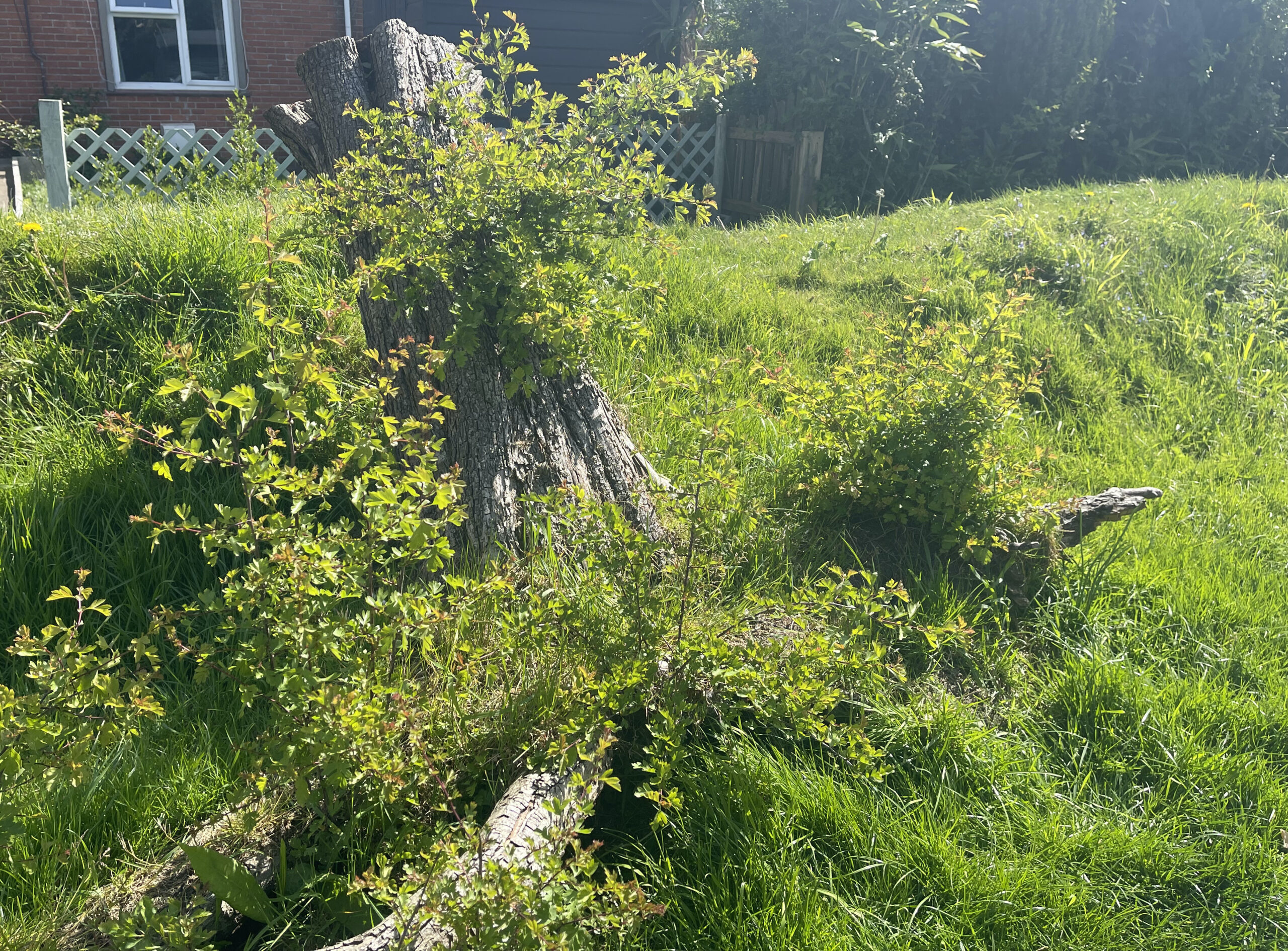
A large, felled Hawthorn tree on the pavement outside a row of houses, Devon. I sincerely hope whoever did the chopping is okay…
Psychedelic, Visionary Plant of These Lands
I have had two experiences with Hawthorn that I count as some of the most intense visionary and psychedelic experiences of my life.
Medical astrologer Judith Hill – a teacher of mine – says that those with water moon placements (Cancer, Scorpio, Pisces) are particularly sensitive to the Moon and its phases (meaning that I, as a Scorpio Moon with several tricky Scorpio placements, and a heavily water-dominant chart, find Beltane to be a spiritually intense time, where, much like Samhain, where the Sun is in Scorpio, the otherworld doesn’t just whisper; it shouts). It’s worth noting here that Hawthorn flowers around Beltane, and gives it berries around Samhain; sharing its bounty with others whilst the veil is the thinnest.
During a tea meeting with Hawthorn flower at herbalism school, just the smell itself sent me into a trance-like state in front of a group of relative strangers. As I inhaled the steam from my cup, I began gagging and retching uncontrollably, a cat on all fours, overwhelmed with a sense of being pulled downwards, deep into the earth below. I had to lie down and put my face into the soil, so intense was the sensation of yearning to be underground, beneath the roots of the tree whose blossoms I had become entranced by.
Then I was crying, quite a lot. I felt what can only be described as a simultaneous deep, existential terror, and a soft, yielding acceptance, of death, of being returned to the earth. When I eventually drank the tea, this feeling only deepened, leading to a very intense twenty minutes or so where I felt completely taken over by the plant, leading to some quite profound and disturbing spontaneous ‘knowings’.25
It was only later, once I’d calmed, that my teacher shared that Hawthorn flowers contain the chemical trimethylamine – the first chemical which forms in the tissue of decaying animals. Its scent of sickly-sweet death quite literally transported me to the underworld, which was equal parts euphoric and terrifying.
Remember that Scorpio rules the nose? My sense of smell being even more powerful as a doorway to experience around this time I attribute to this. As the Moon, and all of the planets, move through the sky, they activate different elemental forces within us, individualised by our natal charts. I like to keep a diary and note when certain things flare up in my body for better or worse; a good place to start is with the Moon’s cycles, then move onto other planets once you have this down.26
Some folks even think Hawthorn smells like sexual bodily fluids, further entangling the watery Scorpionic sex/death associations into the plant’s magickal lore. Looking into this (I include myself amongst them), I discovered that trimethylamine also accumulates in the sex organs and fluids of humans and animals, as well as in our sweat and urine – all of which parts and processes are ruled by Scorpio. It’s usually converted to the odourless trimethylamine N-oxide, unless you are experiencing an issue with buildup of the chemical – a condition called trimethylaminuria.27 Interestingly, humans are unusually sensitive to its smell and can typically detect it at extremely low levels. Perhaps this explains aspects of my body’s intense reaction to the tea!
Pollinating insects who like to feed on carrion (the decaying flesh of dead animals), like blowflies (Calliphora spp.) and Carrion Beetles (Nicrophorus spp.), are vital for ecosystems, and are attracted to Hawthorn’s heady perfume, ensuring it higher reproductive success. Funnily enough, “the tree is known as ‘promiscuous’, with the two to three hundred species within its genus being able to successfully cross breed and create even more variations,” due to the large variety of insects helping to pollinate it.28 I’d love to know what the smell of Hawthorn conjures for you, if you fancy sharing in the comments below! I still can’t decide if I love it or hate it, but I’m definitely leaning more towards love – and let me know if any of you know of any perfumes containing Hawthorn!
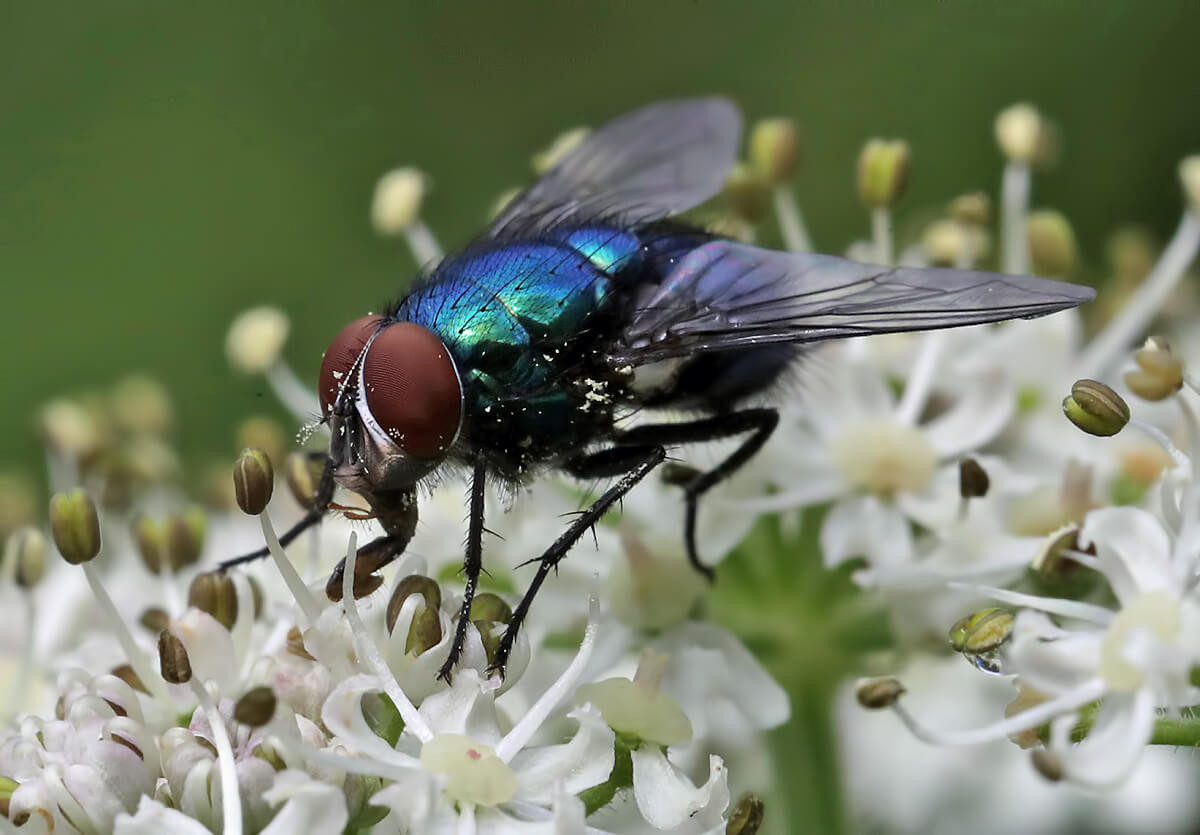
A feeding bluebottle, with the very apt latin name of Calliphora vomitoria.
Long before botanists discovered trimethylamine in Hawthorn, there existed, and still exists, a belief that bringing Hawthorn into the house would bring death, lending it the charming nickname ‘mother-may-die.’ This may potentially have been borne of the trauma of those that lived through the Great Plague of 1665-66, as the blossoms were said to smell like the decaying flesh of those that perished. The ancestors of these lands would have been more acutely familiar with that smell, as it was common practice to lay out the dead and sit with them for several days before more sterile burial practices became the norm. My great-grandmother was the community undertaker in her inner city Birmingham neighbourhood, laying out the dead when called upon to do so. I’d love to know what she thought of Hawthorn.
Some Mayday traditions in England and Ireland involve hanging a Hawthorn branch on the door to the house, or planting one in the front garden, dressing it with ribbons and providing it with offerings; in essence, ‘bringing home the May,’ but not bringing it into the home.29 Instead, the Hawthorn served to protect the household from witches and fairies from the outside. A fearsome yet beloved ally, the doorway to worlds unseen, guarding precious human portals in turn.
A Watery Scorpionic Ritual for Beltane
Before I close this month’s dispatch, I’d like to share with you a traditional ritual for Beltane, that focuses on connecting with the water element of Scorpio, and can also be used to honour the Hawthorn.
Before sunrise on Beltane morning, go outside and collect the dew from the grass in your garden if you have one, or anywhere there’s grass near to you (you might need to be a bit more discerning if you’re in a city regarding the likelihood of pee from dogs or people being present). You can splash this dew on your face and let it dry naturally, or bottle it up, and use it for anything you like later in the year.30 It was said that this morning dew had magickal properties, bestowing youth and beauty upon those who bathed in it.
You could even use it as part of this next suggestion:
A simple tea meeting with Hawthorn flower, perhaps using some of the dew you collected in its water. You could do this alone, sitting under a Hawthorn tree, or perhaps with some friends around a fire. Let its scent and taste transport you, write down or share how it made you feel and where it takes you.31
For some further listening, If you haven’t already, I urge you to listen to Blindboy’s brilliant podcast, in which he shares tales of Irish motorways being rerouted around Whitethorn trees, a billionaire car company collapsing because they dared to build their headquarters on a fairy fort, and a hypothesis on how Hawthorn trees are used as markers for underground nuclear waste and radiation.
Endnotes
1. Maria Leach, Funk and Wagnall’s Standard Dictionary of Folklore, Mythology and Legend (Harper SanFrancisco, 1972)
2. Seeking out to maintain and sustain that which is initiated by the Cardinal signs, Fixed signs are those falling in the middle of the season, with a steady and dependable nature. The Earth element of Taurus adds to its grounded practicality.
4. The Eighth House is the house of transformations, endings/death, sex, taboos.
5. See this article for a discussion of planetary octaves in astrology.
6. Scott Richardson-Read, ‘Lá Bealltainn – The Gaelic End of Winter Festival‘, Cailleachs Herbarium, (29th April 2016).
7. Nicholas Culpeper, Culpeper’s Complete Herbal, (Richard Evans, 1814) p.90.
8. David Allen and Gabriel Hatfield, Medicinal Plants in Folk Tradition: An Ethnobotany of Britain and Ireland (Timber Press, 2004) , p.155.
9. Mrs M. Greive, A Modern Herbal (Tiger Books International, 1998).
10. Li Li, Xianli Gao, Jiguang Liu, Bimal Chitrakar, Bo Wang, Yuchuan Wang, ‘Hawthorn Pectin: Extraction, Function and Utilization’, Current Research in Food Science, 4 (2021), pp. 429-435.
11. Kim Kalliber, ‘Hawthorn, Traditional Medicine for the Heart’, Tulalip News (October 20th 2022).
12. Alexander MacBain, Celtic Mythology and Religion (1885).
13. Annie Loughlin, ‘Bealltainn – Part One‘, Tairis.
14. Norbertas Vėlius, Baltu Religijos ir Mitologijos Šaltiniai”, ‘Comprehensive source collection of Baltic religious and mythological sources from earliest times to end of 15th century’, Mokslo ir Enciklopedijų Leidykla, I (Vilnius, 1996).
15. Maria Leach, Funk and Wagnall’s Standard Dictionary of Folklore, Mythology and Legend (Harper SanFrancisco, 1972).
16. Scott Richardson-Read, ‘Lá Bealltainn – The Gaelic End of Winter Festival‘, Cailleachs Herbarium, (29th April 2016).
17. Maria Leach, Funk and Wagnall’s Standard Dictionary.
18. The Mabinogion, trans. by Lady Charlotte Guest (2002).
19. Anne Ross, The Folklore of Wales (2001), p.39.
20. John Gregorson Campbell, The Gaelic Otherworld (2005), pp. 174-75.
22. Niall MacCoitir, Ireland’s Trees (M H Gill, 2016), p.52.
23. ‘úath‘, eDil, the Electronic Dictionary of the Irish Language.
23. Ibid.
24. See a telling of ‘The Fairy Thorn’ here.
25. I shan’t go into them here as the content might be extremely upsetting for some (content warning for sexual violence, violence against women and children, ableism, homophobia) but if these themes speak to anything of your own experiences, I’m open to sharing privately.
26. For example, I have a chronic issue with my gums that flares up during full Moons. The Moon rules the gums, and is full and swollen, therefore, so is my face. I use Llewelyn’s astrological pocket planner, I think it’s the best one (I’ve tried several that arrive completely inaccurate, and have had to send them back!).
27. Dr Delwyn Dyall-Smith FACD, ‘Trimethylaminuria’, DermNet (2010).
28. Helen Bruce, ‘Plant of the Month: Hawthorn’, Dartmoor Preservation Trust (March 25th 2025).
29. Niall MacCoitir, Ireland’s Trees, (M H Gill, 2016), p.52.
30. Annie Loughlin, Bealltainn – Part One, Tairis.
31. Though my own meeting with Hawthorn flower as a tea was particularly intense, this is typically a gentle way of meeting the plant! I encourage you to sit gently with your own process, and you are more than welcome to reach out to me to share and reflect together.
Hat Fidkin is a student of plants and the stars from the West Midlands, based in Devon. They are a practicing astroherbalist, bringing the plants into their work as an astrologer. You can find out more about their work at datura.uk
Editor: Leo El-Qawas