
Plants in British Gardening Culture: The Stories We Tell
Drawing on the author’s experiences of working as a gardener, this article takes a critical look at the language of British gardening culture and its implications.
How do we talk about plants and why does this matter? What are the narratives we use and the stories we tell?
In showing some of the ways that these can reflect the biases and prejudices of wider society, it suggests that questioning the narratives, reimagining these stories and changing some of this language may offer a step towards creating more nurturing and holistic relationships with the environment and with each other.
by Nicky Buley
10th August 2026
Read time: 25 minutes
How We Talk About Plants and Why It Matters
I spent seven years working as a gardener in London. Over the course of that time, I encountered many gardens, many plants and many people. One thing I did not initially anticipate, but which quickly became central to my work, were the many discourses and narratives I was to encounter around plants that underpinned and shaped people’s conceptions of gardens and gardening, and my own possibilities as a gardener.
Gardens can be a place of connection with and care for the natural world. Within the intentional space of the garden, the human and the non-human can support and sustain each other. Most of my clients professed a wish to have their gardens cared for in a way that was environmentally sound. Yet I often encountered resistance as to what this meant in practice. There were times when it seemed that the very language people used to speak about the plants and gardens they sought to care for brought them into conflict, rather than connection.
In their essay ‘The Stories Plants Tell: An Introduction to Vegetal Narrative Cultures’ (2023), scholars Middelhoff and Peselmann note:
many stories told about plants are more revealing about the people telling them, the cultural contexts and the prevailing ontologies […] than about the actual qualities and potentials of vegetal worlds.1
What then are the stories told about plants within British gardening culture, and what do they reveal about this cultural context and its prevailing ontologies? And what are the possibilities for relationships of greater care and connection – for the environment, and for ourselves – when we reimagine the stories we tell, use language that connects instead of dominating, and cultivate alternative narratives of inclusion and kinship?
Plants as ‘Bad’ vs ‘Good’
One of the foundational tasks of garden maintenance is weeding; removing some plants in favour of others. There have been many and varied definitions of a weed. But essentially, the term refers to any plant that conflicts with human preferences, needs or goals.2 Plants categorised as ‘weeds’ have long been demonised in horticulture. But are these plants genuinely problematic? Or is the problem a discursive one?
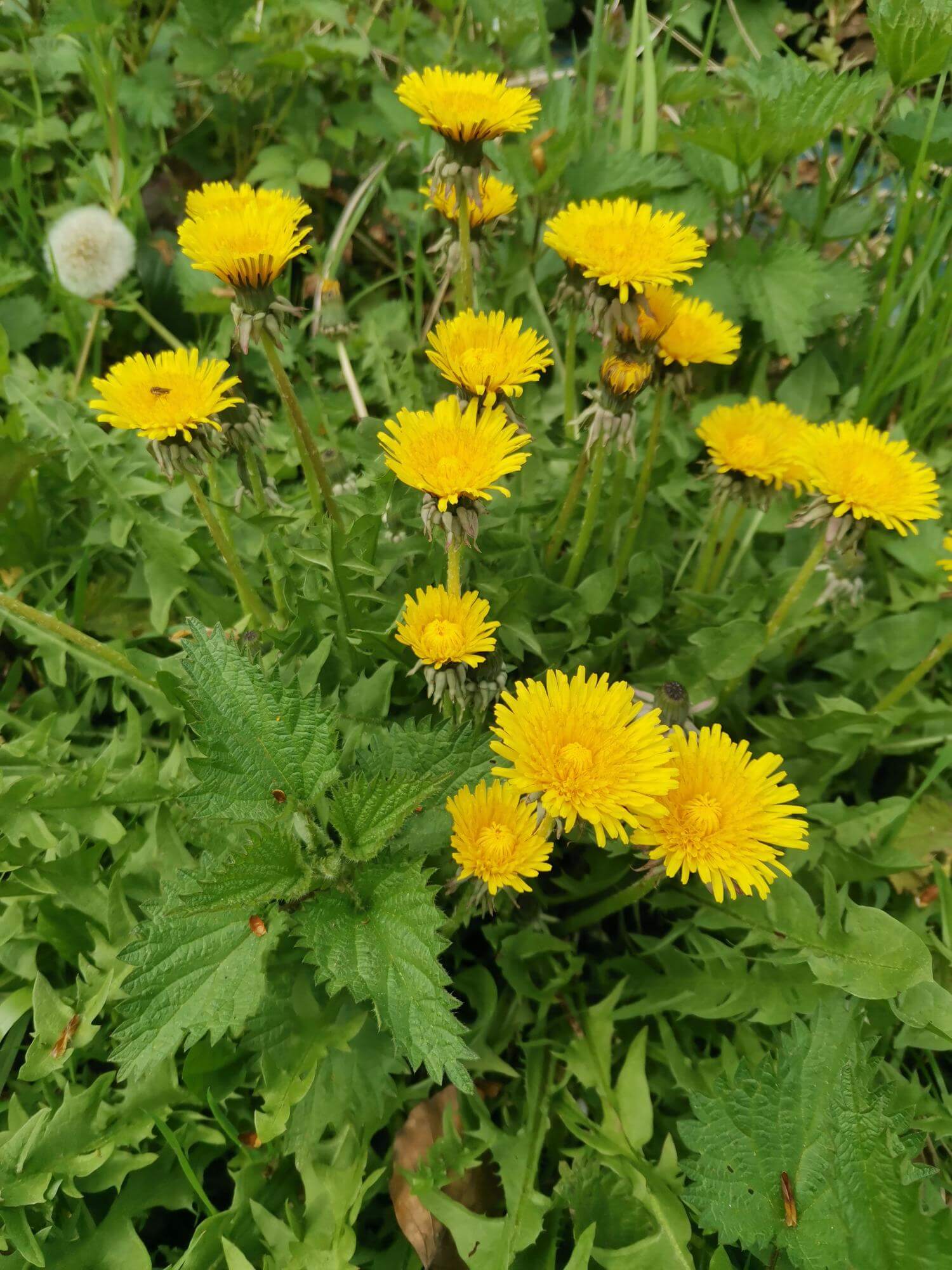
The lawn is a particular site of conflict when it comes to ‘the war on weeds’. A client once looked at the spread of wildflowers in her lawn – bright yellow Dandelions, a speckling of Daisies, the violet spikes of Self-heal – and asked me to point out the ‘bad’ weeds. ‘Bad’ in what way? What did she think the ‘bad’ plants were going to do? She asked whether we should remove everything that wasn’t grass. I offered her a choice – leave the plants for pollinators, or remove them if the aesthetics were more important. She chose to remove them. She had a self-professed wish to encourage biodiversity in the garden, but she also had an image of what a lawn was – and it did not include Dandelions.
Another client examined her lawn in detail, asking what a particular plant was. It was a Cyclamen, something she regularly bought to go in her window boxes. “Well, it is not welcome here” she said of its presence in the grass. In both of these cases, an awareness of the need to support biodiversity conflicted with a deeply held conception of what a garden – and, in particular, a lawn – should be. When it came to lawns, grass was good and anything else was bad.3
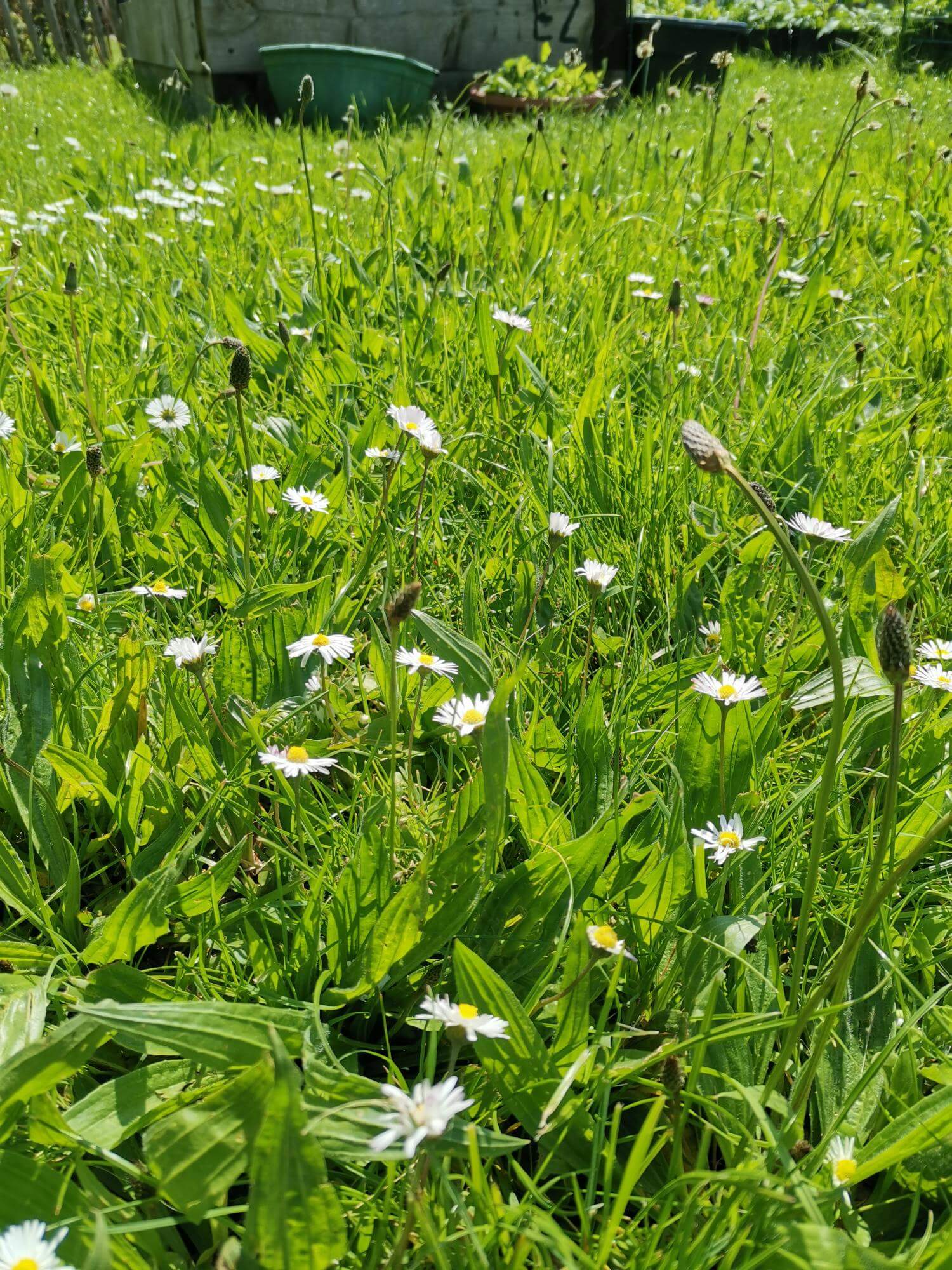
That same spring, I learn that Daises are also known as ‘bruisewort’. I infuse a jar of oil with Daisy flowers on a sunny windowsill. All summer, I use this to tend the bumps and bruises that the physical work of gardening leaves me with. Every time I dab it on my skin, I visualise the delicate white flowers dancing through the grass.
The lawn emerged as a feature of the garden in the late industrial revolution, and became widespread in the twentieth century, as a growing middle class increasingly bought their food from supermarkets rather than growing it themselves.4 The lawn became a status symbol – an unproductive yet resource-intensive patch of ground – demonstrating a person’s ability to spend money and time on something solely for pleasure. Lawns played a role in colonialism in Turtle Island, where what was deemed ‘natural’ (and therefore closer to God) was a well-maintained lawn, as opposed to the ‘wilderness’; where Indigenous peoples lived. In the 50’s and 60’s, as overwhelmingly white suburban neighbourhoods continued to expand, lawns became increasingly associated with whiteness. It is chilling, in fact, to note that Dichlorophenoxyacetic acid, used as a selective weedkiller in lawns all over ‘North America’, was also the principal ingredient in Agent Orange.
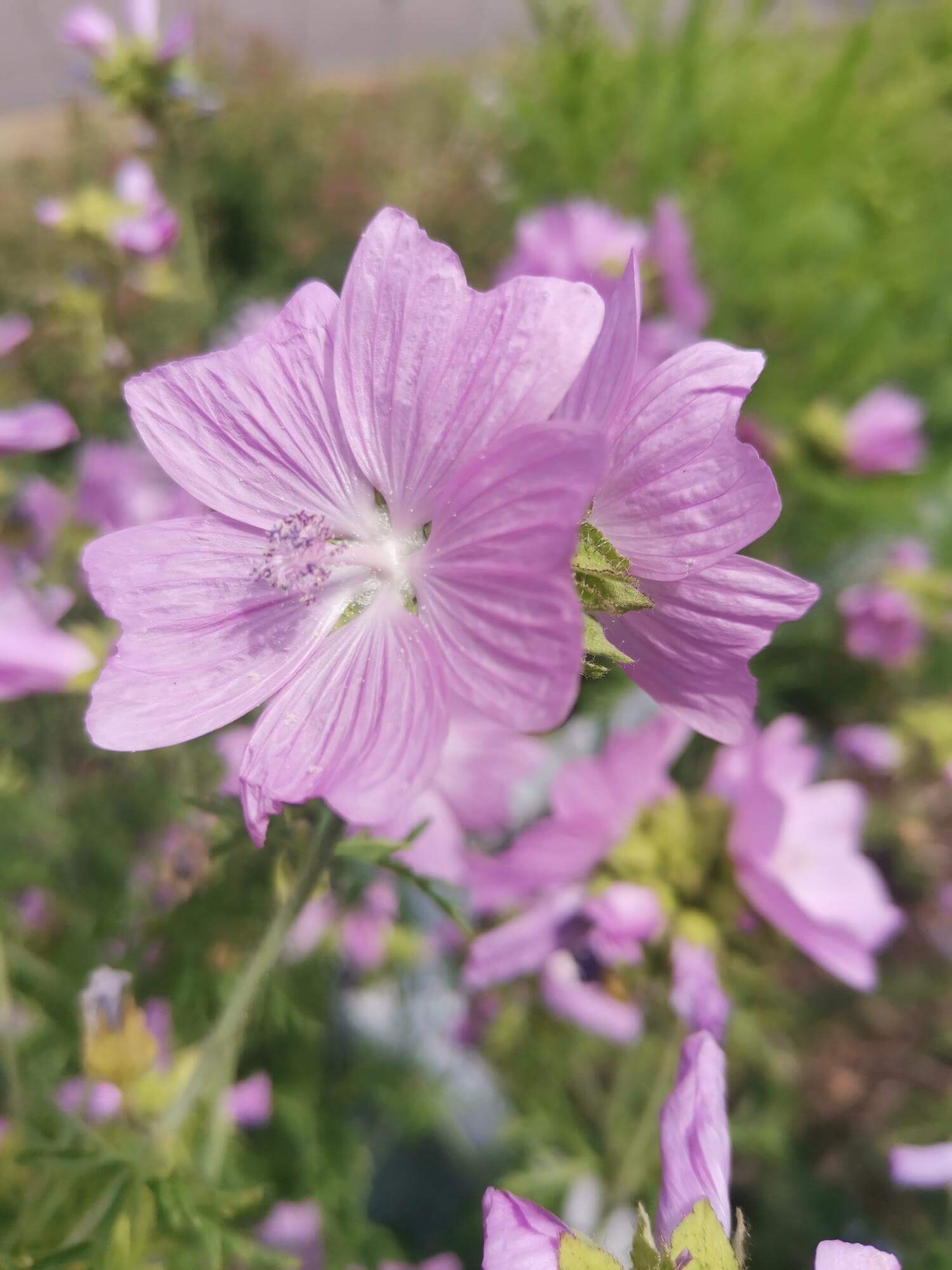
There were other instances where the ‘good’/‘bad’ dichotomy emerged. In one garden that had recently been planted up, the clients were admiring a large flowering Mallow that perfectly complemented their colour scheme. When I mentioned that the plant was self-seeded, they were immediately worried. They asked whether we should remove it, despite the fact that seconds before they had been admiring its beauty. When they realised it was there of its own volition, their attitude quickly changed. In that moment, the plant went from a “beautiful shrub” to an “enormous weed” – and ‘weed’ was bad because it was something they had not intentionally permitted into their space. They also feared that others might think their garden was not being properly tended. I often wondered what people would think if I presented them with a ‘weed’ in a plastic pot, with a label from the garden centre. Would the Mallow’s beauty win out in that context?
The dichotomies that emerge in horticulture – plants that are ‘good’ vs plants that are ‘bad’ – often result in humans interfering in a way that makes the ecosystem less diverse – pollinator-sustaining gardens full of ‘weeds’ are replaced with monocultures of grass – or shuts down possibilities of more intimate or reciprocal relationships with plants. Environmental scholar Catriona Sandilands has suggested queer ecology as one possible framework for understanding the natural world in a more nuanced and open-ended way.5 Rather than imposing dualities on the environment, queer ecology encourages thinking in spectrums and multiples, and so imagines different types of relationships. When we perceive plants not within a dichotomy of ‘good’ and ‘bad’, but rather as a diversity of beings, all of whom contribute to the ecosystem in multiple ways, we might not be quite so quick to yank them out of the ground.
Plants as ‘Invaders’
There was often a particular edge to the way people described ‘bad’ plants. If someone decided that a plant had encroached on space to which it was not entitled, it was often described as “invasive”, “taking over” or “thuggish”.
Marchelle Farrell references this when describing her encounter with Green Alkanet on an Oxford pavement.6 When she looks the plant up to find out what it is, it is described as “invasive”. She comments that it was no doubt brought here deliberately, on a human whim, but when it became ‘too’ successful it was denigrated. Green Alkanet was indeed introduced to the ‘UK’ from Europe as a garden plant in the seventeenth century,7 and due to its ability to self-seed and grow in a variety of different soils, it became naturalised in the environment. Now, it is most often weeded out. Tsitsi Mareika Chirikure explores this dynamic in relation to Himalayan Balsam in an article in Wort 4 in which she traces her relationship with the plant.8 As with Alkanet, it was originally brought to the ‘UK’ for its ornamental value, yet has more recently been labelled ‘invasive’. Chirikure observes; “once adored, the plant came to be seen as a threat”. Yet we might equally choose to conceptualise the deep tap roots of Alkanet or the “open mouths” of the Balsam flowers as ‘flourishing’ or ‘resilient’.9
Moreover, these adjectives of incursion are mostly applied to plants deemed to be ‘non-native’. There is a general consensus in gardening, and in the broader environmental sector, that native plants are ‘better’. But what even is a ‘native’ plant? Generally, a plant is described as ‘native’ if it was not brought here by human intervention.10 However, plants introduced to Britain before Medieval times are also considered native. Plants ubiquitous with the idea of the ‘English country garden’ – Cornflowers, Poppies, Apples – were originally brought here from abroad. As with our complex social fabric, the ‘UK’ has very few plants that are truly endemic. Chirikure notes the difficulty in defining the concept of ‘nativeness’, but the very real impact being labelled ‘non-native’ has on people, plants and animals. The discourse around native plants is not based purely on objective science; these terms are freighted with meaning and value judgements.
Sandilands explores the violence involved in the forcible relocation of plants under colonialism.11 Removing plants from their environments and taking them to botanic gardens such as Kew for study and exhibition was a process not only of extraction, but also of erasure. Often, the knowledge and understanding that gave that plant a cultural meaning and importance within its human social context – even down the name it was known by – was ignored and invalidated. The eradication of invasive plants has now become a huge and profitable industry, and it might be argued that this ‘war on invasives’ is a doubling-down on the historical colonial process of extraction and erasure. Plants that were once introduced are now subject to vehement campaigns of removal, often couched in the language of militarism and morality, with little acknowledgement of the processes by which they were brought here in the first place.
The characterisation of plants as ‘aggressive’ actors in the ecosystem was another justification for their categorisation as unwanted. One client, who admittedly was prone to dramatic turns of phrase, described a Hawthorn tree as “evil” because she had caught her arm on it, and requested that I cut all of the individual thorns off, before she finally employed a tree surgeon to cut it down. A thousand tiny wounds to the plant, to avenge her one wound. Another client wanted a severe cut back on some palms with spiky leaves, describing them as “very violent” plants. Western cultures tend to perceive plants as passive; we do not generally imbue them with agency or personhood. It is interesting then, that when they do something we’re not keen on, they become actively out to get us, and we are justified in responding with force.
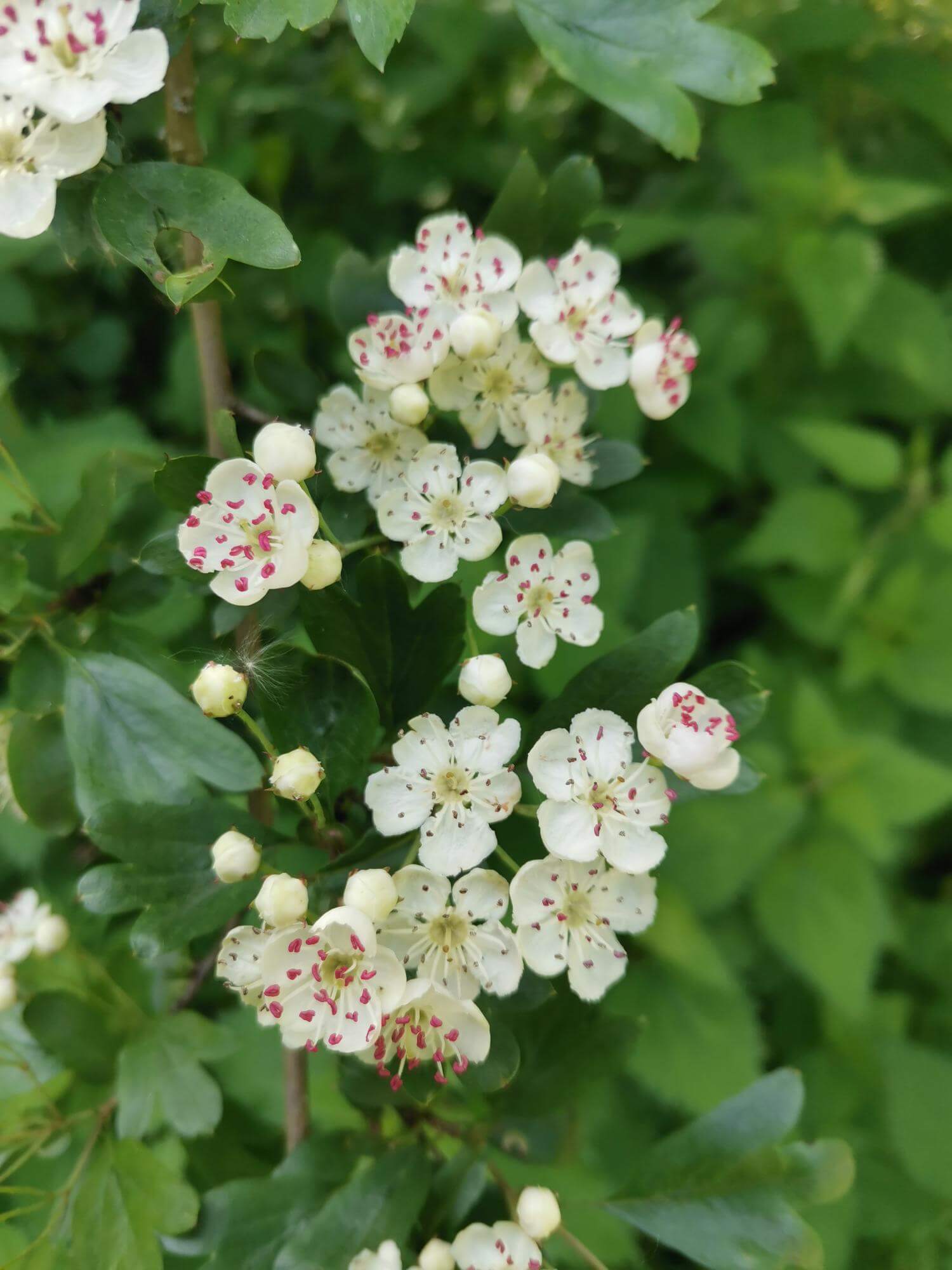
Years later, in early May, I walk through a country park in North London carrying a particularly heavy heart. As I walk, I notice that the hawthorn has started to bloom. The clusters of white flowers permeate me in a way nothing else has; they offer me the possibility of heart-healing.
Narratives of invasion and aggression cast particular plants as violent. But often the reactions that these narratives serve to justify themselves perpetuate violence on the landscape. In an article exploring the ‘nativist dogma’ in ecology, philosopher Carlos Santana comments, “we should be concerned about employing unnecessarily destructive methods of control”, giving the example of herbicides used to control riparian invasive plants ending up in our water supply.12 What’s more, studies have suggested that in creating wildlife-friendly gardens, ‘non-native’ and ‘exotic’ plants do have a role to play.13 Chirikure suggests a reconceptualisation; rather than particular narratives being an automatic justification for a plant’s removal, could we instead pause to ask what the plant might teach us about adaption, survival and flourishing in a rapidly changing world?14
Plants as Property
Another frequent narrative was that of plants as property. This was most often expressed in the ways that people conceived their ownership and possession of what was in their garden, and defined the boundaries of their gardens as territory.
There was an issue of encroachment and containment. One concrete back yard had a fence covered in flowering climbers; the star-like, fragrant flowers of Clematis armandii were intertwined with the twisting stems of Honeysuckle. I was asked to remove everything, right back to the top of the fence, because the plants originated from the garden next door. When I asked whether the clients were sure – the climbers were beautiful and they would just have a wooden fence to look at if I removed them – they looked at me surprised. “But they’re not our plants,” they said. This was echoed in another garden, where I was again asked to clear the fence-line. “His [the neighbour’s] plants are coming into my garden! And mine are going into his!” (this was said with a slight sense of alarm). Of course, the notion that ‘these plants belong to me, and those ones to him’ mean nothing to and are not heeded by the plants in question. And yet, despite inevitable plant transgression of these dichotomies, such interventions to re-establish boundaries represent a constant effort to force plants to comply with human rules and order. In these narratives, plants are again classified as “invaders”, originating outside of one’s own home and territory.
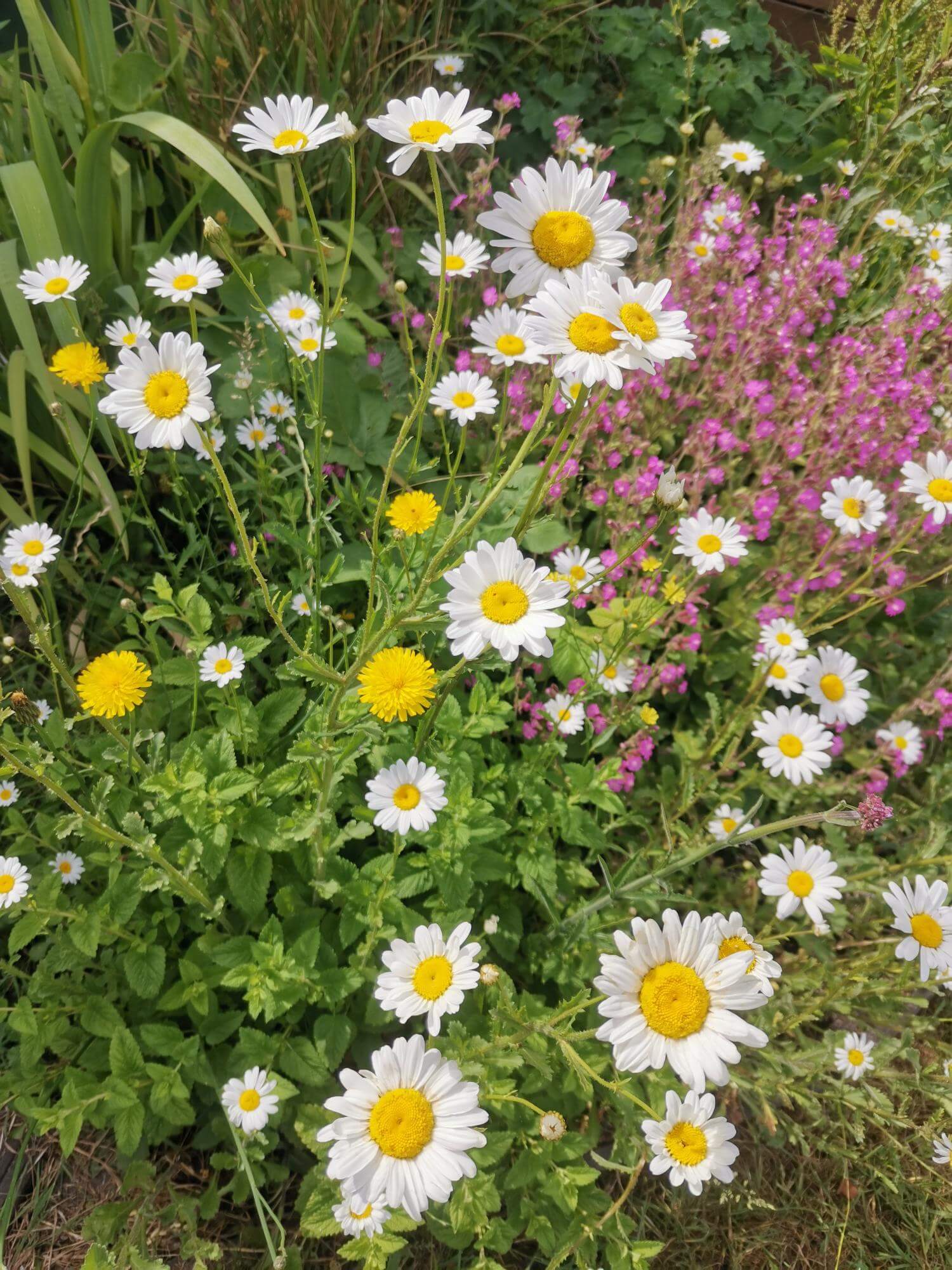
As well as attempting to contain interference from elsewhere, many people wanted strict boundaries within their own gardens. Coming into physical contact with plants was often unwanted. More than one client said they did not like “being touched” by plants, and requested that the foliage by paths be cut back, to avoid brushing their skin as they passed. I once spent an afternoon cutting down the slender stems of Ox-eye Daisies and the pinky-red blooms of Campion. The flowers were in a wildflower meadow that leant gently over onto the path. The message was clear; I want my nature contained, and I want a hard edge between nature and me.
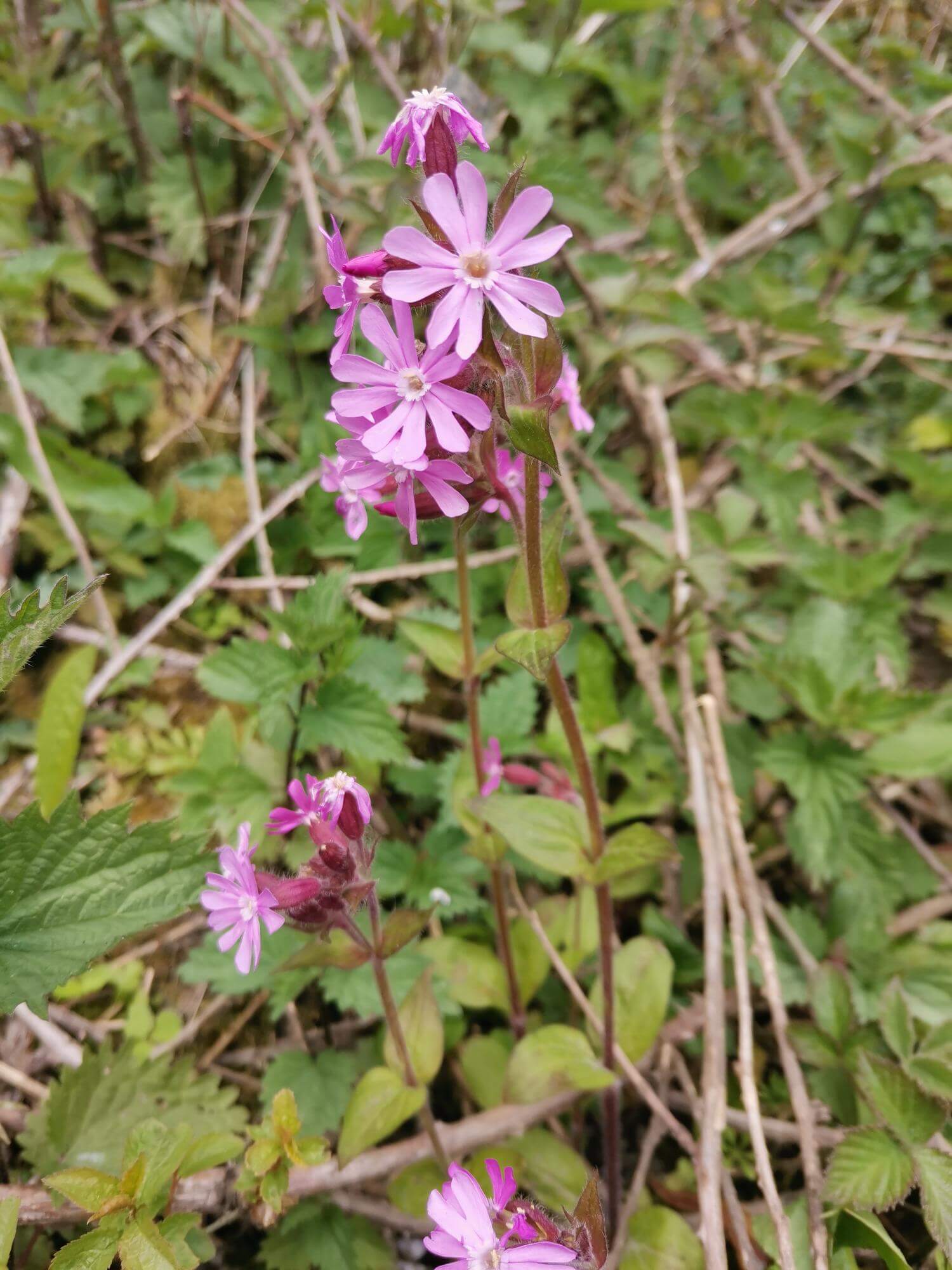
In folklore, Campion is said to act as a guardian, sheltering fairies and the honey stores of bees. I feel a dissonance as I cut it down; what other lives am I displacing in the process, what possibilities for protection and healing am I denying?
The creation of barriers and borders has often served as a way of manipulating landscapes to contain and dispossess certain populations. Plants themselves have often been co-opted into this dynamic – hedges constituting living fences to enclose land and divide territories. And yet today’s hedgerows can also be havens for wild plants and wildlife. Ecology refers to the “edge effect”;15the way in which there is a greater diversity of species at the juncture of two ecosystems. Could we bring this understanding of ‘the edge’ into gardening, to recognise that, just because humans have created boundaries, it doesn’t mean that plants will stick to them – indeed there can be positive interactions between two neighbouring garden ecosystems? And could we welcome the spilling of plants into ‘our’ spaces in ways that acknowledge them as collaborators and co-creators, and so find new ways of co-existing with the non-human world?
Indeed, to return to Chirikure’s suggestion that even the most unwelcome plants might have wisdom to offer of survival and flourishing, might we re-imagine the edges of green spaces not as private property but as spaces in common; places where we can connect and share with others, places where seeds and stories can flow between us, over the ‘boundary’ of the garden fence? If the boundaries of our private lives met in this way, what new and unforeseen possibilities might arise?
Plants as Performers
In Horticultural Appropriation, Claire Ratinon describes a visit to West Dean Gardens soon after the end of lock down, during which a gardener lamented all of the things that had not happened that year. There was a concern that the garden was untended. Ratinon comments: “there’s a strong attachment to the garden’s performance every year without fail”.16 It is seen as the role of the gardener to curate this performance. A client once expressed shock because she had forgotten to prune her Roses that year, but they flourished nonetheless. She was surprised this had happened despite the lack of human intervention.
Of course, humans can be positive actors in the ecosystem – we absolutely have a role to play in creating flourishing and resilient environments – but it is not human curation that causes the Roses to bloom.
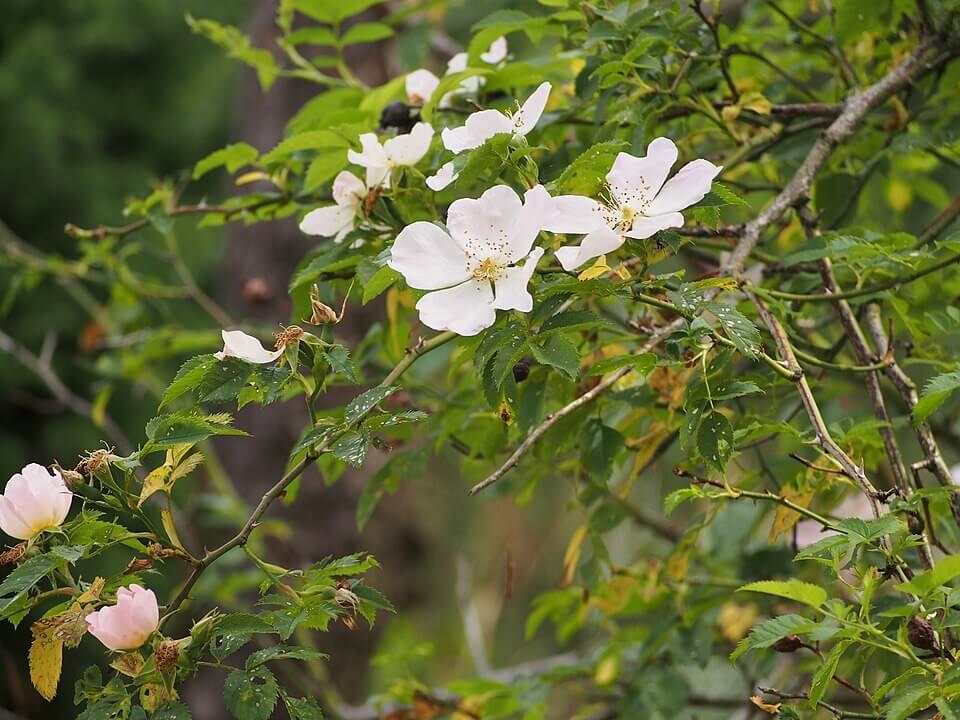
I have a handful of Lemon Balm, some leaves from a Currant bush, and I am in search of a wild Rose. I find a hedgerow full of blooms. I harvest some petals, adding them to the other herbs, and macerating them in brandy. Time and again, the resulting tincture soothes and calms me.
A great deal of the work involved in garden maintenance – curating the performance – could be described as ‘tidying up’. That is, removing anything that is deemed unattractive; often material that is dead or dying. For example, although it is better to leave perennials that have died back over winter, so they can provide food and shelter for wildlife, it remains gardening convention to cut them all down in autumn. Ostensibly, people do this because the dying plants are ‘messy’. They wish to see them only during the months of their ‘performance’, and the essential process of dying down and re-emerging is to be hidden from sight.
I wonder, however, whether there is something more to this urge to tidy up – whether it has something to do with our cultural taboos around death; whether perhaps we find it distasteful, or even confronting, to look at things that are dying? Dead plant material is removed, composted neatly in the corner out of sight – this essential process that provides so much of the life force for a garden is removed from our vision. This was expressed to me very clearly on one occasion. A client who was approaching ninety asked me to cut the browning heads off her Hydrangea. “At my age, you don’t want to see things dying” she said.
Perceiving plants primarily as performers denies their fullness as living beings that participate in the cycles of life and death. It is so apparent in a garden that all stages of a plant’s lifecycle are embedded in those of the wider ecosystem; flowers for pollinators turn into seed heads for birds, which fall and turn into food and shelter for invertebrates, which eventually decompose and return nutrients to the soil. Everything is valuable in the cycle of life, and everything, if seen for itself on its own terms, holds beauty – whether browning flowers or sculptural seed heads.
Gardens can be a microcosm of our relationships with the Earth, the stories we tell about them reflecting wider societal dynamics. When we tell stories of violence and invasion, stories of being unsightly or unwelcome, we lose sight of the “qualities and potentials of vegetal worlds”.17 Gardens are spaces where we can connect with the Earth; marvelling at the first blooms of spring, running our hands through aromatic leaves and feeling the tickle of seed heads on our skin. There are a multiplicity of stories we could hear and a multiplicity we could share. Changing the language of gardening culture could be a path to changing our relationships not only with gardens, but with the living Earth; a route (or perhaps a network of roots?) through which to create nurturing relationships with and between the multispecies world around us, the cultures we shape within it, and each other as participants and stewards of both.
Endnotes
1. Frederike Middelhoff and Arnika Peselman, ‘The Stories Plants Tell: An Introduction to Vegetal Narrative Cultures‘, Narrative Culture, (10:2), 2023
2. ‘Weed’, Wikipedia (n.d.)
3. Increasingly fashionable during the years I worked as a gardener was plastic grass. Plastic grass is an ecological disaster – reducing vital habitat and contributing to heating within cities. However, it was favoured because visually, it looked like the ‘perfect lawn’. One client was horrified when weeds began to pop up in his plastic grass. He emailed the company who installed it to complain, sure that the lawn was ‘faulty’. The diplomatic response came back: “the lawn is a part of the dynamic environment in which it is situated”.
4. Sarah Shuttleworth, ‘The History of Lawns: Status Symbols, Class History and Changing Beauty Standards‘, Plantlife (n.d.)
5. Green Dreamer podcast (ep. 362)., ‘Catriona Sandilands: Botanical colonialism and biocultural histories‘.
6. Marchelle Farell, Uprooting: From the Caribbean to the Countryside – Finding Home in an English Garden, (Canongate Books, 2023)
7. Jane Perrone, ‘Green Alkanet: that mystery plant, revealed’ (n.d.)
8. Tsitsi Mareika Chirikure, ‘Echoes of an Uprooted World’, Wort, 4 (2026)
9. Chirikure, ‘Echoes’
10. ‘UK Native’ Plants and Fungi: The Meaning, the Misconceptions and the Science’, Kew: Grow Wild (2022)
11. Green Dreamer, ‘Catriona Sandilands‘
12. Carlos Santana, ‘Conservation’s Prejudice‘, Aeon (Feb 2026)
13. Adrian Thomas, ‘If you want to help wildlife in your garden, should you plant native plants?‘, RSPB Community (Aug 2017)
14. Chirikure, ‘Echoes’.
15. Gia Mora, ‘Edge Effects: Habitat Biodiversity and Human Interference’, Treehugger (Aug 2022)
16. Claire Ratinon and Sam Ayre, Horticultural Appropriation (London: Rough Trade, 2021)
17. Middelhoff and Peselman, ‘The Stories Plants Tell‘
Nicky Buley is a community grower, with a deep interest in the relationships between plants and people. She is trained in horticulture and permaculture. She is curious about how people and plants can build reciprocal relationships to support and care for each other.
Editor: Leo El-Qawas
Suggested citation: Nicky Buley, ‘Plants in British Gardening Culture: The Stories We Tell’, Wort blog (11th Aug 2026). <www.wortjournal.com/plants-in-british-gardening-culture>
Great article! Thanks… This might sound a little far out may be? But as a child of the eighties I’ve grown up through a period where realities of manifestation, synchronicity and collective consciousness have gone from the obscure pseudo science tin foil hat category to becoming mainstream, even if that is just hearing about such things.
I also see many people at war with themselves and with nature, as you say even nature lovers. What we still fail to recognise is how our inner environment of thoughts, feelings , emotions, that which we relate to with our outer environment is creating realities on the subtle energetic and collective field, we are at war with ourselves and with our nature creating the world we see. For things to change, we have truly change ourselves. Plants, herbs are the greatest of healers and teachers in this respect, nature teaches us how to be when we listen, rather than react.
Mark – thanks for your comments. I think what you say about nature teaching us when we listen rather than react is so important. I’ve just been reading The Nutmeg’s Curse by Amitav Ghosh and he talks about the systematic ‘muting’ of nature – the way its voice has been silenced – so that we no longer communicate with the non-human world around us, and like you say, it’s become “weird” or “out there” to do so. But I absolutely agree; if we take the time to communicate with plants, they can offer us so much.