
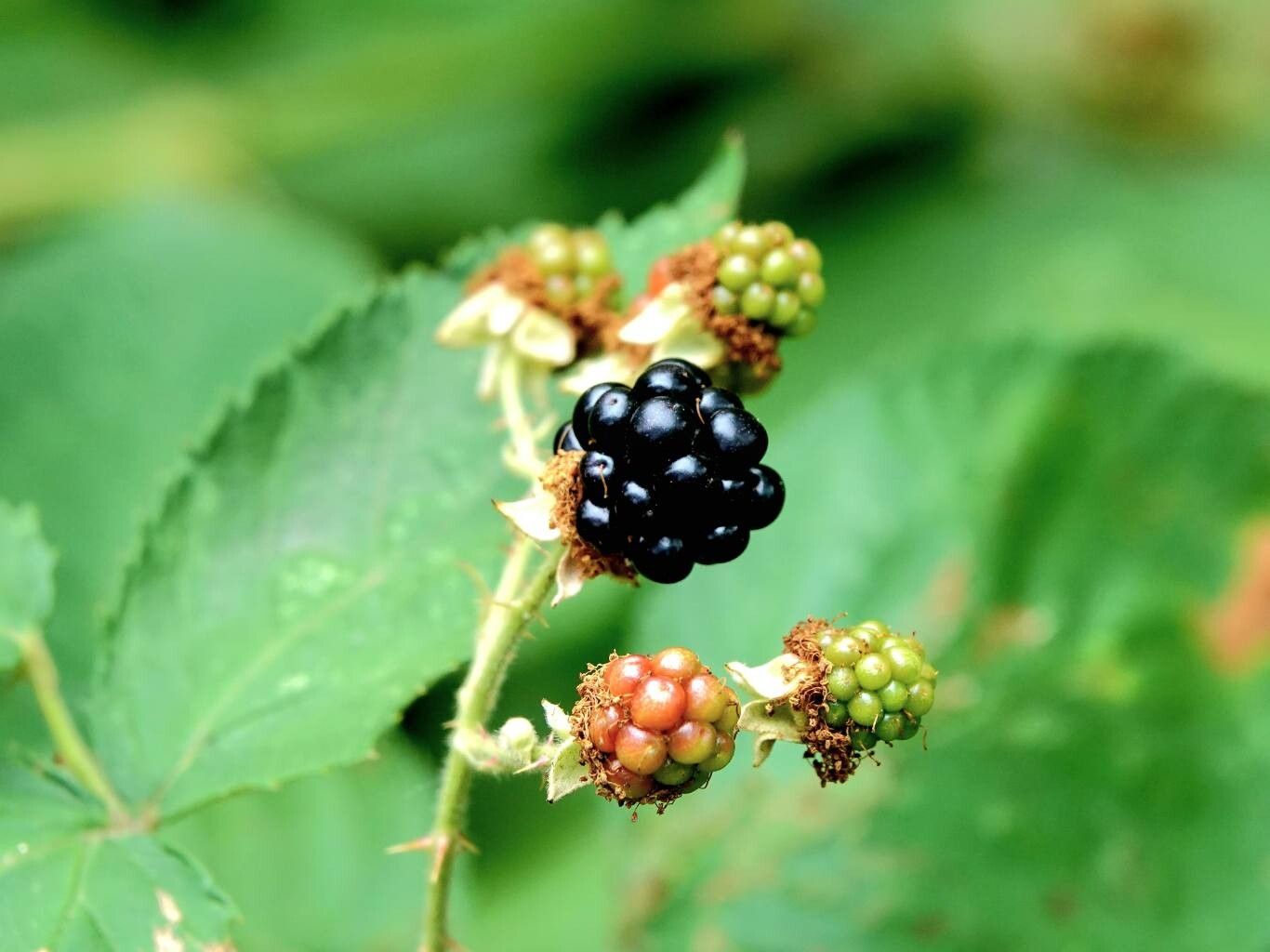
Bramble is a Commons
Everyone knows Bramble. How does this weed still have such a grasp on hearts and minds in these lands where other wild plants are forgotten? In this article we explore Bramble’s provocations to remember and reconnect to ways of being that are in common, and understand it as a medicine for our times.
By Leo El-Qawas and Hannah-May Batley
Audio read by Hannah-May Batley
17th September 2026
Read time: 24 minutes
Listen to this article as audio
We sit in a circle.
In green the permanent marker reads: “recall a potent plant encounter”.
Anxious eyes scanning the room, darting from one another to the recycled flip chart paper. Though it is never wise to assume, I make a solid, fairly robust assumption; this is not what the participants were expecting, nor wanted. Silence. I don’t imbibe the discomfort with chirper remarks. I allow things to ferment some.
Accompanied by what feels like a collective gasp, the first woman finally speaks: “Blackberry”, she says. “Blackberry pie made by my Mam. Despite having nowt, we had this.” Another woman, wriggling on her seat “same”. “Blackberry picking with my nana, blackberry picking down snickets near’t estate”. “Blackberry picking with my siblings and this feeling of the best is yet to come, shoving em in us mouths, laughing when we got a bad un”.
Blackberry. Blackberry. Blackberry.
Nearly twenty women in this room and all bar three speak of Blackberry.
I could say this was a one off, it wasn’t. Eight times out of ten, when working in communities, this is what’s revealed. A potent encounter with blessed Blackberry.
Another question scribbled in green: “What does this encounter evoke?”
This time, the women are less nervous. Eager. “Comfort”, bursts one. “Nostalgia” exclaims another. “A feeling things were gunna be oreyt”. “Togetherness”. “Warmth.” “Community”. “Joy”. “Cosyness”.
Words froth, more green scribbles, more memories, more experiences.
A brightness accompanies the conversation, a brightness that smells hopeful and sweet.
The above is from one of Hannah-May’s workshops, bringing plant medicine to working class communities where she grew up in South Yorkshire.
In her essay ‘Patterns of Perception – An Encounter with Blackberry’ in Wort #4, she shared the story of her own relationship with Blackberry; of her curiosity.1 How Blackberry barged its way into both her consciousness and her imagination, exposing her habitual choices; reworking her patterns of perception.
Recognising this encounter reflected in the recollections of her workshop participants, Hannah-May writes:
I too share this affinity. As an adult, Blackberry re-emerged from the margin to the center. An initiator plant. All belly and boldness. A plant who offered allyship and transition, a guide, between one state of being to another. Captured one September afternoon, after more hours than I’d like to think, sat stagnant at a computer screen. Blackberry summoned me. Grasped me by an unironed collar and dragged me like a sulking pup down the country lanes. Legs walking whilst mind remained vacant, enclosed in the prison of the intangible. Walk, walk, walk. “Nobody in the lane, and nothing, nothing but blackberries”, as Plath says.2
Blackberry perception, or rather perceiving through the relational vessel Blackberry initiates, seemingly – as far as my work and research in communities goes – conjures a way of being, albeit momentarily, which disrupts habituated codes of relating and relationship.
Hearing Hannah-May recount how Blackberry figures so prominently as an entry point for plant connection in her work with her local communities sparked the question for Leo, why Blackberry? What is it about them that consistently provokes this sort of embodied remembering? How is it that Blackberry has this capacity to call the humans of these lands to more participatory, nature-entangled ways of being (such as Hannah-May describes of her own story in in Wort #4)? Sparked too, by her own seasonal Brambley adventures and explorations with friends, she wondered of the unsung profundity of Bramble/Blackberry as a folk medicine; its depth and complexity perhaps – a paradigmatic weed – hidden in plain sight.
The idea seemed immediately fitting then, that this piece be a collaborative one, although neither of us have ever written this way before.
Blackberry for Everyone
Everyone knows Bramble, because Bramble grows everywhere. Countryside and city. Woodland, hedgerow, park and car park. If you’ve tended a wild space or a garden or allotment, chances are you’ve spent time pulling them up or fighting them back. If you venture off the path on a ramble (or if you stick to it), chances are you’ll encounter Bramble somewhere along the way. Once in berry, it’s easily recognisable for its form – a cluster of dark, rounded, crowding drupelets – making it safe for those who’d never dream of picking another kind of berry from a hedgerow.
Forager Miles Irving writes: “Blackberrying or brambling is the major unbroken British foraging tradition. […] pretty much everyone has picked and eaten wild blackberries. For some reason, they still register as an immediately available food source [whilst] more often than not plums and apples fall to the ground in public places and rot.”3
And once home (the ones that make it home!), so many possibilities of creation: syrups, juice, jams, jellies, junket(!)4, vinegars, pies and crumbles (along with the apples, with which they coincide in the season). They’re great on porridge, on yoghurt… great infused in gin or vodka, and they’re very forgiving for throw-it-all-in-a-bucket country wines.
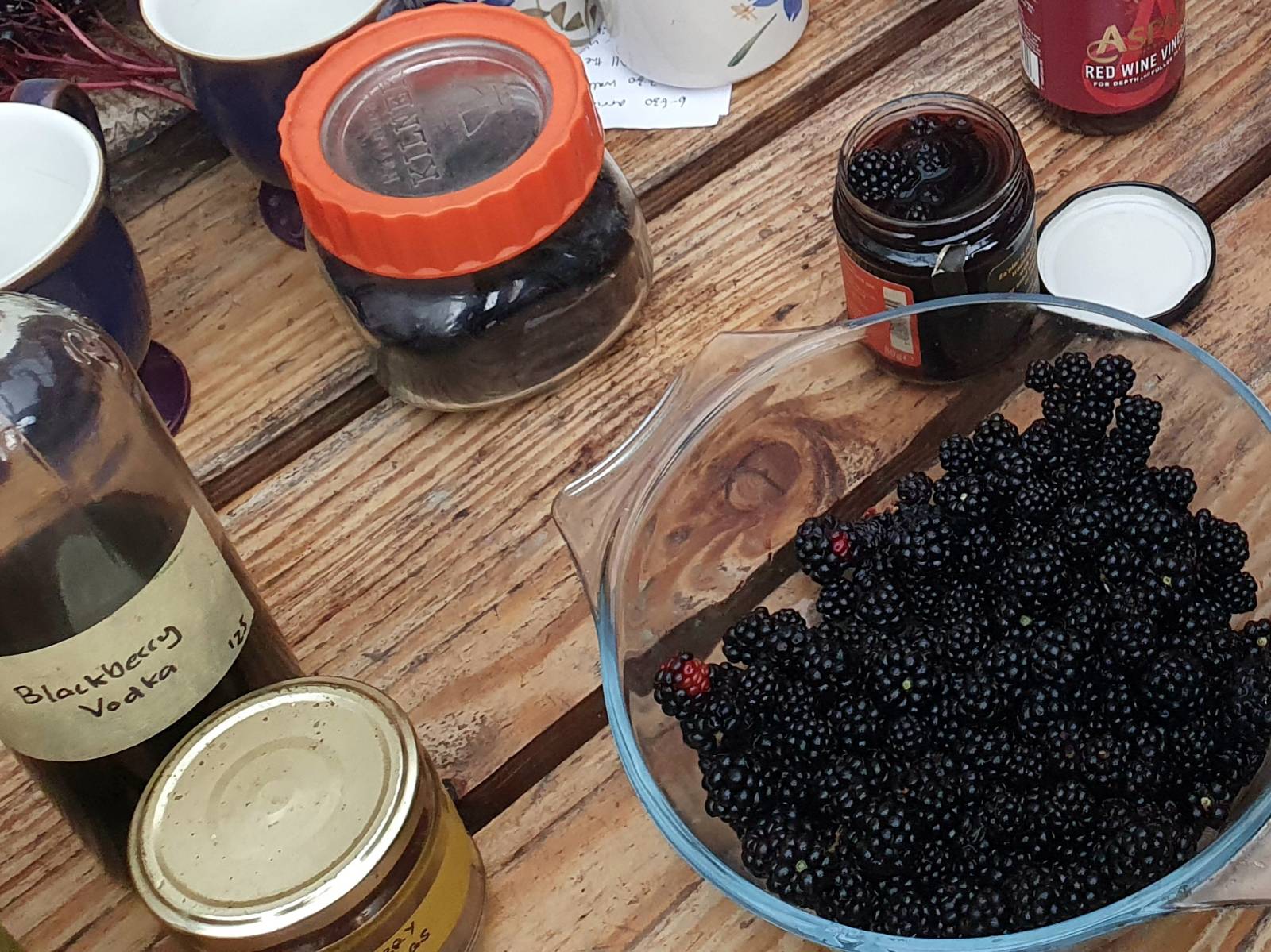
Leo remembers her first winemaking as a Blackberry wine of this sort. An unhurried morning picking the hedges along the opposite field on the protest site where she lived. A sizeable harvest! A pot of water boiled on the fire, then everything mashed together in a bucket with really quite a lot of sugar, covered with teatowels, and watched over the next days for bubbles – the magic of the yeasts carried on the Blackberries’ own skins – before it all gets filtered and racked into a demijohn, and the long wait until it’s ready. It turned out quite well, as she recalls.
And Hannah-May remembers her grandma’s crumble:
My grandma always used to make blackberry and apple crumble. Postbox red and buttercream ceramic dish, caramelised and gooey round the edges sitting on the cooker top. Superking cig infused Vanilla air freshener, Weakest Link, an old jack russel called Pip chelping at the theme tune, Grandma lip syncing to Anne Robinson. Birds custard bubbling too-yellow in the pan. Tiny hands around too big bowls, knees up, tart but sweet, shovelling cinnamony violet into eager mouths. Three musketeers; me, brother and sister scooped up into the palm of my grandma’s pudding. Forgetting about the absence. Forgetting about school. Just being with the comfort of the crunch and then the chew of a perfect crumble top. Ginger nuts sometimes sprinkled on top – if we were lucky.
Blackberry is a commons.
Around Blackberry, still, we gather, we harvest, we collect, we sit ruddy cheeked, eager bellies and longing eyes ready for our spoils. Around Blackberry we soften. To-do lists, work meetings, whatsapps, email, urgency – nothing is as important as right now, is it? Plucking blackberries, delicately washing, stewing.
The last vestige of commons, represented symbolically through the blackberry.
“Despite having nowt, we had this.” Togetherness. Warmth. Community.
Blackberry as a mnemonic for the commons, and in that it is a bone for the imagination to chew on.
Blackberry Invitations
Why is it that Blackberry can still cut through post-capitalist disconnection to pull us back to the commons in this way? Why is it still so deeply culturally inscribed in the collective folk memory of these lands? What is it about Blackberry that invites this kind of embodied memory making?
Surely something of Blackberry’s allure is in its shape and colour. The plumpness, the roundness, the glistening curves. The deep violet sheen, so glossy. Just reflecting on the shape and colour, for us, stimulates mouth-watering receptors.
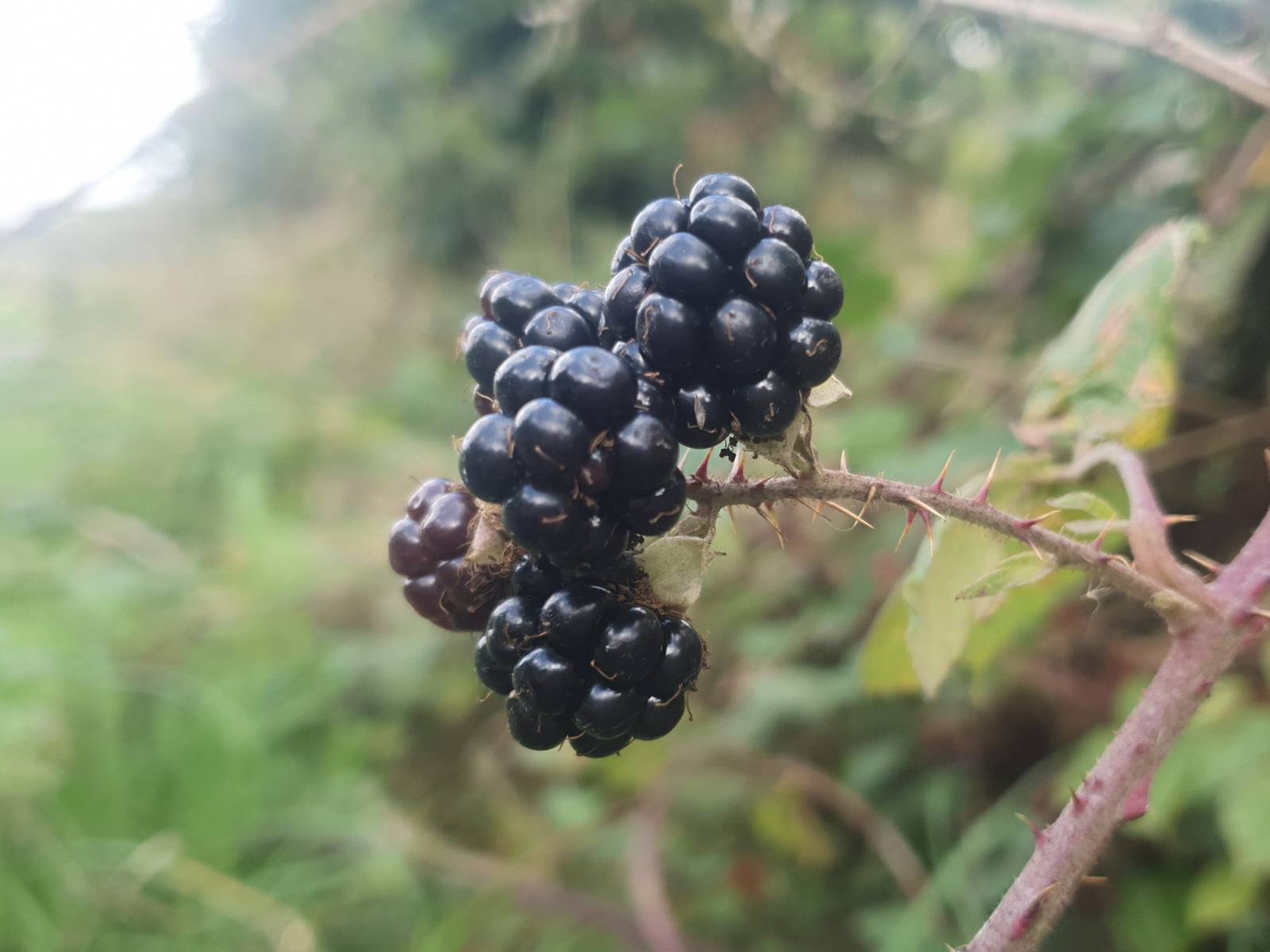
And the visceral sticky sweetness of the berries. Purple-stained fingers that get stickier as you go. Belly to hand. Cramming the sweetest ones into your mouth straight off the bush – occasionally one that’s too sharp or too far gone. This uncertainty keeps us on our toes, invoking focus; scanning, we pay attention. But it doesn’t take much to become a connoisseur; to develop the discerning eye that knows the look and feel of the perfectly ripe ones, the discerning hand that habitually measures resistance to the touch and the tug. Picking blackberries is a deeply embodied and sensory activity, one that engages the haptic and sensorial.
Blackberrying invites other kinds of risk taking too. There is longing, creative problem solving; upturning buckets or calling in bunk-ups for getting to the ones just out of reach.
And the thorny thickets demand care and patience: it’s hard to strip a bramble hedge. The scratches and stains mark the effort. We return thoroughly Brambled and Blackberried.
Blackberry also invites playfulness. Seldom do you see a group of folks blackberrying that look disenchanted by the task at hand. Blackberry – embodies a quality not too dissimilar to a curious child eager for the world and experience.
Working with Blackberry both individually and collectively, Hannah-May sees this quality imbibed within the ones who work with it. Internally, one could say Blackberry invites a porosity to the internal territories, it is a carpenter of doorways; burrens through the collective and personal imagination. It invites connection where there is segregation, movement where there is stillness. One participant on Hannah-May’s course noted that “Blackberry is a Patti Smith of the Plant world circa 1975”. Dancing on the edge of feral, but not quite. Rampant, rapturous, but also delicate and tender. Like Patti’s music, Blackberry invokes a multiplicity and perhaps this too is a part of its playfulness.
Often, too, there’s a sense of adventure. Brambling is an outing, with community, family, friends.
“A generation ago”, wrote Roger Phillips in his 1983 guide Wild Food, “ blackberry-picking time was an event on the calendar almost as significant as that of Christmas or Easter. Entire families from town and city, armed with buckets and ‘tilly’ cans, descended on the countryside and plundered the roadsides, hedges, woods and waste ground.”5
Leo remembers being trusted as a child to descend, with the other kids of the neighbourhood, on the lake at the bottom of the estate – or occasionally to the next one along – gobbling at least as many berries as went in the bucket… an accessible adventure for kids of all heights (not like the hierarchical invitations of trees).
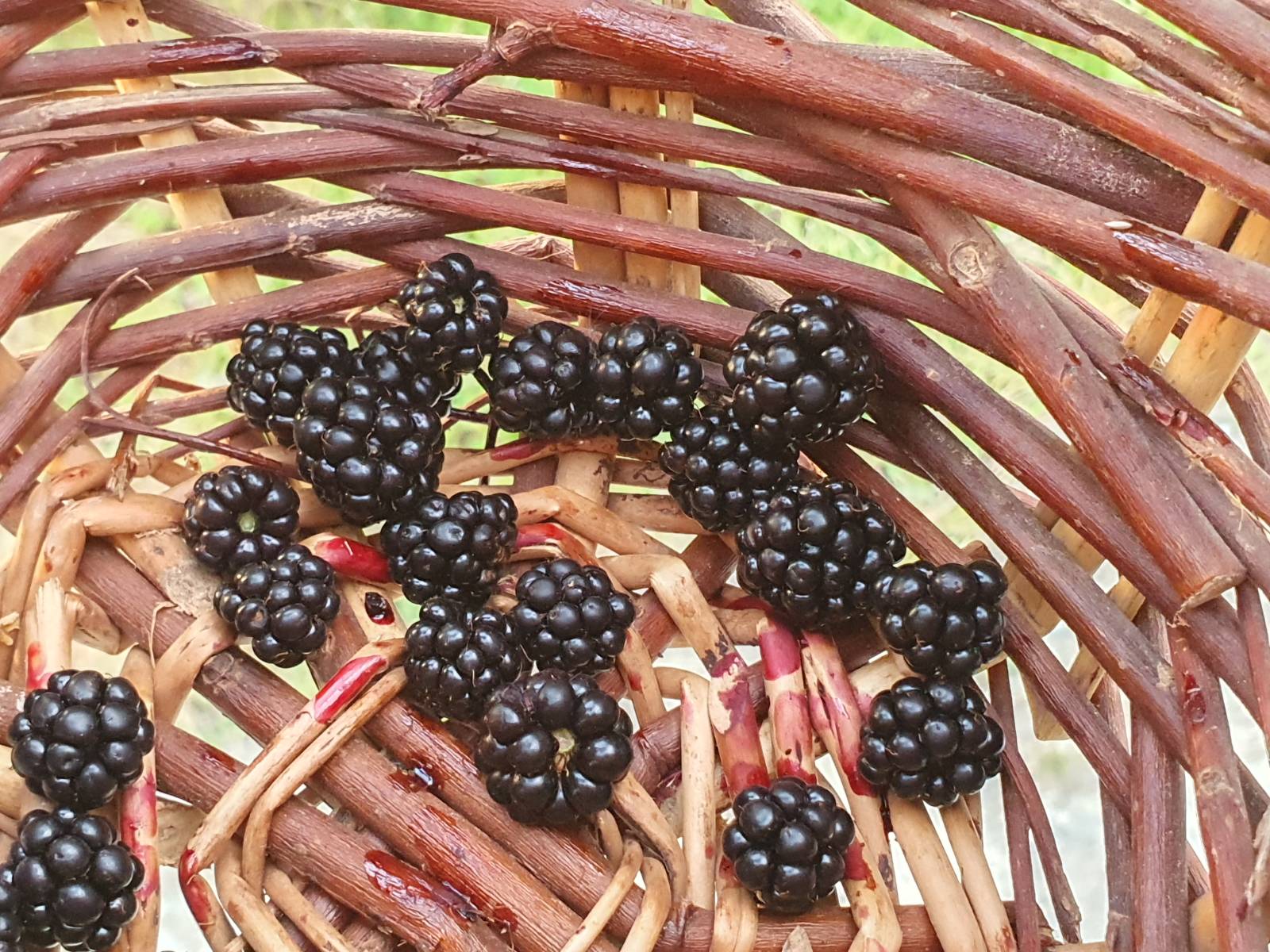
And then there’s Blackberry’s sociality with us. The way it’s always there and present as a hedgerow plant, but comes into visibility in a quite magical way when it comes into berry (though it definitely makes itself known year-through in its habits of snagging and scratching, nudging us, albeit not subtly, to pay attention, to ourselves, our bodies, our entanglements). This colour does not stop at the visual.
Ebon in the hedges, fat
With blue-red juices. These they squander on my fingers.
I had not asked for such a blood sisterhood; they must love me.
– Sylvia Plath6
Blackberry marks us, and in the marking there is an agency; a sweet, sticky contagion.
Blackberry love is something Hannah-May, like Sylvia, relates to – the moment you’re on a roll, find a cluster that is perfectly ripe. Just the right balance between sweetness and tartness, the first ripe Blackberry of the season. Head nodding. Mouth alive with the blue-red ooze. Yes. There are moments where such encounters have rendered her speechless. Moments of awe which feel like love; awe that one can just pluck and pick juicy ebony jewels from our hedgerows. There’s a disbelief, a suspension, a timelessness. It was this invitation to awe – the call of Blackberry – that hurtled her down the path of reprogramming her perception of the natural world, changing her habits and marking Blackberry as one of her allies.
Bramble Being of Borders
Blackberrying adventures are a fond element of the cultural relationship with Bramble in these lands. But Bramble carries an ambiguousness within it too. It is a dweller of borders. Often it is itself the borders. And it occupies this place symbolically and metaphorically for humans in multiple ways.
In foraging classic Food for Free, Richard Mabey notes the way that it tends to bridge urban and rural worlds and imaginations, and at the same time the boundaries of comfort and discomfort; civilisation and wildness; the safety of the harvest and vegetal unruliness:
Blackberries have a special role in the relationship between townspeople and the countryside … Blackberrying carries with it a little of the urban dweller’s myth of country life: abundance, harvest, a sense of season, and just enough discomfort to quicken the senses. Maybe it is the scuffing and the scratches that are the real attraction of blackberrying, the proof of satisfying toil against unruly nature.7
There is a mild sense of stimulating wildness. The bounteous abundance of Bramble’s fruit is measured by the scratchy, troublesome, thicket-forming unsociability of its thorns. But you couldn’t have one without the other.
Bramble is part of the human world, but on the edge; with one foot in the village, and one foot in the forest. As any gardener knows, it is not easily controlled, nor contained, and it’s the first to take over untended space; indeed, it is an icon of nature’s reclamation of urban spaces. It is often enlisted as a boundary marker, but left to its own devices it will rally any border, fence, or pathway, defiant in its right to roam. Its unruliness is reminiscent of the revolts of common folk upon these lands. Blackberry gives no shits for our measly human agendas. It gobbles up Landlord’s attempts to siphon common land as private property. It is anarchic and feral, a wilful being with a bite.
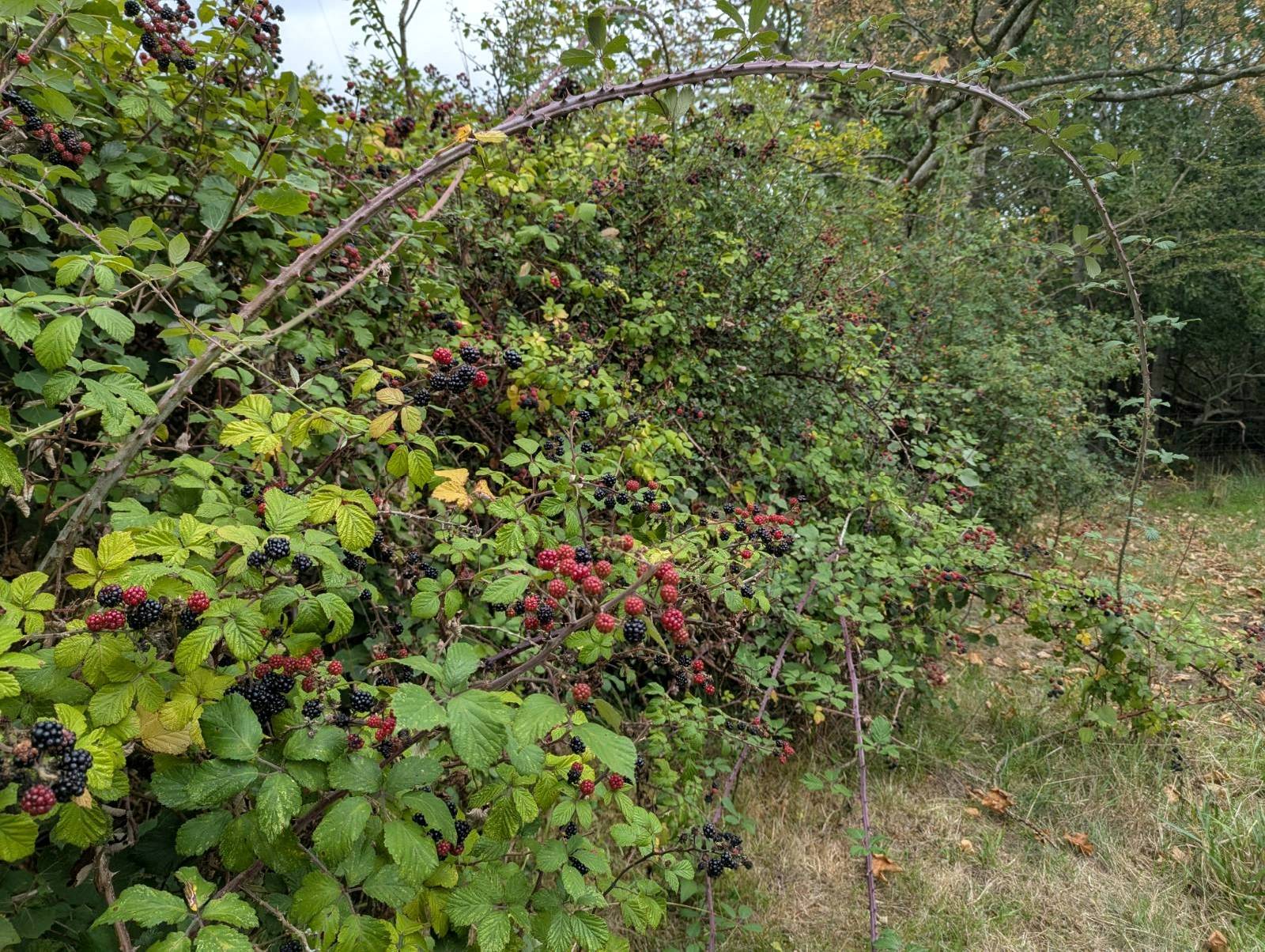
Leo recalls a big-mooned evening, post-revelry, wandering the woods for a place to lay a sleeping mat and her head for the night, the briar seeming to snatch and catch at her ankles at every step… the mild (inebriated) terror of the dark tanglewoods.
At the same time, as a hedgerow plant, Bramble also encompasses a fierce protectiveness for other kin. It offers shelter and concealment for small animals, and is a guard for young saplings, vulnerable to grazing and winds. Its ‘keep out’ is also a ‘come in’.
This protectiveness translates medicinally too: the leaves and root offer a puckering astringency, which energetic contraction also speaks to Bramble as border, strengthening mucous membranes, gathering, tightening and fortifying against microbes. This is in contrast to the juicy gregariousness of the berries and the exploratory expansiveness of its growth. But Bramble as a folk medicine hasn’t survived into contemporary consciousness in the way that Blackberry as a wild food has.
As a border plant, Bramble also offers itself as a border ally, inviting us to be with our own borders – the edges of solitude and togetherness, self and community – and with the uncouth in ourselves. In the plucking of blackberries from abundant hedgerows on solo quests, snaffling one, two or ten. To collective harvesting; blackberry rhizomatic – many hands and many berries making goodies for the larder.
Blackberry the border being, both singular and collective. Sympoeitic. Social.
Blackberrying with Grief
Bramble marks a temporal border too; between the seasons – Blackberry time means the fading of summer into autumn – and more symbolically, between life and death. Juicy plump summer berries soon give way to fermentation, flies and maggots. Seamus Heaney wrote of the hard lessons of this ephemerality in the poem ‘Blackberry Picking’:
You ate that first one and its flesh was sweet
Like thickened wine: summer’s blood was in it
Leaving stains upon the tongue and lust for
Picking. […]
We hoarded the fresh berries in the byre.
But when the bath was filled we found a fur,
A rat-grey fungus, glutting on our cache.
The juice was stinking too. Once off the bush
The fruit fermented, the sweet flesh would turn sour.
I always felt like crying. It wasn’t fair
That all the lovely canfuls smelt of rot.
Each year I hoped they’d keep, knew they would not.8
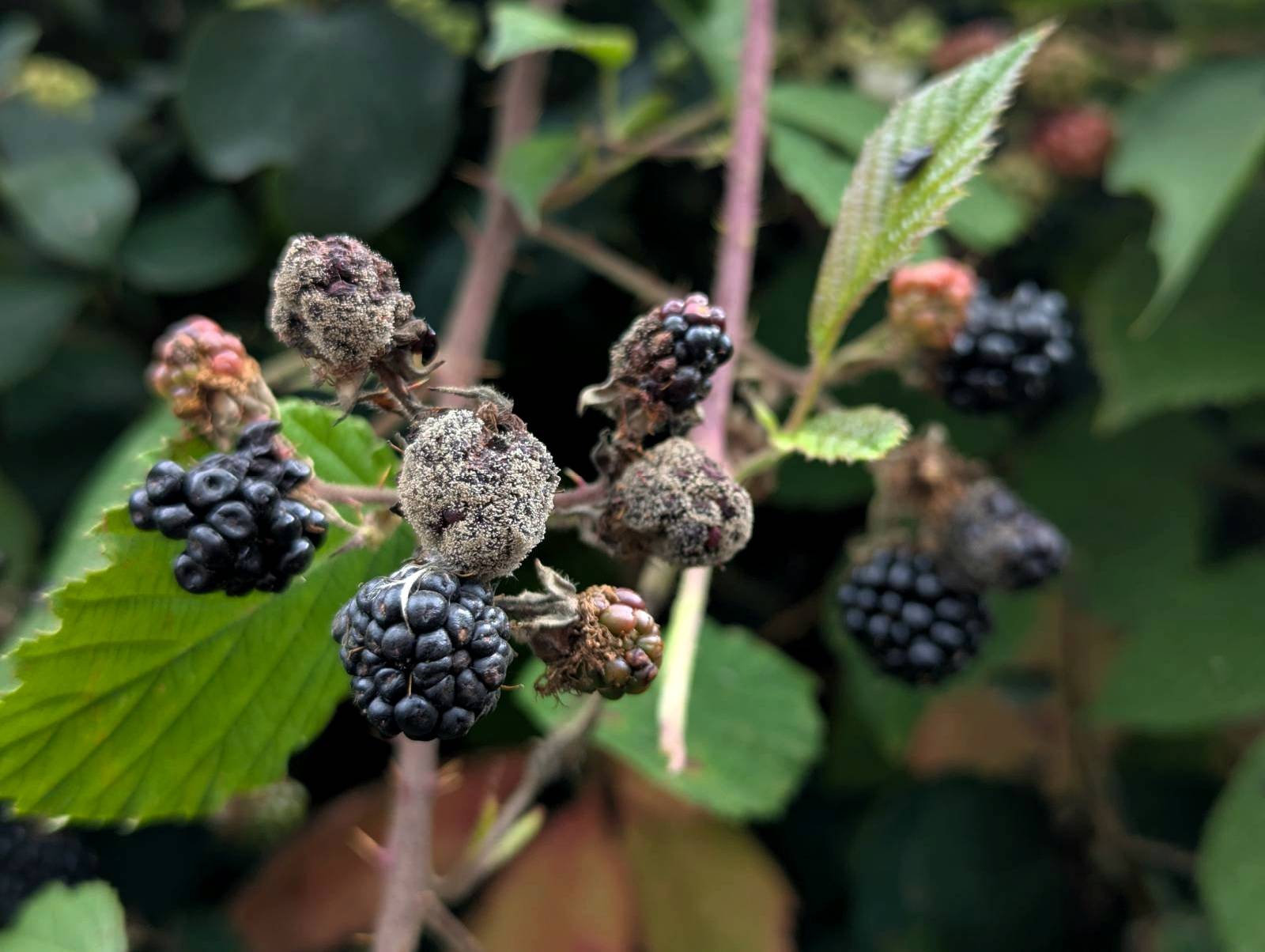
A bit of Bramble folklore tells that the devil, freshly cast out of heaven and annoyed at the added indignity of landing in a Bramble bush, spat on the berries to spite them; and for this reason you never pick the berries after Michaelmas. As we write this in early September, the blackberries local to each of us have already started rotting on the hedges – so early! It seems ambitious to imagine they’ll make it as far as Michaelmas – invoking something of the same feelings Seamus speaks of; childhood grief at the realities of death and decay, but with the added weight of climate disruption. The days of drought (in Wales! In Yorkshire!) shown in crisped brown leaves, followed by heavy rains that cannot soak the dry soil. Rat-grey fungus cocooning the once succulent druplets. Rot. In and amongst Life. In and amongst the Blackberries which haven’t ripened and the few that still are.
Still though, the season is not past.
Many people, through many times, would have stood, hearts tender and weary, picking the smaller, sparser berries. Bramble holds the memory of wars, of rationing, of bombs, of enclosure and loss. It is an archivist – a keeper of our collective and personal memories and stories. It has witnessed human hardship along with weathering its own – hardships that economists like Gary Stevenson predict are only going to become more pronounced for the working classes and other structurally marginalised folk of Britain.9
Hannah-May chooses, amidst news of political nonsense, to go blackberrying with grief. Clumsy with it. Thorns puncturing thumbs. Enjoying the puncturing. Not so much the pain, but the disregard for humanity; like death. A sobering equaliser. Plucking with the reminder she is a relational being despite existing in times which erode relationality. Plucking to be reminded there are still choices – regardless how small; this blackberry or that one.
Standing before a hedge heavy with rotten fruit initially invokes a sharpness and a dismissal, a desire to move on to another more abundant patch. But, on this occasion she feels inclined to stay. To observe the rot. Spidery, gossamer tendrils, ashen-ness, sunken-ness, softness, paradox. Maggots oozing in and out wearing shimmery violet skins. The living-dying aliveness of death. Of change. Ephemerality iridescent and opulent. Seeing past the cultural perception of rot, being with rot, with the collapse of a singular druplet overcome by a maggot. In being with the rot, a question emerges: what is life-giving?
Rotting berries now gathered from the hedge. Rotting berries for the making of ink, dye and poetry, painting with grief, dying with collapse. Adapting with disruption.
The Rosaceae family is renowned for its heart medicine. Blackberry anthocyanins – the purpling pigment – can lower blood pressure and modulate inflammation, support the function of the blood vessels, and protect cells against oxidative stress. As well as supporting cognitive function. Heart and mind. Blackberry can be a medicine for weary hearts, for grief, for creativity. Blackberry can be a remedy for isolation. Blackberry can be a medicine for confined hands, confined spirits. A protector of life force.
Beneficent, Beloved, Blessed
These common Bramble themes – the invitations (to adventure; to attention, to play; to creativity; to feeling); the provocations (scratching and snagging; overstepping bounds; marking flesh with purple stains); the realisations (of impermanence and mortality); the rememberings (of collectivity and the commons; of embodiment and of our own wildness, of abundance and joy) – seem to us an integral part of its medicine.
For all of the love-hate relationship that Bramble/Blackberry tends to inspire, it is, culturally, both iconic and beloved for, and as, a weed. For all its thorns and suckers and scratches; for all its association with the impenetrable tanglewoods and the neglected wastelands, it is, nonetheless,its beneficence that wins out in the collective cultural imagination; familiar, safe, abundant, delicious. Historically, in Scotland and Ireland, Bramble was considered a blessed plant, in contrast to the Blackthorn, whose dark, wild edges could not be resolved into an ultimate relational intimacy.10
Perhaps it is Britain’s love of puddings which makes Blackberry so culturally beloved. Or perhaps, it is Bramble’s affinity to the commons and Britain’s radical working-class history, reminding us – in its defiance – of qualities that were once more prevalent in our cultural identity. How Bramble in some ways epitomises a history rich in rebellion; the peasants who fought against the enclosures of common land and the crofters who fought the clearances; the abolitionists and later the campaigners of the anti-apartheid movement who fought for the liberation and autonomy of oppressed people; suffragists who sought to equalise; strikers and conscientious objectors enacting a politics of refusal; the activists who collectively topple statues of slave traders and anti-raids groups who protect their communities against State violence.
It is a common aphorism that what one sees in others is what one cannot see in themselves. By that, we can see how Bramble becomes blessed. How Blackberry can be an ally for these times.
Endnotes
1. Hannah-May Batley, ‘Patterns of Perception’, Wort, 4 (Ceredigion: Umbel Press, 2024).
2. Sylvia Plath, ‘Blackberrying’, Collected Poems (HarperCollins Publishers Inc, 1992).
4. Blackberry junket is one of the recipes in the 70’s foraging classic Food for Free, where the author describes it as “(t)he most delicious Blackberry product I know… made from nothing other than Blackberry juice.” Leo gave it a go this Blackberry season, and can attest to its deliciousness. See: Richard Mabey, Food for Free (London:,Collins, 2007), p.113.
5. Roger Phillips, Wild Food (Oxford: Macmillan, 2014)
6. Sylvia Plath, ‘Blackberrying’.
7. Richard Mabey, Food for Free, p. 112.
8. Seamus Heaney, ‘Blackberry Picking‘, Death of a Naturalist (1966).
9. Gary Stevenson discusses his Mormon upbringing, sparring with Rory Steward and why a wealth tax could save the economy’, The Louis Theroux Podcast, Podcast Rex, 28th July 2026.
10. Niall McCoitir, Ireland’s Wild Plants (Cork: The Collins Press, 2015).
Hannah-May Batley is a community herbalist, writer, PhD researcher and artist educator working in rape crisis centres with folks recovering from sexual violence. She founded Hedge School in 2024 and nurtures a passion for exploring patterns of severance and connection with other kin, both creatively and academically. @woman_ofthe_hedge // Unruly Bodies
Leo El-Qawas is a folk herbalist, herbal scholar and hedgerow philosopher, and is the editor of Wort. She has a doctorate on herbalist-plant relationships and is deeply preoccupied with the crossings of plant and human languages.
Suggested citation: Leo El-Qawas and Hannah-May Batley, ‘Bramble is a Commons’, Wort blog (17th Sep 2026). <www.wortjournal.com/bramble-is-a-commons>
0 Comments