
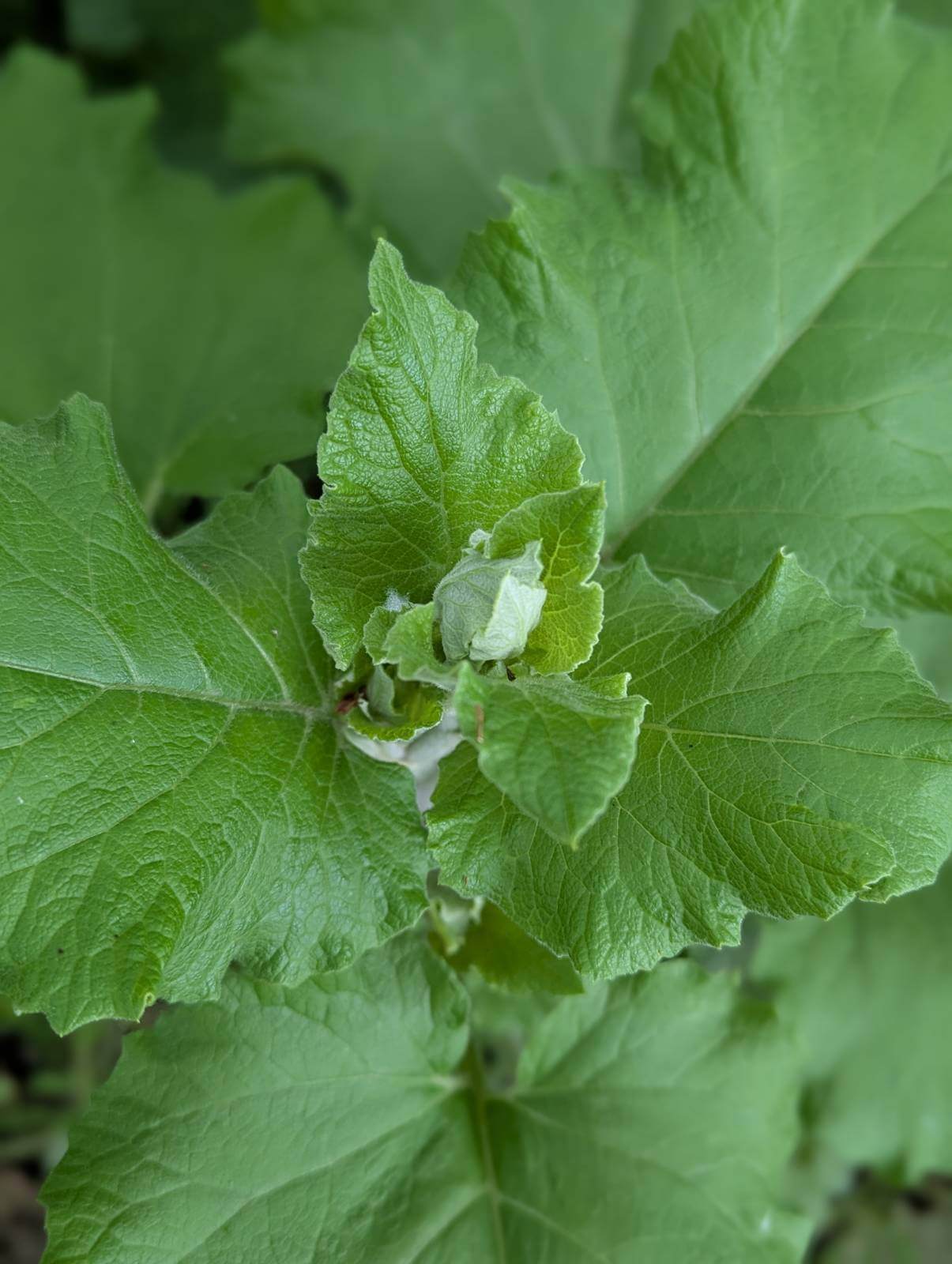
Astroherbal Dispatch: Jupiter in Leo (Burdock)
Astroherbal dispatch for Jupiter in Leo.
Read series intro here.
by Hat Fidkin
17th June 2026
Greetings Plantfolk near and far,
2026 is a year of a lot of planets in air and fire signs. Neptune and Saturn are in Aries (a fire sign), Uranus is in Gemini (an air sign), and Pluto is in Aquarius (an air sign). Jupiter, the great benefic, has been in their sign of exaltation, gentle and nurturing Cancer (a water sign), for the first half of this year,1 which transit has been somewhat calming the fireball of intensity that has been creating heat on both the global and personal scales. But that’s all about to change when they move into Leo (a fire sign) on June 30th.
Fiery Leo is the sign of confidence, creativity, courage and leadership. Jupiter likes being in Leo because they get to be their big, bold and expressive self here quite easily. However, there is a shadow side to this expansive self empowerment; the tyrannical egomania of certain members of the ruling class shows Jupiter and Leo’s darker aspects taken to extremes. So, instead of adding more fire to the proverbial fire, I’ve chosen to explore Jupiter’s energetics and transit into Leo through a seriously Earthy plant ally, to help with rooting back into being whilst things on the home planet heat up.
‘Transits’ are the passage of planets at present, over positions of planets at birth. They are constantly re-entering into relationship with one another, and can be a helpful tool for forecasting what areas of life might become particularly highlighted at any given time.
Everyone is affected by these transits in their own way, depending on their individual birth charts.
I hope this dispatch can be supportive in navigating the forthcoming spicy summer!
Jupiter in Leo
In traditional astrology, Jupiter is known as the planet of luck, abundance, optimism and growth. Seeking insight through knowledge, Jupiter expands in all directions. For this reason, they have an aptitude for perceiving life’s greater patternings. The biggest planet – so big that they almost became a Sun – Jupiter is composed entirely of gas; mostly hydrogen and helium (like the Sun) and possesses a similar yang energy.2 The two celestial bodies work in tandem to bring joy, brightness and optimism to those on Earth.
Jupiter is the traditional ruler of Sagittarius and the ninth house, and Pisces and the twelfth house. With a roughly twelve year long orbit, it spends about twelve to thirteen months in each sign.
Leo is a fire sign, ruled by the Sun. Leo is the lion reclining in the long grass, swishing his mane and relaxing, knowing he’s top of the food chain. Leo energy is ecstatic creative expression; whether alone in your room for the sheer love of it, or in front of a crowd so deeply, so passionately in flow you forget you’re being watched at all; creativity as a prayer; spirit moving through. It’s knowing who you are and being so secure in that, that you’re unashamedly yourself no matter who or what challenges it. Its shadow side is arrogance, boastfulness, and selfishness; the ego getting in the way of receiving constructive feedback, a penchant for drama and pettiness. Leo is a personality-driven sign, and when Jupiter – who also leans towards flights of fancy, and moving with leaps and bounds rather than baby steps – is here, things can start moving quickly, or bursting into flames, for better or for worse.
Jupiter’s journey through Leo can support those who tend towards introversion to discover confidence in sharing their hobbies and passions with the wider world. Perhaps you may discover a newfound bravery in standing up for what you believe in, maybe taking on roles of organising or of grassroots leadership for the first time within your community, expanding your skills beyond yourself to guide and facilitate others. This transit also gives fire to the rise of the egomaniac, unnecessary drama and power struggles. Jupiter’s move from cosy Cancer to full-frontal Leo might feel like a sudden and dramatic one – the crab can tend towards staying in their shell, whereas the lion is rarely shy. I’m hoping that this dispatch’s plant ally can be a gently grounding presence for some of you who might be feeling the overwhelm of this season’s tendency for pushing beyond the comfort zones.
Burdock: Cleansing, Nourishing, Expanding Reach
Jupiter in Leo is well expressed in the giant of the wayside that is Greater Burdock (Arctium lappa). Native to Asia, North Africa and Europe, it is a member of the Asteraceae family (the same family as Sunflowers, Calendula and Daisies) with thick taproots, and big, expansive leaves – the perfect example of a Jupiterian plant. It contains lignans, bitter principles, inulin (a starch), mucilage, sugars, pectin, minerals including sulphur, and organic acids.3
Plants of Jupiter are usually thick, large and stout. They can be aromatic, dispersing their essence through air like the great gas planet (Lemon Balm). They can be yellow and orange (Dandelion), showing their affinity for working on the bile of the body, and thus the liver, small intestine and gallbladder (co-ruled by Leo). They usually have large taproots – up to a length of a metre4 – reaching deep into the Earth whilst still growing and expanding to great heights above ground, demonstrating the lesson of walking a spiritual path with grounded feet.
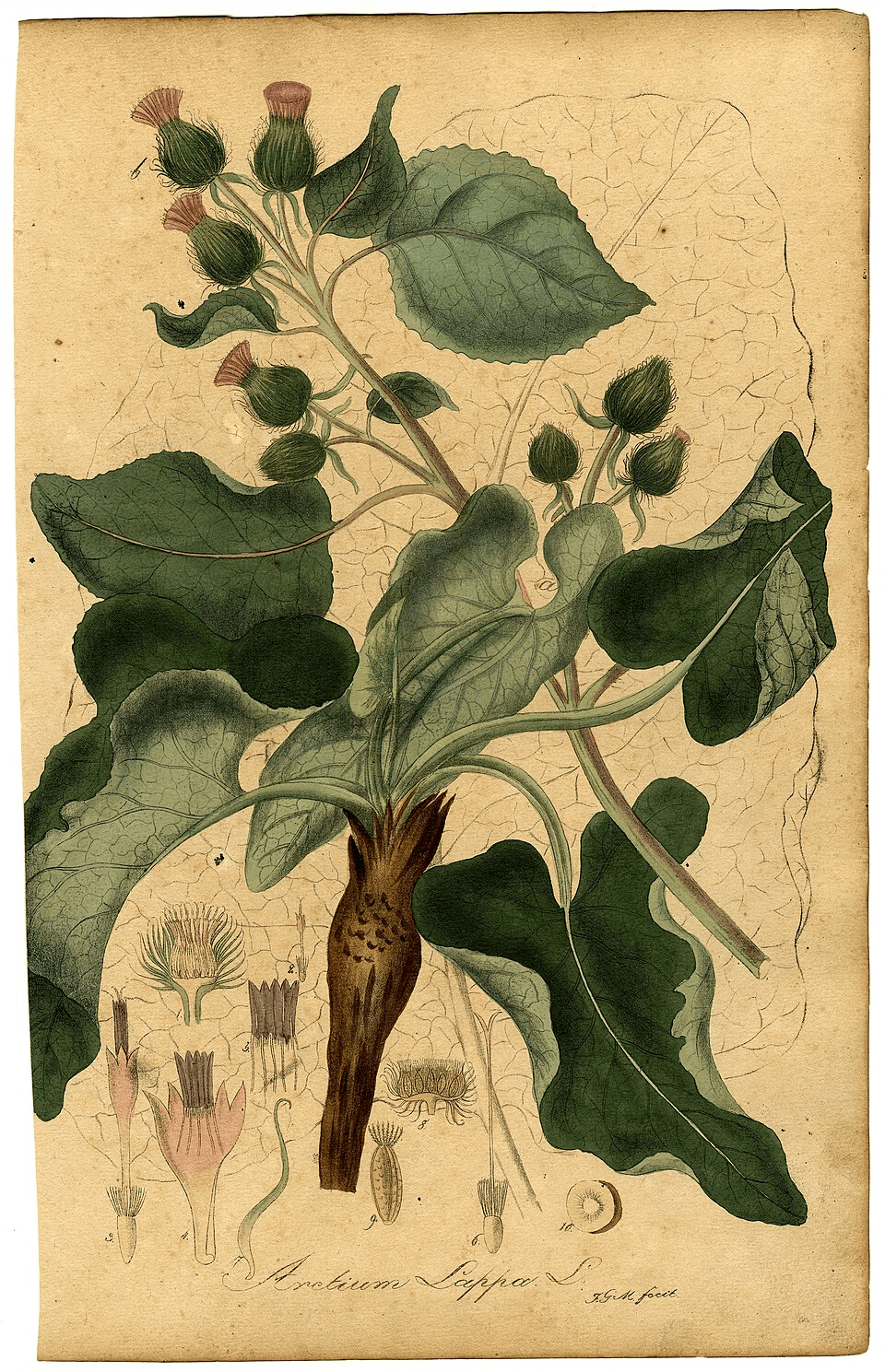
Arctium lappa, Johann Gottlieb Mann, from Deutschlands wildwachsende Arzney-Pflanzen (Germany’s Wild Medicinal Plants), 1828.
Leo is the hottest of signs according to medical astrologer Judith Hill, and with all of this seasonal fieryness in mind, Burdock is an excellent medicine for the fire of inflammation in the body that may be heightened during this time.
Herbalist Matthew Wood indicates the root of Burdock for dry/atrophic conditions, where there is a need for tissue cleansing and increasing bile secretions. Containing both bitter principles and mucilage, Burdock stimulates the digestive tract, promoting better absorption of fats and oils by the small intestine, better gallbladder (co-ruled by Leo) activity and increased oil processing by the liver. One interesting use of Burdock is to help with sugar imbalances; “with a lack of fats and oils, there is reduced anabolism of lipids for the body to use, with wasting and dryness”,5 which can lead to a dependence on quick sugar fixes for nutrition. Burdock can remedy these ‘dry liver’ symptoms, curbing sugar cravings that are harming the body.
When the body is not producing enough oils, which deficiency may be indicated if you tend towards hot and dry, bile secretions are poor. With a shortage of oils in the body, dry, scaly skin conditions can manifest, due to blocked sebaceous glands. I can think of a few friends with a lot of Leo in their charts with chronic eczema, dandruff and/or general dryness, or skin that tends towards irritation. Burdock is a wonderful skin remedy, its alterative actions flushing out toxins from the inside out through its work on the blood. For treatment of skin ailments, naturopathic practitioner Susanne Fischer-Rizzi recommends that “the patient should either drink a cup of Burdock root tea or ingest a pinch of Burdock root powder three times a day. The external application of freshly mashed Burdock leaves enhances the effect.”6
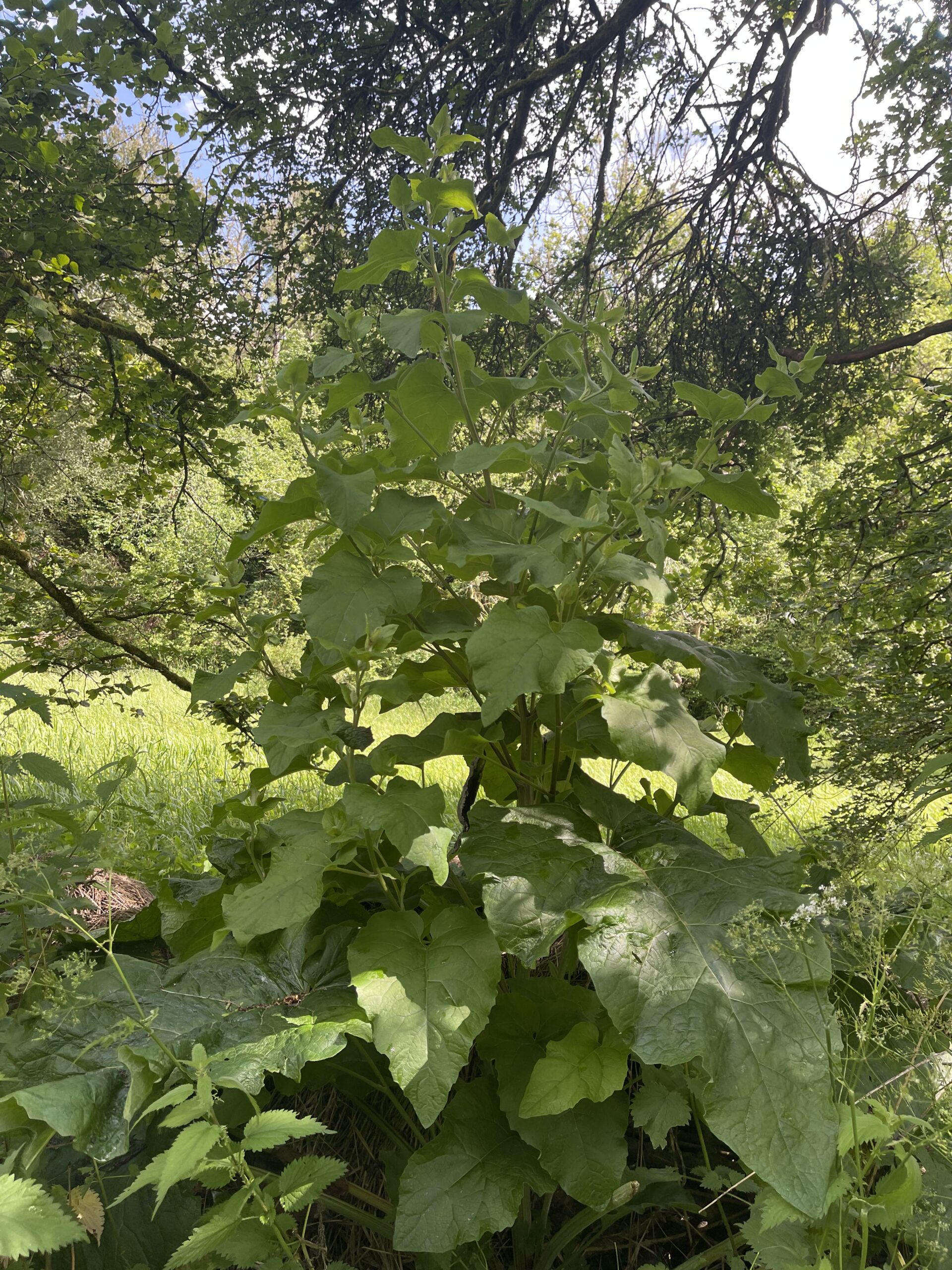
A giant Burdock dancing in the wind in Sapperton, Stroud.
Burdock root’s cleansing properties may be useful to keep with you in spirit as we move through the last few degrees of Jupiter in Cancer – a sign that can sometimes find itself stuck within the confines of familiarity, the home and one’s own shell. Its alterative action can guide towards a clearing out and prepping for the spotlight and stepping-towards of Jupiter in Leo, helping to flush out anything that might be holding you back from fully inhabiting your power, whilst remaining grounded in the process.
Another Jupiterian quality of Burdock is the burrs themselves; the seeds of Burdock that are covered in tiny, hooked hairs, sticking to whatever they touch. The burrs travel great distances by attaching to the fur of animals, expanding the plant’s reach far and wide, thus expressing the traveller archetype of Jupiter. They can teach us to grab onto what we want; the specific name lappa is derived from the Latin word meaning ‘to seize’, whilst Arctium, is derived from the Greek arktos or ‘bear’ (αρκτος), possibly due to the seeds’ hairy, furry appearance.
The burrs of Burdock possess the capacity to aid us in grabbing, or seizing, what it is that we desire; a very important lesson of Jupiter in Leo is the commitment to our own truth, which pushes us towards standing firmly in our integrity, and pursuing our desires, no matter how big or small.
In traditional Anatolian Kilim weaving, a popular motif is the pıtrak (Burdock), used to repel the evil eye and to call in abundance. The motif is often woven onto flour bags, symbolising abundance through nourishment.7 I sometimes forget to nourish my body satisfactorily, getting so absorbed in my plantwork, studies, and creative practice that before I know it, it’s late afternoon and I’m extremely unregulated and even more airy than before. I’ll be using the spirit of Burdock to call in nourishment, so in turn I can show up better to nourish my community.
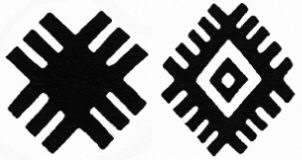
Burdock Kilim Motifs (Turkish: Pitrak). The plant is used to ward off the Evil Eye, and, having many flowers, is a symbol of abundance. Image by Chiswick Chap, CC BY-SA 4.0

Burdock is another exceptional example of the deep essential nourishment that roots and tubers can offer in times of emotional ungroundedness or physical depletion. Eaten extensively throughout Japan, where it is known as gobo (牛蒡, ごぼう), the root is a staple food included in many popular dishes. Now is not the time to be harvesting your own (autumn or early spring are the points at which Burdock’s energy is in its roots; here’s a harvesting guide), but if you wanted to try making Kinpira Gobo8 sooner, you can usually find them at Asian supermarkets if there’s one near you, as they are cultivated widely in Japan.
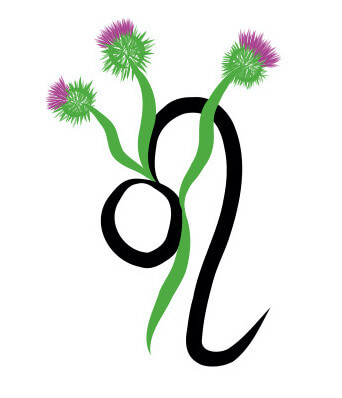
Sticking Together: Joyful Tomfoolery and Defiant Folk Fun
Burdock has several folk names, including Beggar’s Buttons, Bachelor’s Buttons, Love Leaves, Happy Major, Sticklebacks, Sticky Bobs, Sticky Jack, and Velcro Plant – the latter a reference to the fact that the inventor of Velcro sought his inspiration for the fastening from the way that burrs cling to any surface they come in contact with, including each other.9
Another folk name is Philanthropium, from the Greek philantropos, meaning ‘loving humankind’. This is a particular favourite of mine, as it references both Burdock’s literal clingy attachment to humans through its sticky seeds, and its generosity towards humans as both food and a multifaceted medicine. Burdock typically establishes itself close to the places where humans live or pass, along waysides and fences, perhaps to increase its likelihood of sticking. This readiness of the seeds to stick to jackets and jumpers is Burdock’s way of engaging us as vectors for dispersal, and perhaps also of starting a friendship; I like to think of Burdock’s reaching out to grab people as a cheeky way of initiating multispecies closeness and companionship. The sign of Leo is a generous one, giving not to receive anything in return, but for the love of giving itself, to build relationships based on kindness and genuineness. The stereotype of Leos ‘needing to be seen’ is also very Burdock; what can be misinterpreted as social dominance is often just a Leonian friendliness and a desire to be liked for who they are.
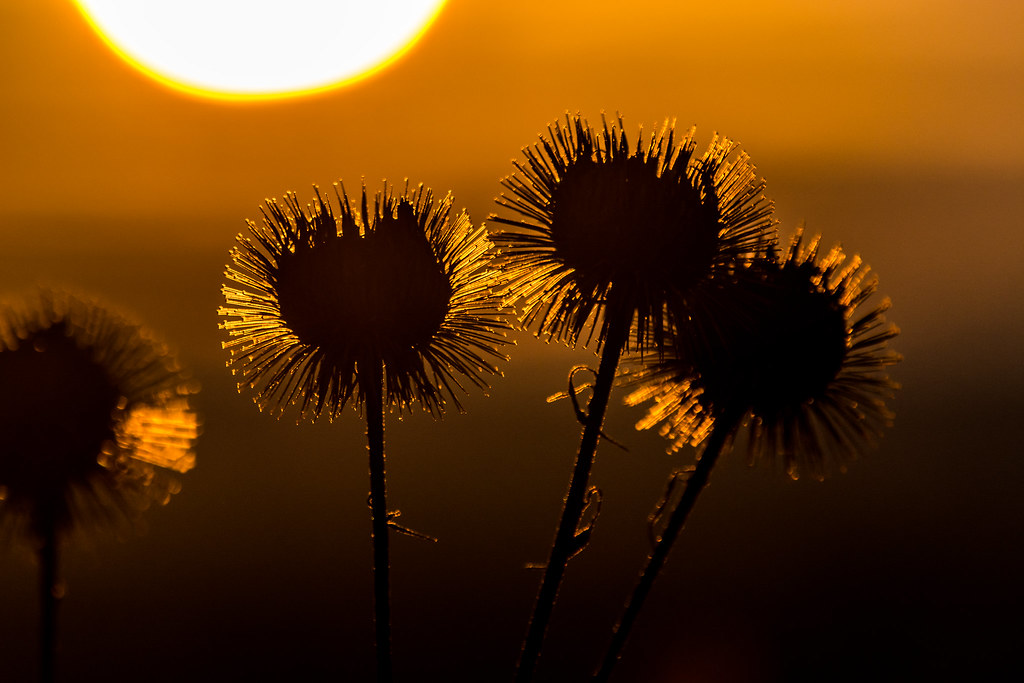
Burdock burrs looking like little lions’ manes under the Sun. ‘Burdock Sunrise’ by J. P Mann.
In Gaelic Names of Plants (Scottish and Irish), John Cameron shares some more lovely folk names, like suirichean suirich, ‘the foolish wooer’ (suiriche, a fool; suirich, a lover or wooer); seircean suirich, ‘affectionate wooer’ (seirc, affection), again alluding to Burdock’s flirtations with people through its clumsy stickiness. Other names include Mac-an-dogha, ‘the mischievous plant’ (mac-an for meacan, a plant ; doghadh, mischievous). Meacan-tobhach-dubh, ‘the plant that seizes’ (tobhach, wrestling, seizing, inducing; dubh, black, or large).10
Burdock certainly is a mischievous plant, associated with fun and silliness in folklore of these lands. The Piskies/Pixies of Cornwall are said to “amuse themselves at night by riding colts furiously around the fields by plaiting their manes, or tangling them with the ‘Billy Buttons’ of the Burdock”.11 Similar to Cleavers (Goose Grass, Sticky Willy), Burdock burrs were used in stealth games of sticking the seeds to the backs of an unsuspecting person without their noticing. In Lancashire, a slightly more elaborate version of the game involved making larger balls of burrs by sticking them together, and then covering yourself and your mates in them. The cling of the burrs is so strong they would “pull a jumper to shreds”, much to the annoyance of parents whose children who partook in Burdock tomfoolery!12
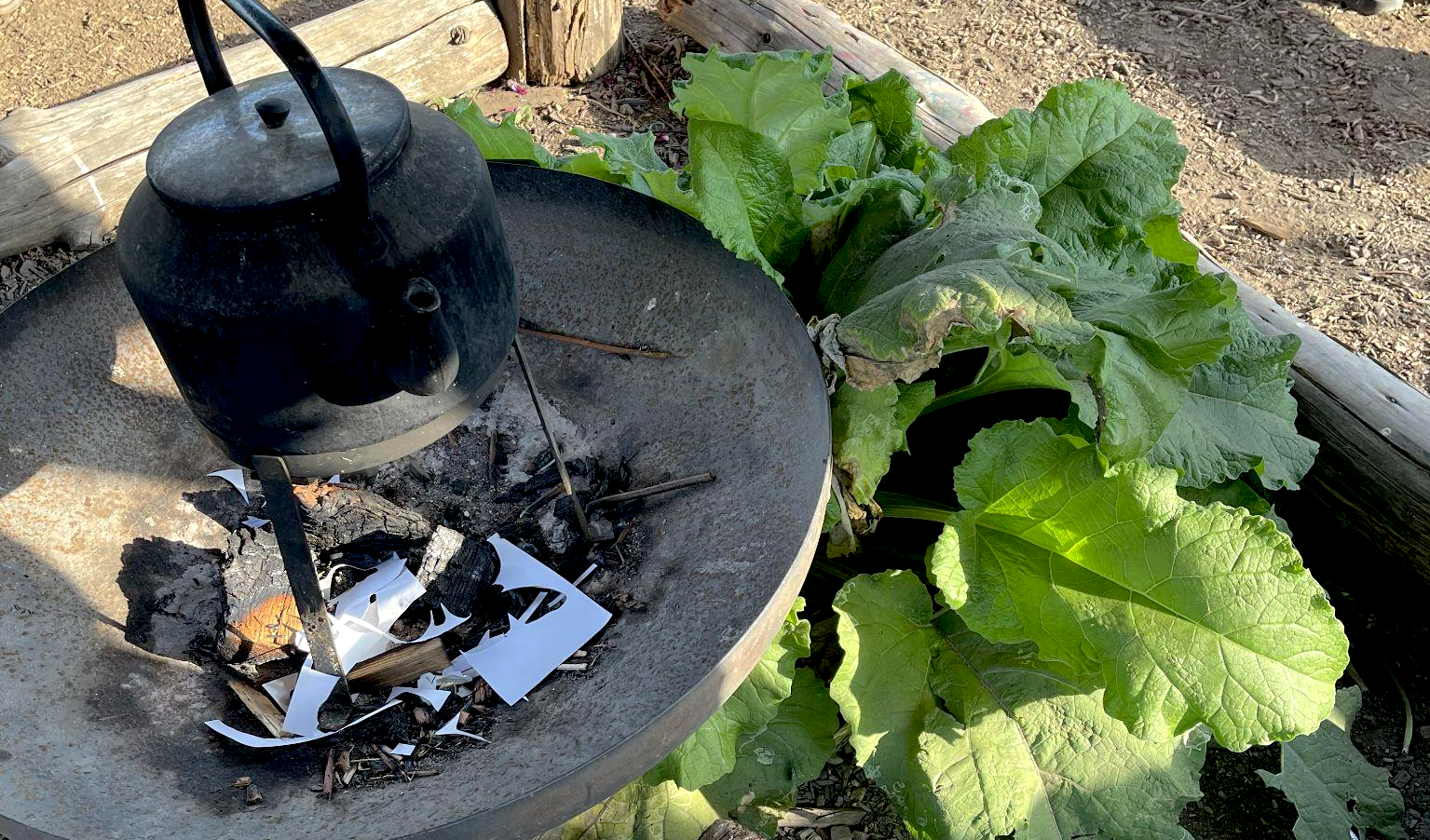
A lovely Burdock growing next to the fire where I sing with the folk choir I’ve recently joined! I love that it is such a part of the music we make together.
I’ve been somewhat impatient to tell you all of the next fun Burdock tradition, which is perhaps one of the most elaborate (documented) plant-based rituals of these lands remaining, its origins unknown. The Burryman is maybe the most hilariously Jupiterian archetype I’ve ever come across. Some cite Santa Claus as the ultimate Jupiterian character (jovial, chubby, spreading good cheer, loves mince pies and sherry,13 travels around the world doing good, etc.), but I think the Burryman rivals even Father Christmas himself.
At nine o’clock in the morning, on the second Friday of August, in the Scottish town of Queensferry, a man emerges from the Staghead Hotel covered head to toe in Burdock burrs, holding two staves of flowers. Shouts of “Hip hip hooray, it’s the Burryman’s day!” ring out through the streets, and away he goes, enacting a ritual that is over four hundred years old, said to bring luck and prosperity to the town and its people, possibly originating from prayers for a good fishing season, as Queensferry is a harbour town.
The Burryman and his attendants (two either side and a boy in front ringing a bell to announce his arrival; the suit is so hard to walk in he requires support to move) then parade through the town, and the Burryman is lavished with gifts of cash (donated to local charities) and whiskey from every pub he passes. Due to the Burryman’s face being entirely covered with burrs, he has to drink the whiskey through a straw, through a tiny mouth opening in his balaclava, to which the burrs adhere. It takes about nine hours for the Burryman to make it around the whole town, meaning he’s left drunk and delirious by the end.
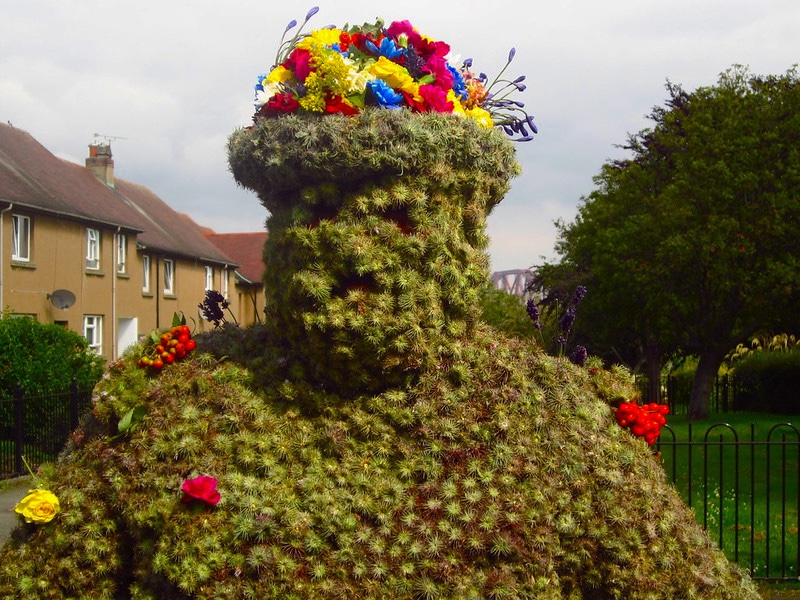
‘The Burryman’, by Angus McDiarmid.
Being the Burryman is no easy feat; the chosen one requires “stamina, a strong bladder, an indifference to the discomfort caused by more penetrative burrs, and a conviction that this ancient custom should not die out”. It’s also required that the Burryman is a “stout man or robust lad”,14 as it’s common for the wearer of the costume to faint from the “heat and fatigue of the dressing”.15 The current Burryman – Andrew Taylor, of South Queensferry council – has been the Burryman since 2012.
The Burryman’s costume is made from over eleven thousand burrs, collected by the Burryman himself and his family and friends. They cling to his tightly-sewn bodysuit with no need for adhesive, and it takes over two hours to attach them and prepare him for his debut. Of the ritual, artist Ben Edge says:
I’ve been quite interested in the idea of it being a kind of activism to come to these things, because we’re not all in tune with the wheel of the year any more. With the need to guarantee good fishing gone, the value of the Burryman lies more in the simple fact that it brings people together. It would be probably really traumatic and upsetting for the town if the Burryman wasn’t to come out one year.16
The Burryman as a defiantly joyful and fun folk custom in the face of capitalistic monoculture feels beautifully aligned with the energetics of Jupiter in Leo; resisting erasure and bringing together community through play and plant lore, which is something I really hope to continue sharing with others through this next year-long Jupiter transit.
In the meantime though, I’ll be noticing Burdock wherever I find it, and continuing my deepening practice of root meditations, in which I meditate on the energy of a particular root, sometimes also holding the physical root whilst connecting to my own root centre (I’ve been working in the imaginal realms with Valerian and Iris root of late, and will be introducing Burdock too!).
I’m also thinking to experiment with gobo in my slow cooker and will be continuing attempting to nourish well and stay grounded through the astrological fireball of this year! May the next twelve months of Jupiter in Leo bring courage, creativity and fun to you, and Burdock as much gentle rootedness as you need throughout it all.
Endnotes
1. Cancer is sign of the home, empathy, care and community. A planet in its sign of exaltation is where it can express itself to the fullest, without struggle or confusion. Jupiter is exalted in Cancer because Cancer loves to nurture, and Jupiter loves expanding. They both love cultivating growth, so their energies dance together joyfully and easefully.
2. The active and dynamic force in Chinese philosophy; warmth, movement, brightness.
4. Susanne Fischer-Rizzi, Complete Earth Medicine Handbook, (New York: Sterling, 2003) pp. 22-28.
5. Matthew Wood, Earthwise Herbal.
6. Susanne Fischer-Rizzi, Complete Earth Medicine.
7. Soumak Boutique, Secret meanings behind Turkish Kilim motifs (August 2025).
8. See here for a recipe.
9. Richard Mabey, Flora Britannica (London: Chatto and Windus, 1998) p. 47.
10. John Cameron, Gaelic Names of Plants (Edinburgh and London: William Blackwood and Sons, 1883), accessed online at Internet Archive 2/6/2026.
11. J.H Davey, Flora of Cornwall, (Penryn: F. Chegwidden, 1909) p. 261.
12. Richard Mabey, Flora Britannica.
13. Jupiter is also associated with gluttony and indulgence, which of course includes food and booze!
14. ‘The Burryman‘ (Extract from Book by W W Fyffe), The Ferry Fair (n.d.).
15. Ralph Jones, ‘My day with the Burryman‘ (August 2024).
16. Ibid.
Hat Fidkin is a student of plants and the stars from the West Midlands, based in Devon. They are a practicing astroherbalist, bringing the plants into their work as an astrologer. You can find out more about their work at datura.uk
Editor: Leo El-Qawas
This was hugely enjoyable to read, as a fellow medical herbalist and student of astrology! Especially loved learning about the burryman!