
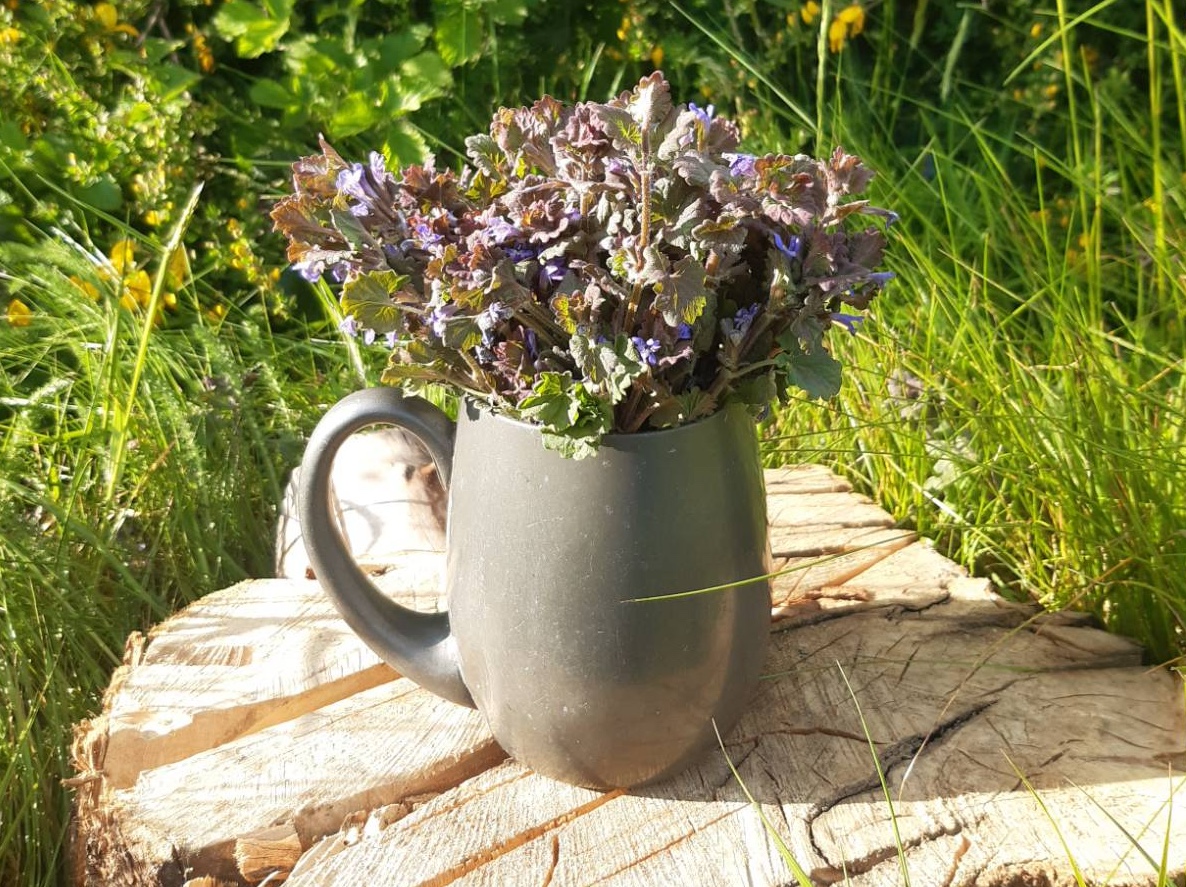
Field Notes: Beltane Ground Ivy Ale
Seasonal observations from herb growing, gathering, medicine making and other landwork.
Brewing a simple herbal ale with Ground Ivy and other foraged plants in celebration of Beltane, plus spring sowings.
by James White
30th April 2026
I t’s the first of May this Friday, and the ale I started off earlier in April is sitting ready in the keg, which resonates like a drum with the pressure of carbonation when knocked.
I’ve been experimenting with herbal ales for a few years now; starting with beer kits to which I added herbs like a big tea, buying huge tubs of malt syrup from organic wholesalers, and making a mess trying to sieve large amounts of malted barley out of hot, sticky beer wort.1
More recently, I’ve settled on a method partly inspired (if I remember correctly – I’ve not been able to relocate the passage) by a description in the novel Harvest by Jim Crace – a work of historical fiction imagining the process of the enclosure of land from the point of view of a rural community in 16th century England. There is a passing mention of one of the women in the village making fairly rough ale at home, using an old barrel with a hole in the bottom as a mash tub, with the barley laid in over a bed of hay.
Of course! Its a simple solution, utilising the materials that are easily to hand. I don’t think there is particular mention of herbs being used in this method in the novel, but its not a giant leap of imagination to think that folks would have chosen to use plant matter that could impart interesting flavours and properties to the wort in the process.
The first ale I attempted in this way was in the height of summer, in anticipation of the Ecotopia bike tour stopping in at the co-op here.2 I had good bundles of dried Mugwort and Hypericum (St. John’s Wort), which worked really well to strain the wort, and gave the finished ale an unfamiliar bitterness and floral taste – quite unlike hops, whose flavour has become inextricably linked with the taste of beer – and an unexpectedly stimulating quality. The five-gallon batch was finished to the dregs over the course of the weekend.
This time, as I was working in early spring, the best plant material I had available for straining the wort was a mixture of spruce branches and downy birch twigs, both of which smell and taste (appropriately for ale) pleasant and bitter and have medicinal and nutritive qualities. Spruce tips are a source of vitamin C, which can be hard to find elsewhere in wild or cultivated plants as early in the year, especially further north. And they smell surprisingly hop-like. Birch twigs (with buds and young leaves) possess anti-inflammatory and diuretic properties, and can be used as a remedy for rheumatism and kidney stones, or externally for skin complaints. They have a musky, spicy smell when warmed or rubbed, reminding me of Bog Myrtle (Myricacea gale) which has also been traditionally used to flavour mead and ale.
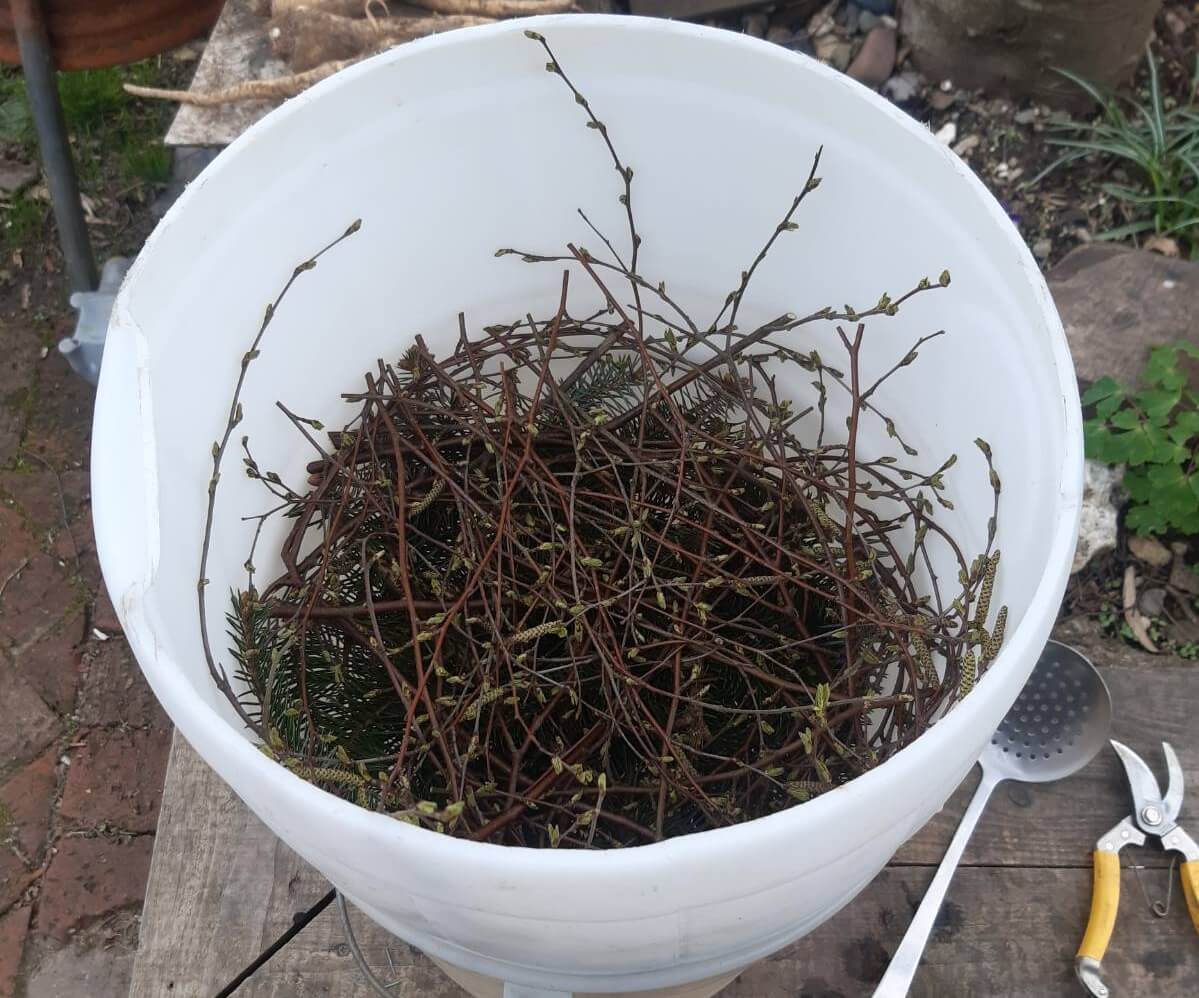
I added a small handful of fresh Ground Ivy on top of this mat of twigs, and then scooped four kilos of crushed pale malt on top. The mash tub sits just on top of a five-gallon brewing bucket, and has an old champagne cork blocking the drain hole that I’ve cut in the bottom.
In goes twelve or so litres of scalding water (70°c if you’re using a thermometer), and I let it sit for an hour or so with a lid on, before pulling the cork to allow the warm wort to flow into the fermenting bucket beneath. I replace the cork and repeat the process, as the mash tub I’m using can only hold half of the five-gallon batch of water when its so packed with herbs and grain.
It’s not the most efficient extraction of sugars from the malt; ideally I’d be doing this on slightly larger scale, the mash then staying at a high temperature for longer, or I’d have a way of heating it throughout the mashing process.3
But it does the job well enough, using what I have, and the chickens finish off the spent grain anyway, so nothing is really wasted.
After the wort has cooled to about body temperature its time to pitch the yeast. I have often used a wild yeast, cultured from elderflowers or the remnants of fruit wines in the summer, kept in a jar with sugar water, a little like sourdough. Unfortunately, I completely neglected my wild yeast starter this winter, and it doesn’t seem lively enough to get the ale started reliably. It’s important that the yeast starts working in the wort fairly quickly, as this first stage is vulnerable to other less desirable microorganisms.
So I tear open a packet of dried ale yeast. I’ll be curious to see how much of a difference this makes to the finished product; this method, which does not involve boiling the wort (as is done without fail in modern brewing) and relying on a mix of wild microbes, usually results in an ale that develops some sour notes in its flavour – again somewhat like sourdough. Boiling denatures enzymes from the malt that would continue to break down starches and unfermented sugars, and some of the yeasts in the wild culture make lactic acid during fermentation.
After about ten days of initial fermentation the ale is drinkable, but best racked off into bottles or a cask for conditioning – a slower secondary fermentation and maturation which happens in a sealed container, often with the addition of extra fermentable sugars. The finished ‘conditioned’ ale will be carbonated by the activity of the yeast converting the spare sugars into a bit more alcohol. The addition of sugars to achieve carbonation is delicate. Too little and you will have flat beer; too much and you’ll be pouring pints of foam or losing the whole bottle’s worth all over the ceiling when you open it.
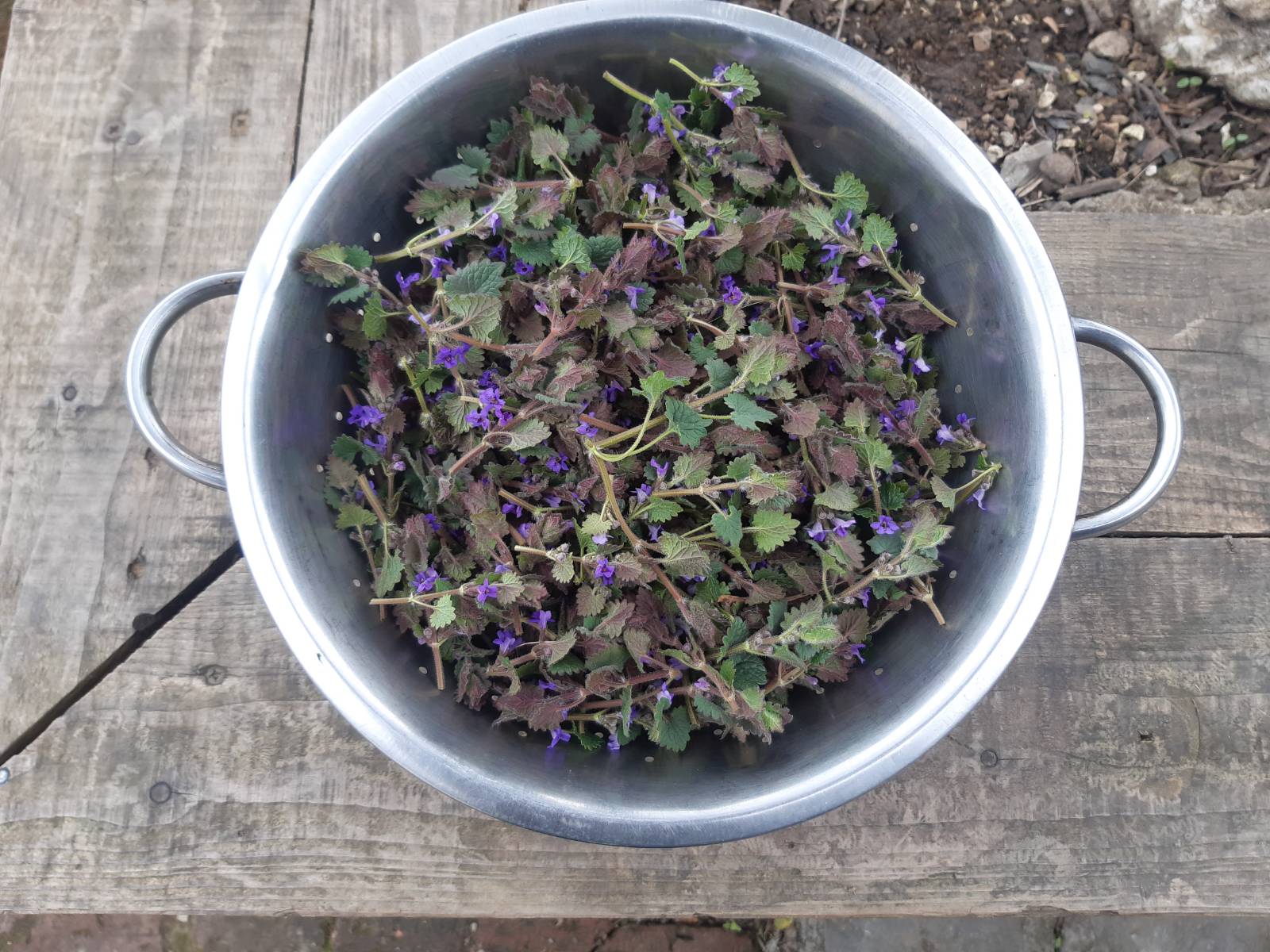
Throwing caution to the wind, I poured in a whole pound jar of local honey, followed by a net bag full of dried Ground Ivy, and sealed the lid tightly. Once the ale has conditioned for at least two weeks, but preferably a month, it should be lively and wholesome and ready to enjoy.
I’ve been harvesting, growing, drying, making tea with, brewing, tincturing, and just generally loving Ground Ivy ever since I first met it under a hedge where I should have been picking up rubbish. While starting to think about this article, I was sent this quote from the introductory pages of Wayside Medicine by Julie Bruton-Seal and Matthew Seal, accompanied by an image of the plant:
country people heretofore did often use [ground ivy, above] to tun it up with their drink […] but this age forsakes all old things, though never so good, and embraceth all kind of novelties whatsoever; but the time will come, that the fopperies of the present time shall be slighted, and the true and honest prescriptions of the ancients come in request again.4
– William Coles, 1656 (!)
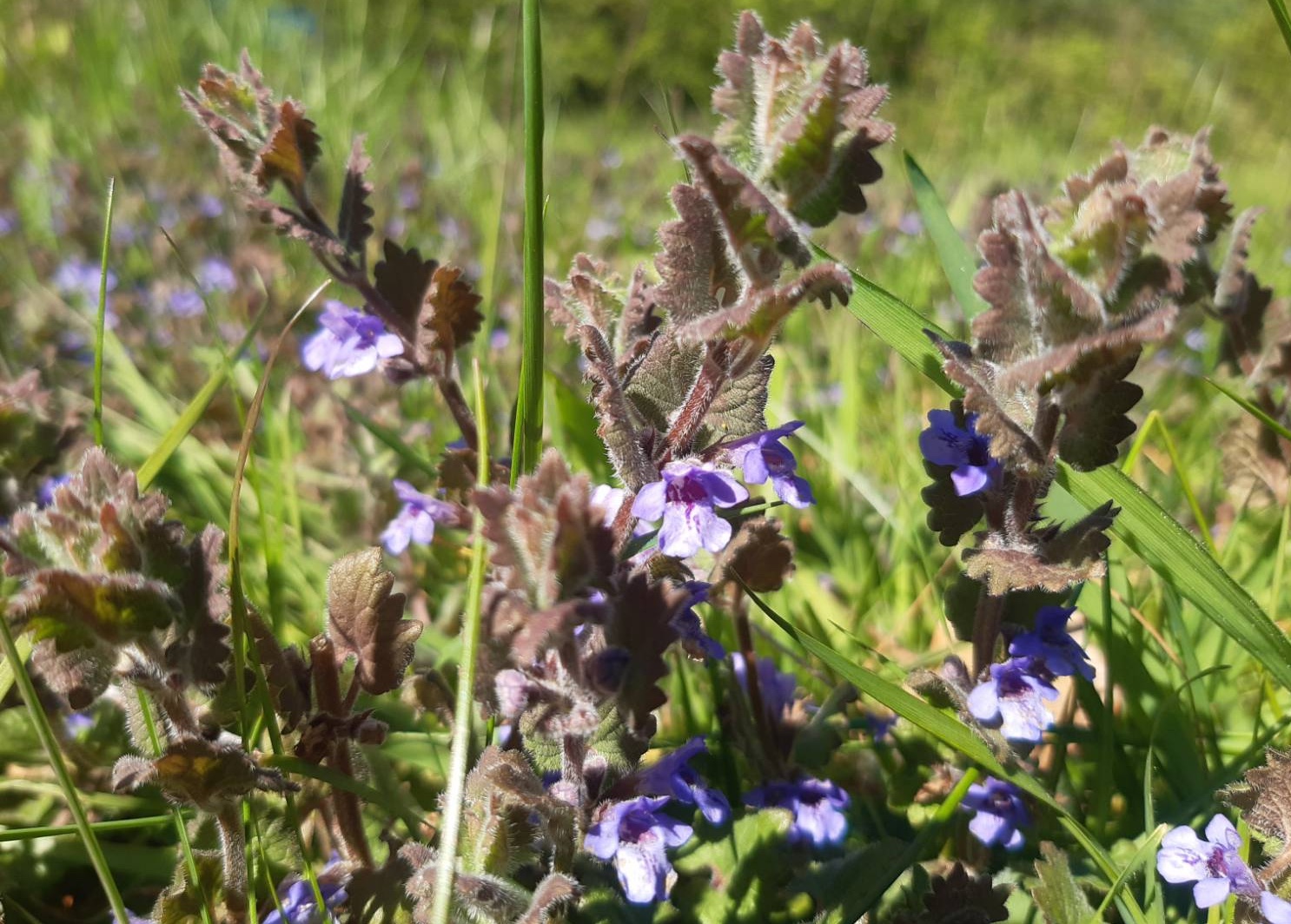
I already raved about Ground Ivy in the previous article, but this month it’s in full bloom, and to be honest its the main plant I’ve been working with in terms of harvesting and processing these last few weeks. It’s Ground Ivy that first got me interested in herbal ale, as I noticed that many of its names refer to brewing:
[…] other names reflect its long period of use, from the Anglo Saxons to the Tudors, as the main bitter herb for brewing and clarifying ale. It was alehoof (hoof meaning herb), tunhoof, (tun meaning the verb to brew, or the cask itself), while from the French ‘Guiller’ (to brew) it became Gill.5
Julie and Matthew in this book refer to ground ivy as a “clarifying herb”; its uses in folk medicine having included clearing congested airways, “removing bad humours from the head”, treating tinnitus, sinusitis and tuberculosis, and even being a tonic for the kidneys. Although it has somewhat fallen out of favour in modern herbalism, I find that it is the remedy I most often turn to for many common respiratory illnesses, having properties that reach beyond symptomatic relief (it was among the handful of easily accessible herbs that went into a mixture as an attempt by friends of mine to replace some of the imported ingredients in a covid treatment protocol early on in 2020, contributing kidney supportive and anti-inflammatory properties alongside clearing the airways ), whilst being gentle enough that I feel confident to take it and recommend it fairly freely. And it makes a lovely tea, especially paired with mint and/or licorice. Another recipe I’m yet to try with it, I think gleaned from Maud Grieve’s Modern Herbal, is to steep it with licorice in white wine, and take it by the glassful.
Besides getting the ale ready, I haven’t been able to give as much time as I would have liked this month to sowing seeds of medicinal herbs, planting out the stock of perennials, or other herb work that I’d like to be doing. Catching up on work commitments after a poorly timed injury, getting on with the plantings for this year’s vegetable garden alongside the folks I live with, and generally keeping on top of all of the maintenance of the co-operative living project, has been fairly full time.
Fortunately, the plantings I’ve done in various places over the years, increasing foraging opportunities for herbs on the land, are providing enough to be harvesting and working with, and are beginning to propagate themselves (in more or less convenient places). Calendula has reappeared amongst the salads, St John’s Wort has seeded itself into hedgerows and pathways, and Oregano is making its way down the field into the top of the veg beds. My early sowing of Tulsi sadly didn’t come to anything; the unseasonable warmth broke for a few weeks of cold winds. I did think it was a little early.
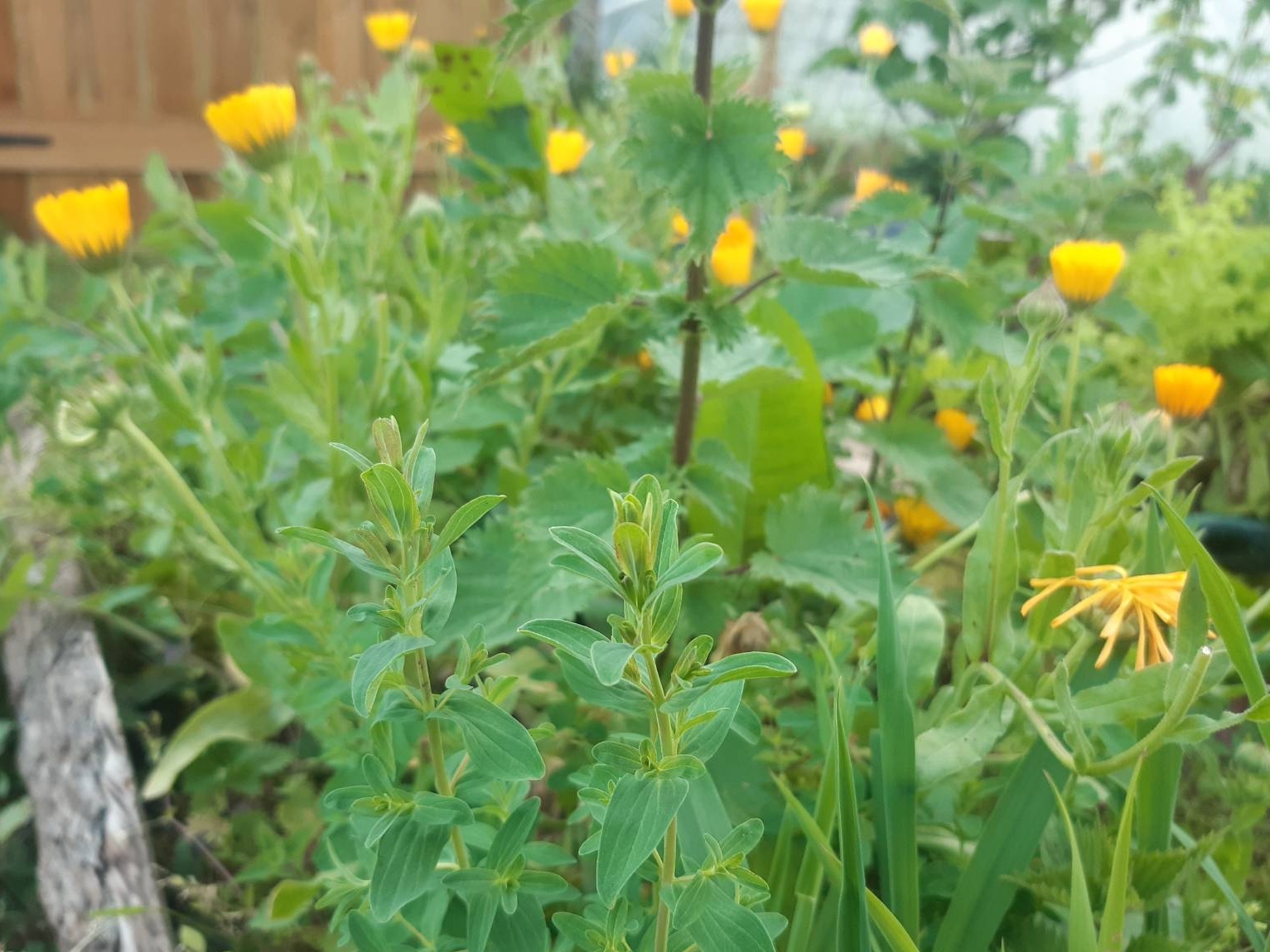
As I write, it’s approaching the full moon, and this week I’m trying to make the most of what feels like the best time to be sowing seeds for this year. I’ve noticed a few years running now that seeds sown before the full moon around Beltane seem to germinate faster and grow better than ones sown afterwards; this learned by mostly missing the date and watching other more organised gardeners have earlier and greater success with their sowings.
So I’ve had another go at Tulsi this week, alongside trays of Artemesia verlotiorum (‘Chinese Mugwort’) and – many years later than I would have liked – Caraway, Jerusalem Sage, Angelica archangelica and Woad; these last four sent to me by a friend while she was working in a medicine garden (if you’re reading this, I’m sorry it took me so long!). I don’t have high hopes for the germination rate after three years, but better late than never. I may be surprised. These herb sowings are accompanied by half a big tray of Swede, which I hope will be ready to follow the early Potatoes when they are dug in June.
Endnotes
1. While reading for more inspiration on traditional/prehistoric brewing practices, I learned of the still living brewing tradition of Sahti in Finland, with similar practices in other Nordic countries. Sahti is a raw herbal ale that is repeatedly strained through a wooden trough packed with juniper branches, after a period of mashing the grain in water that is kept hot by adding rocks from the fire. See this article for more information.
2. ‘Wort’ is the word for the unfermented liquid that will become ale or beer – a concoction of malt sugars and herbs, these days almost exclusively hops. It is interesting to note that it shares a name with the Old English word for ‘useful plant’ (and indeed this journal), which leads me to wonder if, in the long history of brewing, the most commonly recognised important property of this wonderful liquid was its content of medicinal herbs)?
3. Ecotopia is an autonomous collectively organised bike tour that happens yearly in Europe, visiting environmental and social projects and practicing forms of activism and sustainable living. See: www.ecotopiabiketour.net
4. Julie Bruton-Seal and Matthew Seal, Wayside Medicine: Forgotten Plants and How to Use Them (Merlin Unwin: 2017), vi.
5. Julie Bruton Seal and Matthew Seal, Wayside Medicine, p.92.
James White is a subsistence farmer and hedge herbalist living in a co-operative smallholding. He grows herbs and makes remedies to share within his community.