
Field Notes: Midsummer
Seasonal observations from herb growing, gathering, medicine making and other landwork.
Harvesting Wood Betony in leaf for fermented tea and untangling the received wisdom of its European lineage.
by James White
20th June 2026
In the weeks leading up to midsummer, it can feel like a rush to get everything done at once; the light has quickly returned, and with it drier (hah) warmer days.
Finally all the jobs that were put off while it was raining sideways feel possible again, while at the same time gardens erupt with crops and weeds, and need more tending than we have time for.
Much of my gardening time is taken up with the collective food growing, and the hundred or so squash plants I sowed in April are now planted in their patch of the rotation.
Weeding the potatoes is endless and a little disheartening this year, as they took a late frost and were knocked back just as the annual weeds were germinating. The rows are a tangle of Fat Hen, Ragwort and Hemp-Nettle, and I’m impressed at the determination some of my housemates have shown in sorting it out.
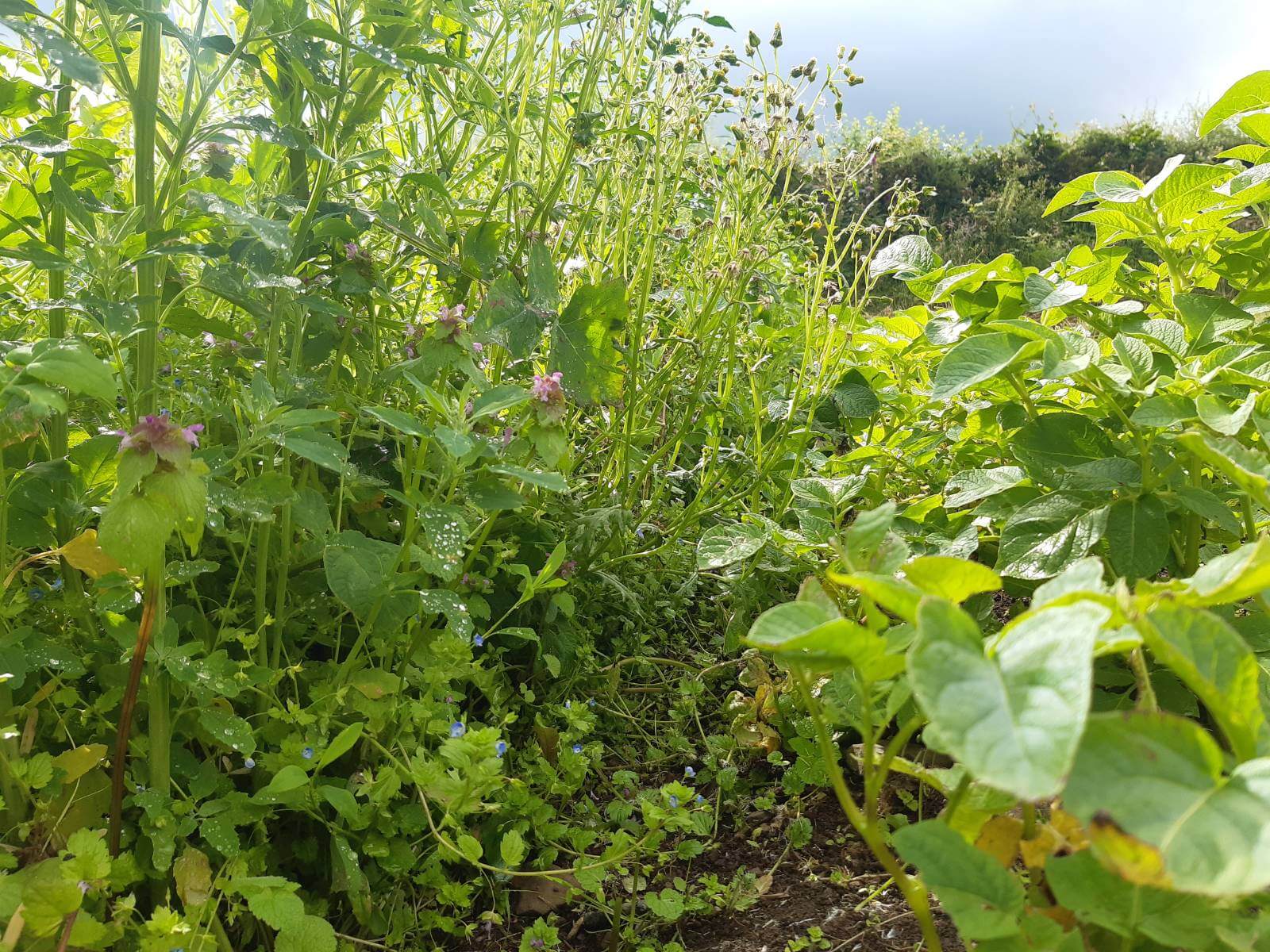
(Common Hemp-Nettle, Galeopsis tetrahit, is a weed that I’ve only recently identified for myself, and I feel I’ve been missing out this whole time! Another Lamiaceae friend with a wealth of medicinal properties to learn about. The Fat Hen we also eat as an early green vegetable, but we let it go to seed a bit too much last year and now it is a problem! We weed it out and feed it to the hens).
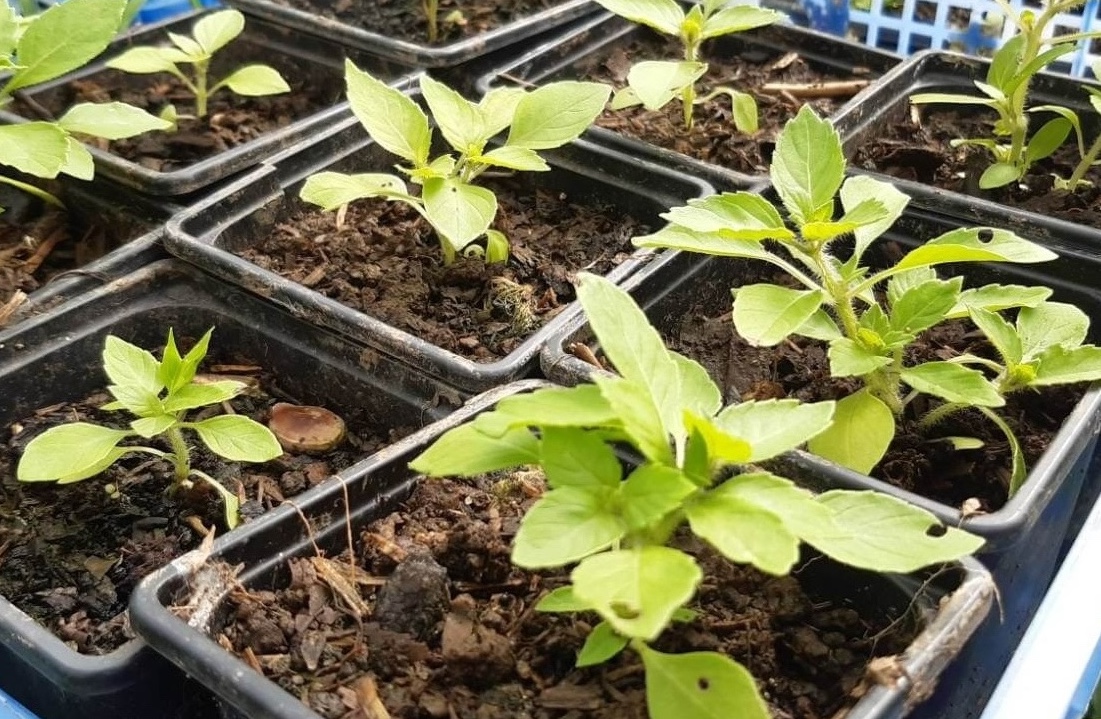
And finally, in late May, some Tulsi seeds began to germinate! I’ve potted on the biggest, and will try my best to keep them safe. I’m thinking that they are unlikely to produce a lot of foliage in the short growing season, especially if it continues to be so damp and mild, and I may try again to keep them alive through the winter, perhaps this time with some grow lights. A head start would do them good for next year.
The accelerating wave will break, however, and I’ll remember that midsummer is earlier in the growing year than it appears to be. The land is abundant now; I pick my tea fresh in the evening. Mint, Lemonbalm, Meadowsweet. There are handfuls of Calendula flowers to scatter over salads. Our store crops and dried herbs from last year mostly ran out about a month ago, and whilst there aren’t yet substantial harvests of roots and beans and such, there’s more fresh salad and herbs than you could shake a stick at.
In these still-lengthening days, it can be hard to remember the value of a store of dried herbs for tea and medicine in the darkness of winter. But I’ve put away a two-litre jar packed with dried Ground Ivy from last month’s harvesting, and I intend to do the same with the Mint and Oregano in the next month or so, just as it begins to flower. I like the extra aromatics that come with harvesting these Lamiaceae-family herbs in flower, particularly the Peppermint, which has some of the aroma of pink grapefruits becoming really prominent after a few days hanging to dry.1 I think they keep more interesting flavour after drying, and I imagine – though without proof or reference – that they are more potent medicine for it too.
Others to put away for teas will be: Hypericum, Ladies Mantle, Lemonbalm, Nettle, Tulsi, and Betony (Wood Betony, Betonica officinalis/Stachys officinalis).
Betony was classified as Betonica officinalis (by Linnaeus) in the 18th century, and has been referred to in Latin and its related languages as Vettonica, Bettonica, Betonie and variations thereon. A common name for it in Gaelic is Lus Beathaig; Lus meaning plant, Beathaig, rooted in the word for life, ‘beatha’.2 It is commonly asserted that the Latin name ‘Vettonica’ was inspired by a Celtic people, the Vettones, but I wonder if the Gaelic also hints at the possibility of the Latin name being drawn from the language of these ancient inhabitants of the Iberian Peninsula?
Betony was later subsumed into the genus Stachys, alongside Hedge and Marsh Woundwort, (S. sylvatica and S. palustris) but very recently has been re-instated in its original genus, Betonica.
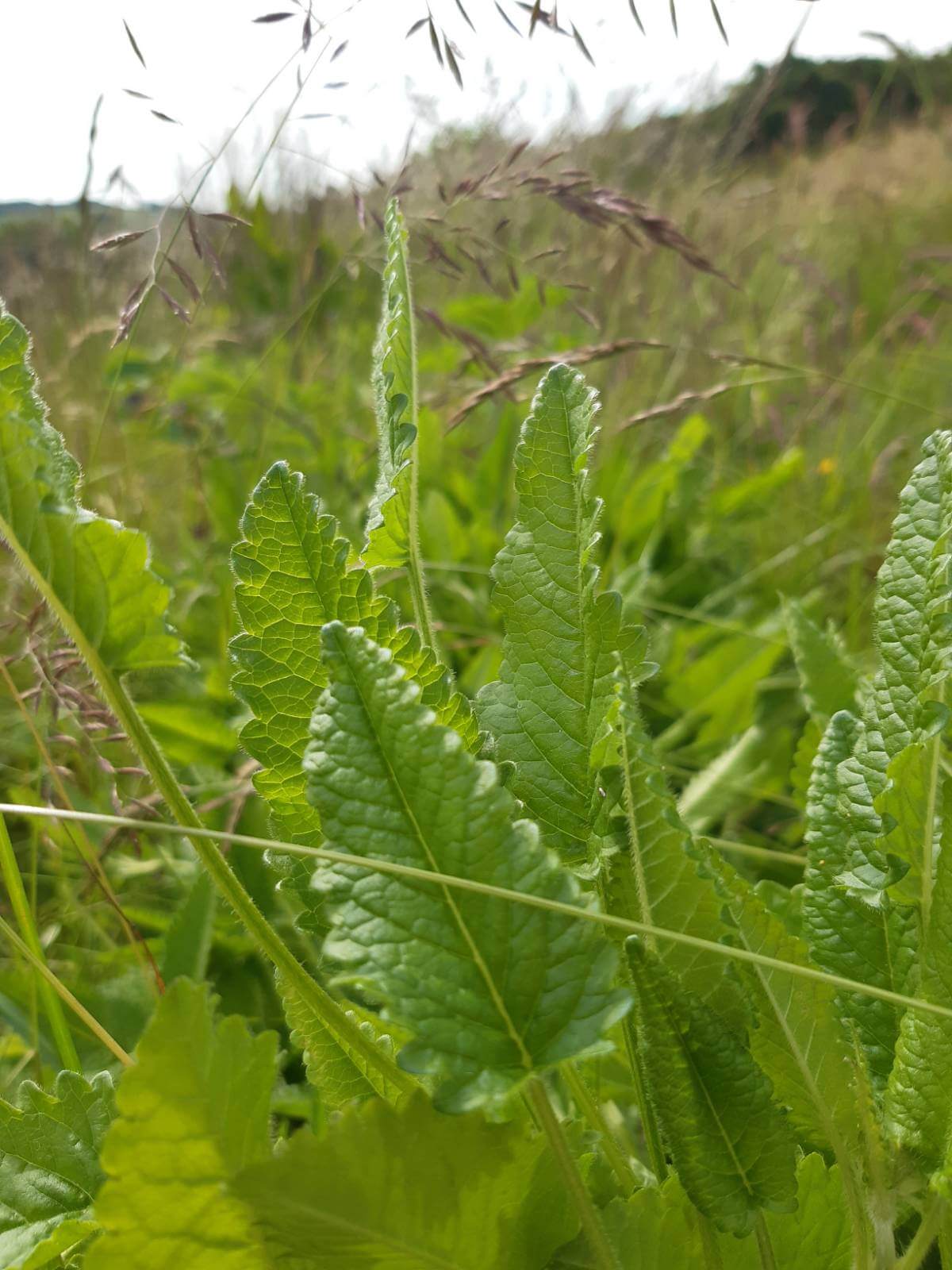
It has an odd growth habit amongst the Lamiaceae family, in that its form more closely resembles that of something like Dock, Sorrel, or Comfrey. Dense clumps of leaves grow, each on a single heart-shaped cross section stem rising from the rootstock. Separate flowering stems rise from late June, more clearly showing the familiar traits of Lamiaceae: square stem, opposing pairs of leaves (being miniature forms of the main growth), and spiky ‘ear of corn’ like flower clusters. The clusters are more compact and close in to the stem than on Stachys sylvatica or palustris, for example, but the overall structure bears resemblance. Oddly, the flower clusters repeat at intervals up the stem, terminating in a single, longer cluster.
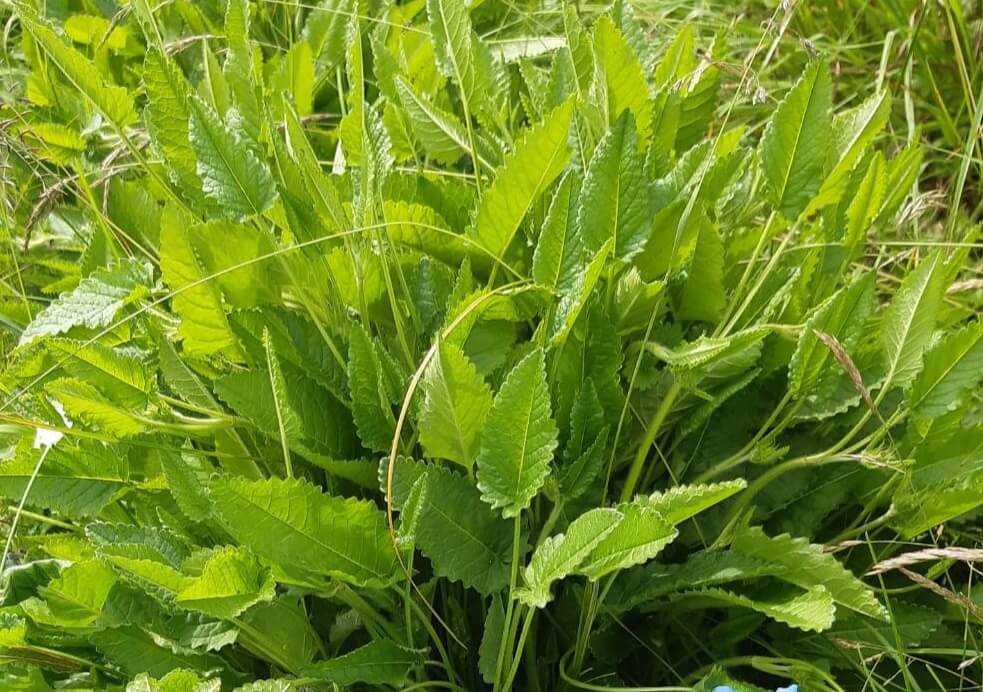
While I am delaying the harvest of most of the other herbs that I’d like to gather until flowering, this difference in Betony’s growth habit lends itself towards an earlier crop, being most valuable in this first accelerated half of the summer, when the rising light encourages green growth.
I have found the leaves of Betony to be cooling, bitter, somewhat astringent, and slightly aromatic.3 There is something reminiscent of cucumber in its flavour, and a faint menthol edge to its coolness. The bitterness is similar to that of Skullcap, but tempered by the other properties so as not to be overwhelming.
In harvesting predominantly leaves, early in the summer, I am going against the advice cited by Maud Grieve in A Modern Herbal, in which she quotes from ‘Apelius’ (the purported author of a popular 4th Century herbal – Herbarium Apuleii Platonici – later rewritten by Anglo-Saxon scholars as ‘The Old English Herbarium’):
it is good whether for a man’s soul or for his body; it shields him against visions and dreams, and the wort is very wholesome, and thus thou shalt gather it, in the month of august without the use of iron; and when thou hast gathered it, shake the mold till nought of it cleave thereon, and then dry it in the shade very thouroughly, and with its root altogether reduce it to dust: then use it and take of it when thou needst.4
I wouldn’t be so keen on digging up the whole plant when I have so rarely found it growing wild, and have since struggled to germinate it reliably from seed, but in any case the old literature also shows that the roots of Betony have an emetic action when taken internally:
Dalechamps and Bauhin emphasize how different the powers of the leaves and flowers are from those of the root: the root is unpleasant in the mouth and stomach, causing nausea, rumbling and vomiting, whereas the leaves are aromatic with a grateful, strengthening smell, and as food and medicine it is a friend of nature. Dioscorides concurs: the root of betony, drunk with honey water, provokes emesis and is employed only to void phlegm from the stomach.5
Anyway back to these leaves.
My first harvest of Betony after planting out these rootstocks some years ago, I dried slowly and a bit carelessly, in a rough pile that I would toss around every so often. The result was something I’ve since been unable to replicate; the leaves darkened almost to black, but still highlighted with deep green on the veins and ridges, and took on a sweet smell like dried apricots, tea or tobacco.
As an infusion, they retained their cooling and bitter properties, but deepened with an earthy sweetness developed in the careless drying. Again contrary to most recommendations to dry Betony as quickly as possible, I am now attempting to deliberately recreate, or improve on the dark dried leaf from that first harvest. I had accidentally dry-fermented them, similar to the process of turning raw green Camelia sinensis leaves into black tea.6
I’ve remembered the bones of the process from being told about it sometime, and have also referenced a few methods found online. I’m sure there’s much art to it, especially in black tea, but a rough method suits me for now.
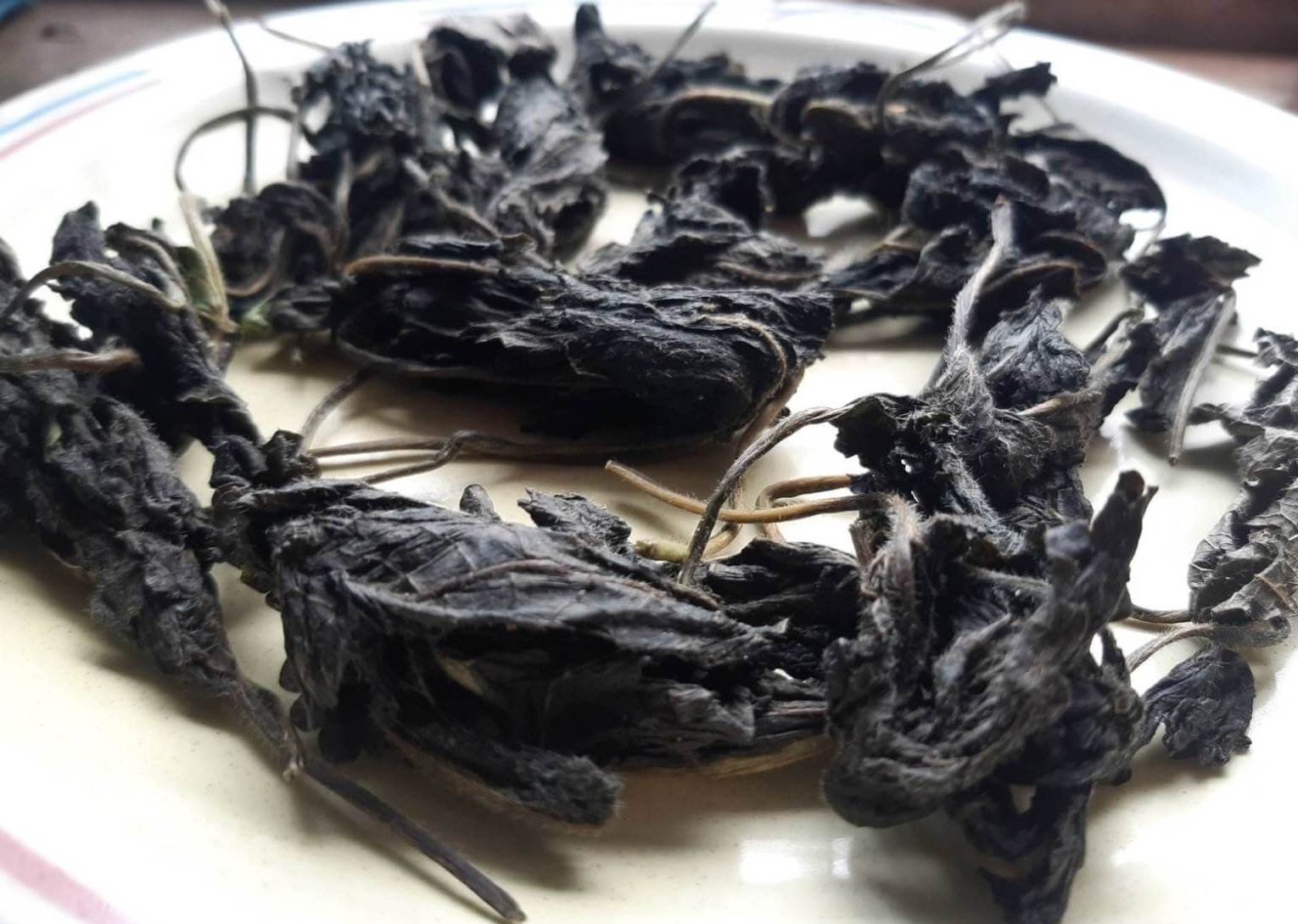
Simply, wilt the leaves in a rough pile for a day or two. Then squash them by rolling a small handful at a time into a bundle or a ball between your hands, to break open cell walls and release moisture. Leave these bundles covered in a bowl for a few days, checking and turning, and once you feel they’ve changed in a pleasing way, dry them quickly to preserve the flavour.
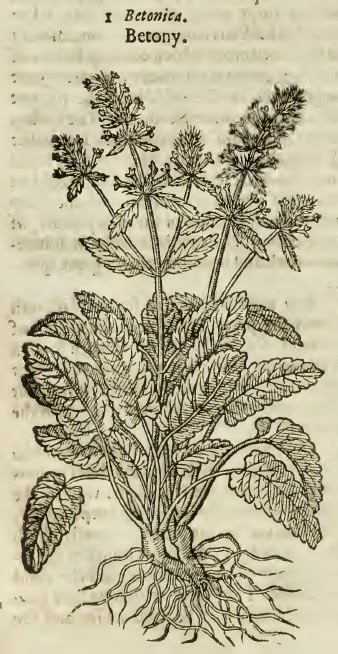
In John Gerard’s Herball, the many and strange virtues of Betony range from its being “a remedy against the bitings of mad dogs and venomous serpents[…] and most singular against poison” (a favourite ancient usage) to that “it maketh a man to piss well”, perfectly illustrating the breadth of application attributed to this plant, appreciated by village herbalists and classical physicians alike.7
A botanical illustration of Betony from John Gerard’s The Herball, or, Generall historie of plantes, published 1597.
Indeed, in his poem ‘The Poor Phytologist, or the Author Gathering Herbs’, eighteenth century itinerant poet James Chambers references this breadth of usage both in application and across social class:
Woodbetony is in its prime in May,
In June and July does its bloom display,
A fine bright red does this grand plant adorn,
To gather it for drink I think no scorn,
I’ll make a conserve of its fragrant flow’rs,
Its spicy flavour in cold gelid hours,
Will help the stomach when we loath our meat,
And will a pleasing appetite create;
Cephalick virtues in this herb remain,
To chace each dire disorder from the brain,
Delirious persons here a cure may find,
To stem the phrensy, and to calm the mind,
All authors own Woodbetony is good,
‘Tis king o’er all the herbs that deck the wood;
A king’s physician erst such notice took,
Of this, he on its virtues wrote a book.8
The book in question is De Herba Vettonica, a treatise detailing the power of Betony to cure forty-seven different diseases, published under the name of Antonius Musa – the physician to the Emperor Augustus (63 BC to 14 AD) – but now thought to have in fact been written at a later date by a different anonymous author.9 In fact it was this text that also formed the basis for the entry on Betony in the Herbarium Apuleii Platonici – also likely written by a less famous author and attributed to Apuleius for traction. This text and its uptake in different forms likely informed much of its reputation and usage by literate herbalists in Europe for the next two millennia.
Although these old and dubious sources are no longer copied as gospel, Betony still finds high favour within the contemporary materia medica, particularly as a gently relaxing and restorative nervine with an affinity for the liver.10 It continues to have a surprisingly wide range of applications, which may remind us of the deep and interconnected processes of our body systems, and their healing. From migraines to poor digestion, liver disease, high blood pressure, wound healing, kidney stones and gum disease, I would be inclined to take seriously its long history of varied use and continue to have it to hand, to “take of it when thou needst”.
I’m hoping that fermentation for flavour can work without lessening the medicinal value of the plant too much.
Once I reckon that these little rolled bundles of leaves are far gone enough, I’ll shred them with a sharp knife, and tease out the strands into a stack of trays in the windowsill to dry quickly. That’ll be one more jar of tea herbs to see us through the winter. Betony leaf, even in it’s simpler dried or fresh form, makes a good earthy base for many herbal tea blends. It’s very well complimented by others in the mint family, providing a grounding, wholesome bitterness for the other more extroverted herbs to shine.
I often include it in my evening tea for its use as a mouthwash, for relaxing and cooling after heavy work, and as a digestive tonic. But I’m sure many others could find plenty of good reasons to use Betony, and would benefit from doing so.
Endnotes
1. I don’t know if this is a characteristic of all peppermints; this particular mint that has taken over a corner of the front garden here may be a unique hybrid, or an unusual result of seed produced from a true Mentha x piperita. It’s leaves are unusually elongated and serrated.
2. Mary Beith, Healing Threads (Edinburgh: Birlinn, 2018).
3. My appraisal of it as cooling is counter to its classification as “hot and dry” by the classical physicians. I’m not sure what to make of this, but this is how it strikes me – and of course there is always a subjective element in the sensory evaluation of herbs, which can show up differently in different people.
4. Maud Grieve, ‘Betony, Wood‘, A Modern Herbal (1931).
5. Graeme Tobyn, Alison Denham, and Margaret Whitelegg, The Western Herbal Tradition: 2000 Years of Medicinal Plant Knowledge (Edinburgh: Churchill Livingstone, 2011).
6. In fact, although the tea industry widely refers to black tea as fermented, technically this process is not one of fermentation (which would involve micro-organisms), but of oxidation. Interestingly, there are mentions in the literature of Betony being used as an alternative to black tea. Grieve writes: “The weak infusion forms a very acceptable substitute for tea, and in this way is extensively used in many localities. It has somewhat the taste of tea and all the good qualities of it, without the bad ones.”
7. John Gerard, The Herball, or, Generall historie of plantes, gathered by John Gerarde of London, master in chirurgerie (London: John Norton, 1597).
8. James Chambers, The Poetical Works of James Chambers, Itinerant Poet, With the Life of the Author (C. Ragan: Ipswich, 1820), p.23.
9. ‘Antonius Musa’, Wikipedia (n.d.).
10. Nicole Rose, Herbalism and State Violence (Croatia: Active, 2024).
James White is a subsistence farmer and hedge herbalist living in a co-operative smallholding. He grows herbs and makes remedies to share within his community.
Editor: Leo El-Qawas
0 Comments