
Finding Meaning and Beauty in Decomposers and Parasites: Chaga
by Leo El-Qawas
7th March 2026
Listen to this article as audio
Inspired by the call in ‘Cultivating Chaga’ (Wort #4) to learn to value fungi as decomposers and parasites as much as for their mutualistic relationships, this article questions our cultural distaste with decay and dependency, and reconsiders these fungi as valuable not only ecologically, but also on a social level.
Decomposition is a Gift to the Earth
Fungi offer the earth the gift of decomposition. About 359 million years ago, some plants evolved lignin in their cell walls. Lignin has a complex structure of strong crossbonds that bind together carbohydrates, making it rigid and tough. It offered these plants strength and support to stand up tall, allowing them to grow to great heights, as well as offering waterproofing and protection. Huge tree-like club mosses, ferns and seed ferns, and equisetums – giant horsetails – grew across the land, covering it with swampy forests.
For about 60 million years, nothing was able to break this compound down again. Following death, the woody remains of lignin-containing plants simply accumulated, layering endlessly. This was the carboniferous period, from 359 to 299 million years ago; the period of the accumulation of carbon in the earth. It is the bodies of the beings of these ancient early forests that, compressed in oxygen-poor wet bogs, over time became coal, which for the last two and a half centuries industrialists have disinterred from the earth in vast quantity to burn in order to power civilisation and empire.
This path of accumulation was halted by the fungal evolution of enzymes that were able to decompose lignin. These fungi were the ‘white rot saprotrophs’ (‘sapro’ from the Greek for ‘putrid’ or ‘rotten’; ‘troph’ meaning ‘nourishment’), which learned to feed on dead wood, leaving behind a white fibrous or spongy mass. Amongst their evolutionary descendents are many familiar fungal friends – Chaga, Reishi, Lion’s Mane, Hen of the Woods, Oysters, Turkey Tails and Honey Fungus – and (299 million years later) this class of fungi remain the only known organisms capable of completely breaking lignin back down to carbon dioxide and water.1
The ancient white rot saprotrophs learned to draw life from the stockpiled corporeal debris of the vast forests, digesting, decomposing, recycling. The towering, tree-like pioneer species that populated them were again, in death, integrated into the greater ecological life cycles of the earth, feeding new fungal life.
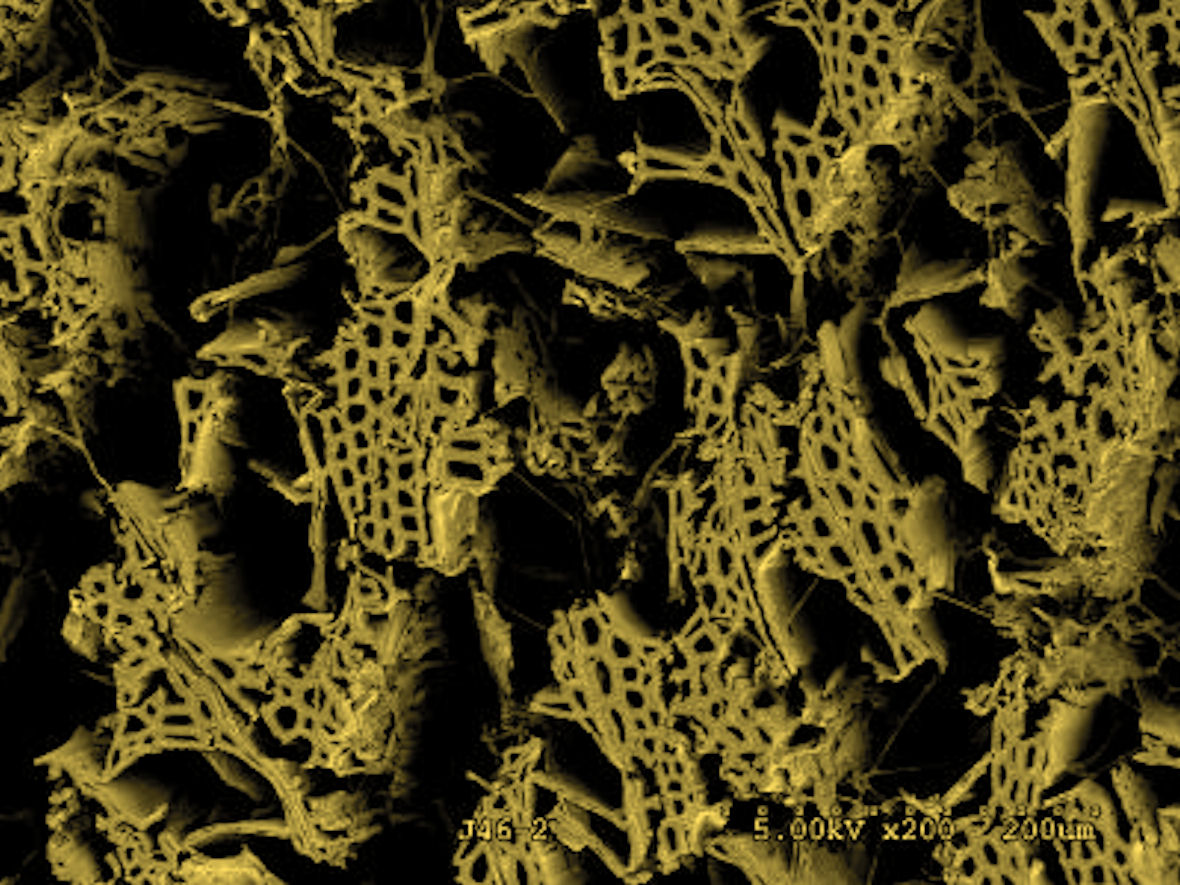
Wood fibres that have been decayed by the white rot species Punctularia strigoso-zonata. Credit: Robert Blanchette
Anthropocene Accumulation: Anti-Ecological Linear Growth
Within contemporary capitalist-extractivist cultures, human lives create lasting detritus. Though the bodies we inhabit are still liable to rot (albeit perhaps in laquered coffins, slowed by preservation chemicals designed to keep bodies looking fresh, which chemicals will eventually leach into the earth) or be turned to ashes (albeit perhaps to be kept in jars and vials), the lives lived by those bodies leave behind persisting inorganic rubbish. This culture is one of accumulation; capitalism is fundamentally premised on accumulation. Its governing economic logics demand growth for its own sake. There is no organicity – no ecological cycles. There are no natural stops.
An example of anti-ecological economic growth in the ‘UK’ is the warehousing and storage industry. It is forecasted that industry revenue will continue to rise 5.7% a year, “boosted by the unrelenting expansion of the e-commerce sector”, as more storage space is needed for more accumulated things.2 Even seemingly intangible data storage and production necessitates space, power, building materials, and trillions of gallons of water a year to cool the giant servers, which demand is threatening water scarcity in the ‘UK’ and globally.3 Over half of the energy used to power data centres comes from fossil fuels – coal and oil. It is estimated that “90% of the world’s data was generated in the last two years alone. And that global data generation will triple between 2025 and 2029.”4 Unfathomable on earth timescales.
The 299 million year old fungal art of decomposition is now back in the limelight, branded as cutting edge ‘bioremediation technologies’, hailed to clear up environmental messes. But there are no easy fixes for the lasting material consequences of the overproduction, overconsumption, overaccumulation that characterises lives lived within capitalist culture.
The geological term ‘Anthropocene’ was coined to name the way that these effects are deep and lasting. To name the way that the detritus of capitalism has inscribed itself indelibly onto the earth, breaking cycles, re-establishing linear accumulation without end.
Embracing Death Enables Life
The term ‘Anthropocene’ has been critiqued (and alternatives proposed) for it’s centring of ‘the human’: for its hubris, and for its homogenising and essentialising implications. Of course, the mark-making it seeks to name has nothing to do with anything essential to human being, but everything to do with the logics of colonialism and of colonial Western civilisation, logics globalised in capitalism, whose hubris loves the notion of somehow outdoing the humbling equalisation of death by way of lasting material legacies.
Denial of death is a hallmark of Western capitalist culture (which of course is also deeply rooted in colonial and many other forms of violence). It expresses itself through a lack of cultural holding (and the institutionalisation) of death itself; through the drive to preserve, extend – and even postpone – life with technologies; through the drive for accumulation and an absence of cultural support for grief and letting go; through the authoritarian enforcement of safety, and many other ways.5
This cultural tendency towards the suppression and denial of death – and of endings; decomposition; grief; organicity) runs deep. In ‘Cultivating Chaga’, in Wort #4, Marco Tenconi of Rhyze Mushrooms Co op writes:
“I have found that many people who attend our workshops are drawn to fungi because of their perceived mutualistic properties, which are drawn on for reassurance that the world can be different. Folk are often surprised when I point out that fungi are just as likely to be decomposers or parasites – but that we should learn to find beauty and meaning in that too.”6
Marco describes grappling with his own biases and value-judgements around modes of non-human relationship whilst exploring the ethics and viability of cultivating Chaga in woodlands. Wondering whether the parasitic relationship of Chaga on Birch might just be not that harmful, or perhaps even have benefits for the host, he reflects critically on his own thought trains, questioning the motives that might underlie them:
Or [is it] maybe because deep down I fear the rot and the death and am drawn to narratives of life and nourishment?”7
A love of life is at the heart of herbalism in its integrity. Herbalism is rooted in vitalism, which recognises a healing power and an intelligence inherent in the vital force – the expansive, exuberant will to life and growth that courses the living world – and seeks to work with this principle of nature. And yet it is a mundane universal truth that the one cannot be without the other. All life ends in death. Death enables new life and growth. Even within life, growth must be enabled via small ‘deaths’; new beginnings via endings. And life lived in denial of death is often prey to readmitting of death as ‘shadow’ in other guises.
In ‘Reishi: a Connection with the Humans Between It All’ in the same issue, Sophia Handler explores the Reishi mushroom’s capacity for connecting people with both life and death; contemplating the artist Dominik Einfalt’s work with Reishi to create living urns. The fungus feeds on, and incorporates in its fruiting form, the ashes of cremated individuals. If so desired, it might then be consumed as a tea by friends and family of the deceased. A continuation of life that also embraces death, and which is borne of it. In collaboration with Reishi, the corporeal detritus of death is transformed, rather than preserved.8
Parasites Show Us Our Cultural Shadow
Both Reishi and Chaga are white rot fungi – descendents of those ancient saprotrophs who learned to break down the lignin-tough bodies of prehistoric prototype trees. Essential transformers. But what when the life is drawn from the bodies of the living? The beauty and meaning of a ‘parasite’ is perhaps a little harder to find and hold; the term a little harder to digest.
Marco notes that its etymology is social rather than biological, meaning ‘eating at the table of another’. It is a term well used in negative tropes on both the right and left – although the latter tends to punch up at those subsisting on the oppression and exploitation of others, and the other down at imagined ‘benefit cheats’, and persons who are refugees and immigrants. Perhaps this righteous revulsion at the notion (real or imagined) of subsisting at the expense of others might be recognised in the current influencer-fuelled trend of home ‘parasite cleanses’; which diagnoses may sometimes obscure other important health issues and which treatments may cause deep harm.
Here’s another set of definitions:
1. an organism that lives on or in an organism of another species, known as the host, from the body of which it obtains nutriment.
2. a person who receives support, advantage, or the like, from another or others without giving any useful or proper return, as one who lives on the hospitality of others.9
It doesn’t feel entirely metaphorical on this account to say that contemporary capitalist society is parasitic upon the living earth, with its utter dependence upon extracting resources, without offering useful or proper return. It’s a relationship that is unsustainable: one that is – with unfathomably escalating speed and voraciousness – killing its host.
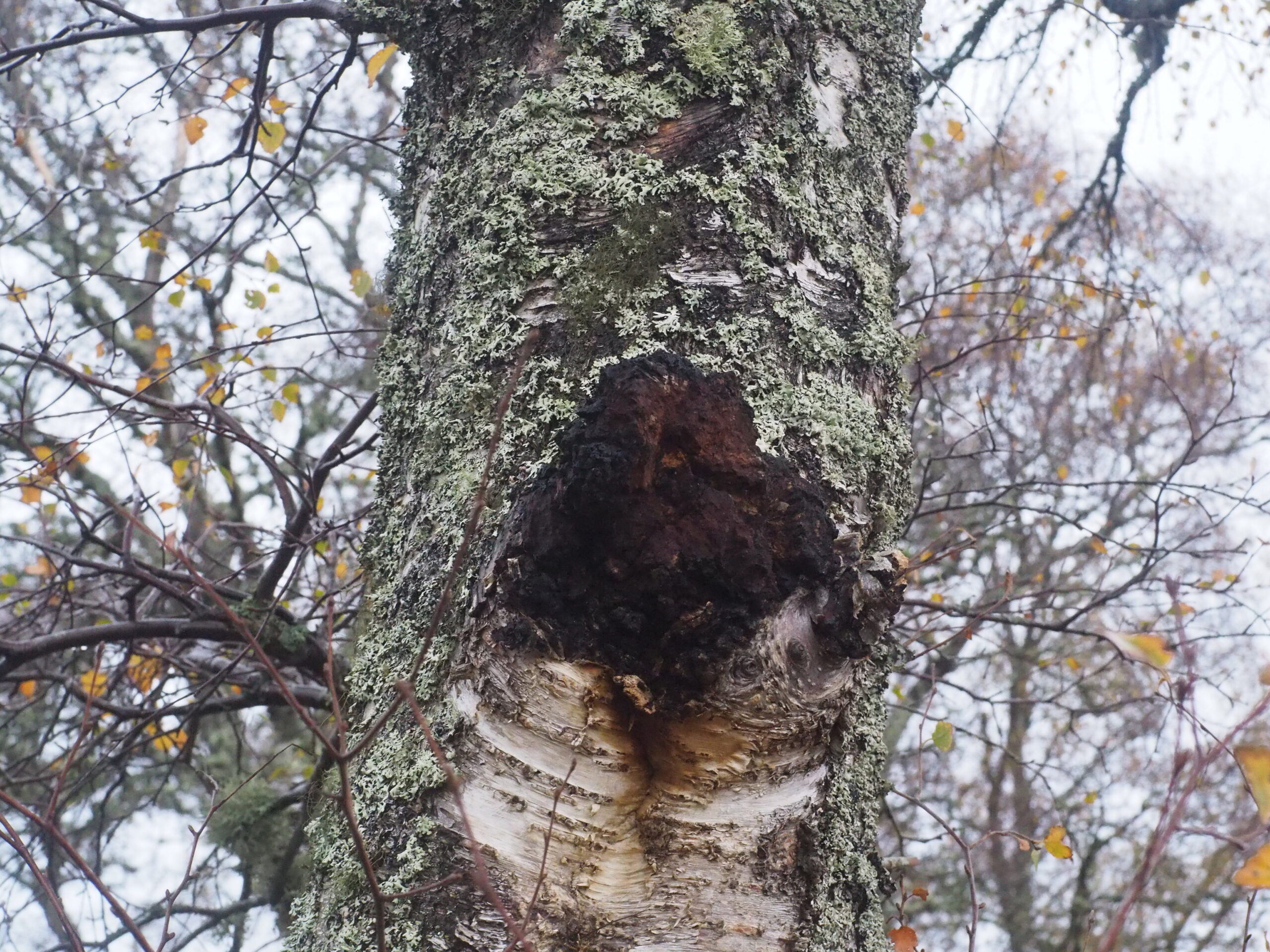
But parasitic relationships are not inherently unsustainable. Although Chaga weakens living Birch trees (its primary host), these two species, as Marco points out, can sometimes live alongside one another for many years (ten to eighty years, or more under ideal conditions),10 before the Birch dies and the Chaga spores. Birch is a pioneer species, flourishing in disturbed areas (including those disturbed by human activity), encouraging the growth of other species including slower growing trees, creating the conditions for more diverse woodland ecosystems. On the level of the forest, Chaga creates news niches, exposing the wood of the tree when it comes to release its spores: one study reports “nearly 50 species of epixylic lichens and allied fungi on birch snags”.11
The parasite Chaga exists within greater cycles of organic exchange. Here we can recognise beauty and meaning in parasites too.12 Within the forest, Chaga is beautiful and a part of the ecological web of life (and death). And those who conscientiously and responsibly forage Chaga, as well as those who would cultivate it, have a part within this web too.
Ecological exchange on an earth scale can accommodate relationships of taking “without giving any useful or proper return”, because the system is more complex than that. There is a place at the earth’s table for parasites, and parasites may bring unexpected gifts to the table.
It is when the ‘taking without giving’ becomes systemic that problems can arise. The capacity of the whole for balance is lost; cycles of renewal are broken; linear growth becomes unsustainable. This may express itself in species imbalance. More often than not this imbalance will right itself with time; probably a lot more often than conservationists like to allow for. But the earth’s capacity for ecological self-righting is not infinite. This is where we find ourselves at this moment, in the geological epoch of the ‘Anthropocene’, where the lines etched by some humans and their created systems have severed the cyclical pathways of other living things, and deeply disrupted the homeodynamics of the living earth.
Perhaps then, the widespread cultural hatred towards parasites – real or metaphorical – belies the way that, psychologically, taking ‘without giving any useful or proper return’ is a shadow trait for capitalist culture.13 For many of us, living within it, receiving without giving back feels often uncomfortable somehow. And perhaps the fact that ‘taking without giving’ is a shadow trait in capitalist culture belies the fact that this is actually its fundamental premise – its continuation, and its logics of endless linear growth, dependent on endless extractivism.14
Reinscribing Ecological Exchange as the Context
Human existence is dependent upon that of other living beings of the earth – flora, fauna, funga – and the ecogical relationships between them. Not to mention the microfauna – the archaea and the bacteria – that exist with and within us, blurring the boundaries of self and other. We cannot live without them. Our being is dependent upon the gifts of the earth: taking and receiving is an integral part of how we must exist in the world. The point is to cultivate our needs and dependencies consciously and conscientiously within a broader context of interdependence and reciprocity, in a way that serves the homeodynamics of the living earth, instead of contributing to its rupture.
The medicine of Chaga is so special in part because of its relationship with Birch. As a medicine, it passes those compounds gleaned from its host (most notably Betulin, which gives silver birch bark its colour, and its derivative Betulinic acid)15 on to us in turn.
Medicinally, we value Chaga for its parasitism – from which relationship we then benefit.
As well as the compounds from the Birch, Chaga also contains the polysaccharides common to medicinal mushrooms broadly that are so supportive to the immune system. For the last century at least, the functioning of the immune system in humans has been modelled in mainstream medicine through metaphors of militarism and war. But the process of ‘phagocytosis’ (in which pathogens are consumed by specialist cells) that is core to the body’s cellular-level immune response, can be described as much as a process of decomposition and digestion as one of ‘dis-arming’, ‘destroying’, ‘elimating’ or ‘eradicating’.
More than this, it can be understood as a process of recycling; of composting and reuse. Recent science reports that metabolic recycling is as much a feature of the way that macrophages (some of the specialist cells that participate in phagocytosis) respond to bacteria and microorganisms (classic ‘foreign invaders’) as they do to dead (apoptotic or just worn out) cells of the body (‘self’ cells).16 Which picture troubles the self-other binarism of the classic ‘detect and destroy alien invaders’ model of the immune system, as metabolically digested microbes from the outside world become a part of our bodies, feeding back into our ongoing immune system intelligence. And those fungi-specific receptors in the cells of our immune system that are stimulated by medicinal mushrooms speak to the evolution of humans alongside fungi.17 The medicinal actions of Chaga in human bodies speak to our existence in an ecological web of relationship, and the negotiation of these relationships.
In taking Chaga-Birch medicine, we are participant in a broader cycle of ecological exchange. It is up to us whether or not we choose to recognise that. We might choose to engage with the medicine of Chaga as an offering and gift. Which offering and gift has meaning within a greater context of ecological exchange, and the fact of which asks for our continued participation in this greater web. Or we might engage with it as a consumer product, where the ‘balance’ is achieved through the transactionality of financial exchange, negating other forms of responsibility; a break in the chain of ecological participation. Of course, the two don’t have to be mutually exclusive. It is very possible to appreciate the gift within items obtained in economic transactions. But the latter has a strong tendency to mask and erase the former. Living within a system where economic exchange is the societal baseline tends to obscure our responsibilities as participants in the ecological systems of the earth.
Mutual aid and the gift economy as modes of resistance are an attempt to reinfuse human social economic systems with an organic, cyclical homeostasis. Like the cycles of ecological exchange, the gift economy does not require each exchange to balance itself out between parties in the moment, but it does rely on the maintenance of an overall balance throughout the system. It requires an attitude and active practice of reciprocity, so that the taking is – on a macro scale – balanced with the giving back (which of course can be two ways to describe the same moment of exchange). Working at this macro scale means thinking of ourselves as part of a greater whole; thinking on a community level rather than an individual one.
Cultivating reciprocity in plantwork does not have to mean leaving a gift every time that you forage a plant or fungus – although this can be a valuable personal practice. It may mean ensuring that the medicine that you make from it is used where it’s needed. It may express itself in the possibilities enabled by the healing offered by that medicine. It may express itself through the conversations that you have, the actions you take, under the (conscious or otherwise) influence of that being. It may express itself in your relationship with the lands you share together. It may express itself in entirely other ways.
Deeper than any transactional exchange is cultivating an understanding of ourselves as part of a greater whole, and creating practices that accord with this understanding. Practices that make sense within and reinscribe organic cycles of energetic exchange. Reciprocity on a macro scale means asking where best to give our energy; how to feed back to the whole. It means asking what part we each have to play, what contribution we each have to give, in the ecological cycles of energetic exchange, of decomposition and rebirth. Those cycles of life – and death – that have sustained life on earth for hundreds of millions of years before us.
Endnotes
1. David Moore, Geoffrey Robson and Anthony P. J. Trinci, 21st Century Guidebook to Fungi (2nd ed), (n.d.).
2. Felix Gilroy, ‘Warehousing and Storage in the UK Industry and Data Analysis‘ (industry report), IBIS World, Nov ’25.
3. A 2025 Environment Agency report states that “England faces 5 billion litre a day shortfall for public water supplies by 2055 – and a further 1 billion litre a day deficit for wider economy”. Yet this figure does not account for data centre consumption even as the government proposes AI being ‘mainlined into the veins of the nation‘, and media narratives focus on “growing populations”, “hosepipe bans and smart meters”.
5. See: Bellatrix Black, ‘Let.me.Die: Pandas, Technology and the End of the World‘ (Down & Out Distro) 2019.
6. Marco Tenconi, ‘Cultivating Chaga’, Wort, 4 (Umbel Press: Ceredigion), Winter ’25, p. 35.
7. Ibid, p. 36.
8. See: Sophia Handler, ‘Reishi for Life and Death: Connecting with the Humans Between It All’, Wort, 4 (Umbel Press: Ceredigion), Winter ’25, pp. 79-89.
9. ‘Parasite‘, Dictionary.com (n.d.)
(Hymenochaetaceae)‘ [MSc thesis], Lakehead University (2025). This thesis also reports that conks “generally form on trees aged 30 years or older (Campbell & Davidson 1938; Balandaykin & Zmitrovich, 2015)”.
11. Asko Lõhmus, Piret Lõhmus, ‘A heart-rot fungus, Inonotus obliquus (chaga), mediates microhabitat creation in birch snags and contributes to forest fungal diversity‘, Global Ecology and Conservation, 56 (2024).
12. Chaga doesn’t require this recognition from us – in many ways human moralising attitudes towards (projections on) plants and mushrooms are by the by for anyone other than ourselves. But there are also ways that human attitudes may have very real impact on plant and fungi capacities for flourishing.
13. ‘Shadow’ referring to the conception from Jungian psychology of a “blind spot of the psyche” that is suppressed within the subconscious and thereby “projected onto one’s social environment as cognitive distortions.” (Wikipedia: ‘Shadow (psychology)‘).
15. ‘Betulin‘, Herbs 2000 (n.d.).
16. Juliette Lesbats et al., ‘Macrophages recycle phagocytosed bacteria to fuel immunometabolic responses‘, Nature, 640 (2025), 524–533.
17. Paul Stamets and Heather Zwickey, ‘Medicinal Mushrooms: Ancient Remedies Meet Modern Science‘, Integrative Medicine (Encinitas), 13:1 (2014) 46-7.
Image credits: Marco Tenconi
With thanks to Marco Tenconi, Keith Williams and Tea Rex for their feedback on this article.
Leo El-Qawas is a folk herbalist, herbal scholar and hedgerow philosopher, and is the editor of Wort. She has written a PhD on herbalist-plant relationships and is deeply preoccupied with the crossings of plant and human languages.
A beautiful reflection that explores so many threads I had in my mind but couldn’t quite get down on paper when writing my article on Chaga for Wort no.4. I think this is such a deep vein to explore. Conceptions both social and ecological of ‘parasitism’ or organisms that rely on others have changed so much both through time and place. I hope ecology can help us frame certain types of dependent relationships as normal and even beautiful; things to cherish and preserve rather than scorn or shame.
Love the new formats too, will definitely try to print and distribute a few zines.